
22nd February 2025
There are assignments you remember because they change your career, and there are assignments you remember because they quietly change the way you see the world. At twenty-six, fresh into a junior reporting job in Kansas City and still convinced that one good baseball feature might eventually carry me into the press boxes I had imagined since college, I regarded an opening-day soccer fixture on Florida’s Gulf Coast as little more than a long drive with a byline attached. My editor described it as an opportunity, which was newsroom shorthand for nobody else wants to do it. Two days later I found myself pointing a grey rental sedan east on Interstate 70, crossing Missouri farmland before dawn and watching the country flatten itself into long ribbons of asphalt that seemed to stretch not towards somewhere, but simply away from everywhere else.
The drive took eighteen hours in total, though it never felt like one journey. Nashville arrived first, glowing in the damp evening air, Broadway already filling with music that escaped every open doorway before dissolving into the traffic. I walked a single block simply because it seemed wasteful not to, stood beneath the neon for ten minutes with a paper cup of coffee and the vague feeling that I ought to stay longer, then checked into a Motel 6 where the walls were thin enough to hear somebody arguing about college basketball through the plaster. Atlanta came the following afternoon in thicker traffic and heavier skies, but by then I had little interest in sightseeing. I found another inexpensive motel beside the interstate, slept badly beneath an air-conditioning unit that rattled like loose cutlery, and left before sunrise with another six hours still separating me from Tampa Bay.
Florida announced itself less by a welcome sign than by the air. Somewhere south of the state line the winter simply gave up. I rolled the driver’s window down out of habit and immediately rolled it back up again because the warmth entered the car like bathwater. By the time I reached my hotel the air-conditioning had failed completely, leaving the lobby smelling faintly of sunscreen, carpet shampoo and resignation. The receptionist apologised with the practiced smile of someone who had repeated the same sentence throughout the afternoon, handed me an old brass room key and suggested I spend as little time indoors as possible. It was advice I took.
The following morning an Uber driver named Carlos collected me outside the hotel and insisted on driving the scenic route into downtown, partly because he preferred it and partly because he suspected I had never seen the city before. He asked where I was from, frowned politely when I answered Kansas City, then laughed when I admitted that my accent still sounded more Midwestern than anything else. “You’re going to confuse everybody,” he said. As we crossed the bridge towards the waterfront he pointed towards the shoreline and told me that Tampa had been built after a Detroit businessman named John C. Williams bought the land in the nineteenth century, a fact he delivered with enough pride that I later checked it in the public library simply to make sure he hadn’t invented it for the benefit of a curious passenger. He had not.
Downtown surprised me. I had imagined Florida as either beaches or theme parks, and Tampa felt comfortably like neither. Office workers drank coffee beneath palm trees before disappearing into glass buildings that looked west across the bay; joggers passed men carrying fishing rods; cafés emptied onto pavements where conversations drifted lazily between English and Spanish without anyone appearing to notice the change. The city moved at a pace I couldn’t quite explain. It was busy, certainly, but it lacked the nervous urgency of the Midwest. Even people waiting at traffic lights somehow looked unhurried.
Breakfast became lunch after I wandered further than intended. I eventually bought a Cuban sandwich from a small white food truck parked beneath a cluster of live oaks, where the owner looked at me for a moment before asking, “You’re not from around here, are you?” When I told him Missouri, he nodded approvingly, as though I had travelled the correct distance to deserve lunch. He explained, without prompting, why no two people in Tampa could ever agree who made the city’s best Cuban sandwich, then waved me away before I could thank him because another customer had arrived. I ate on a bench overlooking the marina, watching pelicans crash inelegantly into the water with surprising success, and wondered how a bird that awkward could appear so graceful from a distance.
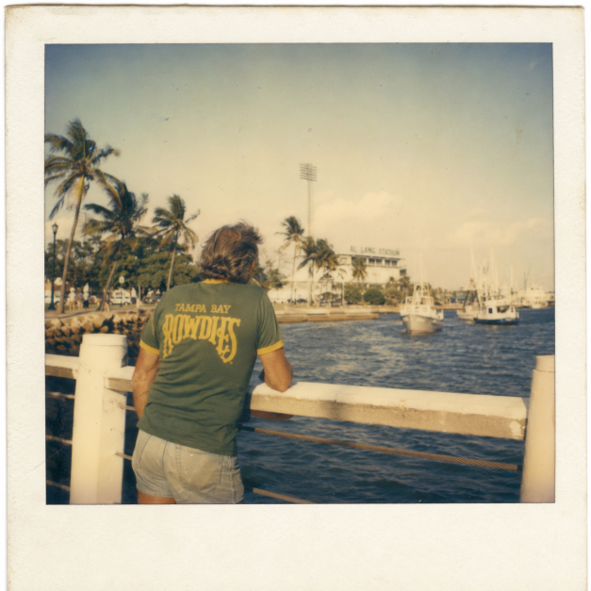
Al Lang Stadium revealed itself gradually through the waterfront rather than dominating it. I had expected parking lots and concrete. Instead there were sailboats rocking gently against their moorings, families strolling beside the water and children chasing one another across the grass while vendors prepared for the afternoon crowd. One pelican landed on the railing beside the stadium as casually as though it possessed a season ticket. Not far away stood a man perhaps in his sixties, leaning against the white marina fence in a faded green Rowdies shirt that looked old enough to have outlived several fashion cycles. He wasn’t looking at the stadium at all. He was watching the boats returning across the bay, one hand resting in his pocket, entirely unbothered by the gathering crowd behind him. I never spoke to him, but twenty years later I can still picture him more clearly than most of the players who took the field that afternoon.
Inside, the atmosphere felt unlike any American sporting event I had covered. There was remarkably little ceremony. No oversized introductions, no fireworks, no relentless insistence that every passing moment represented the greatest entertainment on Earth. People simply filtered into their seats, greeted familiar faces, bought beer, unfolded flags and began singing well before kickoff. Somewhere behind me a group chanted continuously in Spanish, while another answered in English from across the stand with melodies I didn’t recognise but found myself anticipating after only twenty minutes. It felt less choreographed than baseball and somehow more personal. I couldn’t decide whether the supporters were creating the occasion or simply revealing that it had already existed before I arrived.
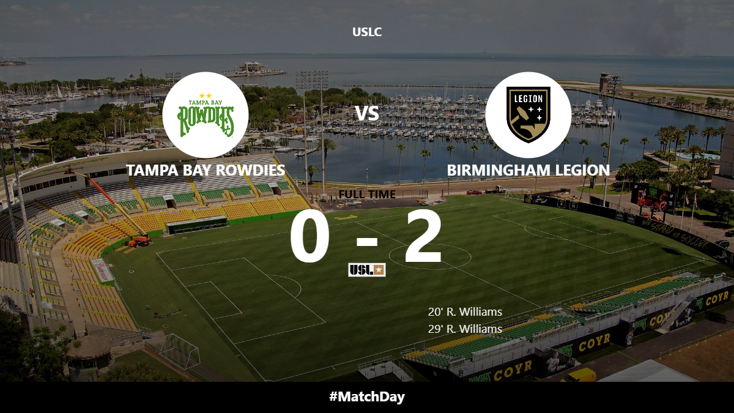
 The football itself resisted the comparisons I kept trying to impose upon it. Tampa seemed to move with an urgency that Birmingham could never quite match, closing spaces before I noticed they existed and reaching loose balls that looked fifty-fifty from the press box. They attacked often enough that I assumed they must eventually score several times, only for Birmingham’s goalkeeper to continue frustrating them with a performance that grew more improbable as the afternoon wore on. My eyes kept returning to Romario Williams, whose movements appeared strangely economical, as though he knew something about where the ball would arrive several seconds before anyone else. I lacked the vocabulary to explain why he fascinated me, only the certainty that whenever Birmingham looked dangerous, he was somewhere nearby.
Late in the second half the weather turned with astonishing speed. The light faded beneath heavy clouds rolling inland from the Gulf, the wind stiffened, and distant thunder announced itself before the first drops reached the pitch. Nobody around me seemed remotely surprised. Rain jackets appeared almost instinctively, conversations continued uninterrupted, and the chanting simply grew louder, as though competing with the storm itself. Birmingham, who had spent much of the afternoon appearing slightly overwhelmed, suddenly found moments of conviction that had been absent earlier. They never really looked like the better team, yet somehow they began looking like the only team that believed the evening still belonged to them. I remember leaving the stadium uncertain whether I had witnessed an upset, a tactical triumph, or merely one of those inexplicable sporting afternoons that refuse to obey momentum.
The walk back along the marina took longer than it had before the match. Rainwater shimmered beneath the streetlights, the crowd dispersed without hurry, and somewhere behind me I could still hear singing carried across the waterfront by the wind. The man in the old Rowdies shirt had gone. Only the empty railing remained, glistening beneath the lamps as fishing boats nudged quietly against their moorings. I drove away the following morning with another interstate waiting ahead, convinced that I had travelled to Florida to cover a football match. Looking back now, I think I travelled there to discover that sometimes the place remembers the game more faithfully than the score ever can, and that perhaps the best stories begin with assignments nobody else wanted.

 The Gaffers Lounge
Leave a comment