
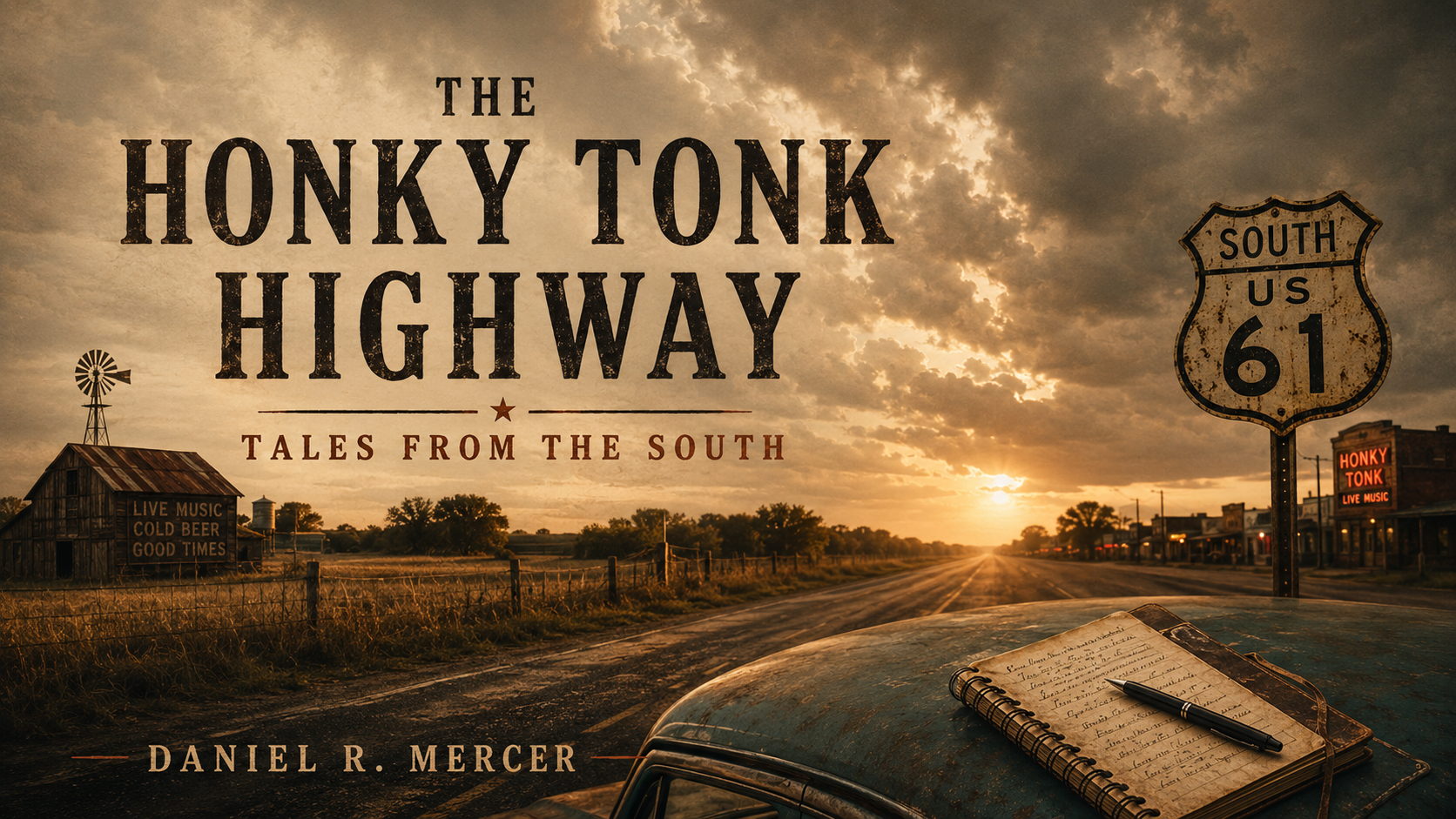

My name is Daniel R. Mercer, and there is a cardboard archive box in the corner of my study that has followed me through four houses, two careers and one marriage. It is held together now with fresh tape wrapped around old tape, the corners softened from years of being lifted, stored and forgotten again. Inside are spiral-bound notebooks, motel receipts, folded road maps that no longer make sense in the age of smartphones, ticket stubs whose ink has almost disappeared and a collection of photographs that have faded just enough to resemble memory itself. Every few years I tell myself I’ll throw it away. Every few years I open it instead.
The notebook from Tampa still carries a faint water stain across the bottom of three pages. I remember the bottle leaking in the passenger seat somewhere north of Atlanta, though I couldn’t tell you exactly where. Between those pages is a receipt for a Cuban sandwich bought from a trailer beside the marina. The total is still legible. The conversation isn’t written down anywhere, yet I remember the man serving it asking where I was from before he asked what I wanted to eat. Twenty years is apparently long enough to lose the price of lunch but not the sound of another person’s curiosity.
People sometimes ask when football became important to me. They expect a single answer: a famous match, perhaps, or a remarkable player, or one perfect afternoon when everything suddenly made sense. Memory is rarely that generous. If there was a beginning, it wasn’t inside a stadium at all. It was somewhere on Interstate 75 with the cruise control set a little above the speed limit, a paper coffee cooling in the cup holder and another few hundred miles to drive before kick-off. Long before I understood the sport, I was beginning to understand the roads that connected the people who loved it.
That wasn’t the assignment I thought I had accepted.
Like most young reporters, I imagined my career beginning somewhere brighter. I had grown up believing the best stories happened under Friday night lights, inside Major League clubhouses or on NFL sidelines. I’d practised writing game leads from baseball box scores before anyone had ever paid me to write one. Soccer, if I’m honest, occupied very little space in my imagination. It existed somewhere on the edges of American sport, occasionally appearing on television before quietly disappearing again. When my editor slid a folder across the desk and asked how I felt about covering the opening season of lower-division soccer across the Deep South, my first instinct wasn’t excitement. It was confusion.
I accepted because young reporters rarely have the luxury of refusing assignments. I told myself it would last a few weeks. Drive somewhere unfamiliar, write a few features, watch some games, come home. It sounded less like the beginning of a book than a detour before the work I really wanted to do.
The first thing I discovered was that the South refused to be hurried.
The distances alone demanded patience. A journey that looked manageable on a map unfolded across mountain ranges, river valleys, college towns, forgotten industrial streets and stretches of interstate so long they seemed to erase any meaningful sense of time. Some mornings began with gas station coffee before sunrise. Others ended beneath the buzzing lights of roadside motels where the air-conditioning rattled louder than the traffic outside. I learnt to judge towns by the conversations waiting inside diners, by the church signs standing beside highways, by whether people asked where I was from before asking why I was there.
The football arrived somewhere in the middle of all that.
At first I watched it the way any outsider watches a new language. I noticed pace before shape, emotion before tactics, coaches before formations. I could usually tell which team deserved to win long before I understood why they were winning. Sometimes I misunderstood what I was seeing altogether. The supporters around me always seemed to recognise something a few seconds before I did, rising from their seats in anticipation while I was still searching for the reason. I filled notebooks with observations that now make me smile for their innocence. They were the notes of a reporter trying to understand a sport through its people rather than its diagrams.
Looking back now, I realise the games themselves occupy surprisingly little space in those notebooks.
Instead there are descriptions of rivers, diners, thunderstorms and motel rooms. Conversations with Uber drivers who became amateur historians for twenty-minute journeys. Waitresses who insisted I try the local speciality before asking what had brought me to town. Elderly supporters who measured the age of their football club against the age of the textile mill that used to employ half the county. Children kicking balls across patches of grass while their parents argued amiably about players whose names nobody outside their city would ever know. Again and again I wrote down the places first and the score second, as though some instinct already knew which would matter more with time.
Perhaps that’s why I kept the box.
Not because it contains the history of a football season. Those results can be found anywhere. The league tables still exist. The statistics remain untouched in databases I no longer visit. What survived inside those notebooks was something more fragile: the feeling of arriving somewhere before I knew why it would matter, the privilege of being welcomed by people who owed me nothing, and the slow, almost accidental discovery that a sport I had never intended to love could become a way of understanding a corner of America I had barely known.
I thought I was driving to football matches.
What I remember now are the roads between them.


Leave a Reply