
27th April 2025
I’d expected my second viewing of Chattanooga to be my last football match of the month, but somewhere between Greenville and the drive home I found myself checking fixture lists the way other people checked movie times. There was an Atlanta United game the following evening, Nashville were in town, and I was close enough that turning the car south felt less like making a decision than following one I’d already made without noticing. It wasn’t an assignment. Nobody in Kansas City expected copy on Monday morning. I bought the ticket with my own money at the club shop just outside the downtown area, folded it into the notebook that had slowly become as important as my wallet, and drove on.
Atlanta announced itself long before I reached downtown. Highways multiplied into layers above one another, glass towers caught the morning sun, and traffic settled into the patient crawl that seems unique to large American cities. After weeks spent wandering college towns, riverfronts and restored Main Streets, this felt almost overwhelming in its confidence. Atlanta did not ask whether you liked it. It simply carried on at its own pace, certain you would eventually fall into step. Everywhere there seemed to be another crane, another apartment block, another billboard promising something bigger than whatever had stood there before.
I spent the morning at the World of Coca-Cola, partly because it seemed the sort of thing a first-time visitor ought to do and partly because football wasn’t due to begin for several hours. The museum was polished almost to the point of unreality, all bright colours and carefully curated nostalgia, but outside the city quickly returned to itself. I wandered into a small restaurant where the waitress recommended lemon pepper wings without asking what I liked, only whether I wanted them “regular or messy.” They arrived piled high on a tray lined with paper, the seasoning somehow both sharp and buttery, and every table around me seemed to be discussing the game. Not the Falcons, despite the enormous stadium sitting only a few blocks away. The soccer game.
The closer I walked towards Mercedes-Benz Stadium, the less it resembled anything I had seen during the previous two months. I had grown used to football existing quietly: tucked inside university campuses, borrowed municipal grounds or neighbourhood stadiums where everybody seemed one conversation away from knowing each other. This felt different. Streams of supporters poured from every direction, scarves already wrapped around necks despite the warmth, and security staff guided people through queues that stretched further than the attendance at some of the matches I had covered. I caught myself staring at the sheer volume of humanity moving towards one building.
“First time?” a man beside me asked.
I must have looked lost.
His wife smiled before I could answer.
“You’ll be fine. Just keep walking.”
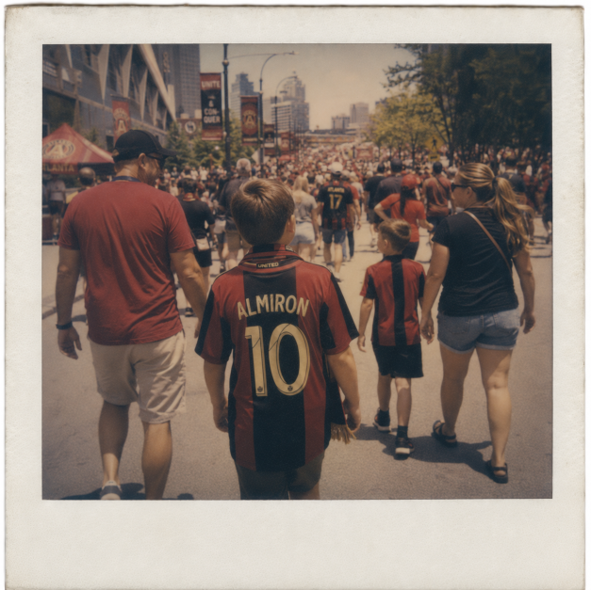
Their son, who couldn’t have been older than eight, wore an Atlanta shirt several sizes too big with Almirón printed proudly across the shoulders. Every few seconds he bounced on his toes to catch a glimpse of the stadium roof appearing between office buildings, as though he feared it might disappear if he stopped looking. They had driven over from Huntsville that morning, his father explained, because attending one Atlanta match every year had become the birthday tradition. Baseball had never quite captured him. Football had.
“It’s the only thing he asks for.”
The boy never stopped smiling.
Inside, the scale almost emptied my notebook. Fifty thousand people have a way of making description feel inadequate. The roof folded above us like some enormous mechanical flower, the halo scoreboard circled endlessly overhead, and the pitch looked impossibly small against everything surrounding it. I’d assumed Major League Soccer would feel like an imitation of the bigger American leagues, borrowing their presentation without matching their importance. Instead it felt remarkably comfortable occupying the same stage. Hot dogs cost ten dollars, highlights flashed across giant screens, internationals whose names I’d begun recognising during late-night reading sessions warmed up only yards away, and yet when the whistle blew, all the spectacle quietly stepped aside for ninety minutes.
The football itself unfolded faster than anything I had watched that spring. Not simply in running or passing, but in thought. Around me supporters reacted to changes I hadn’t even noticed. A ripple of conversation would move through the crowd before one player drifted wider or another tucked inside, followed almost immediately by applause when the adjustment worked exactly as they’d anticipated. I spent the first twenty minutes trying to understand what they had seen, then gradually accepted that I didn’t need to understand everything to appreciate the rhythm of it. There was pleasure simply in watching thousands of people recognise patterns invisible to me.
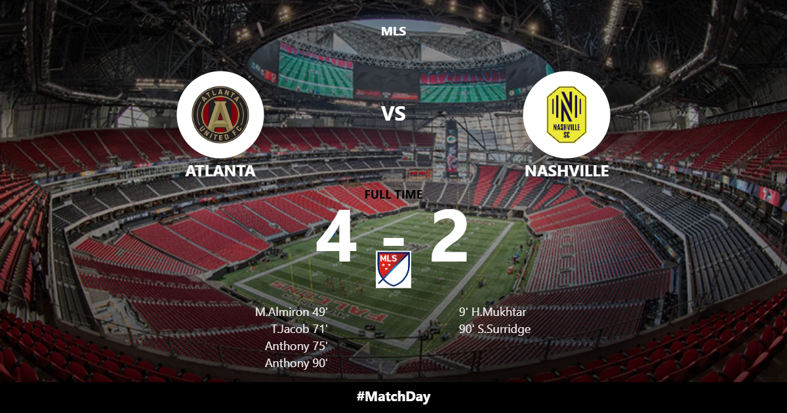
Atlanta attacked with a confidence that suited the city, and Nashville refused to disappear even as the game threatened to run away from them. Goals changed the volume rather than the mood. Every attack seemed to carry expectation with it, every mistake an audible groan from fifty thousand amateur analysts who believed they had spotted the problem before the players had. A Nashville supporter sitting two rows behind me laughed after one particularly heated debate broke out between home fans.
“Y’all think soccer fans are different,” he called out. “Spend one Saturday in SEC country. We’re all the same.”
Nobody argued.
When the final whistle came, nobody hurried away. The crowd simply spilled back into downtown like water finding every available street, conversations continuing without interruption as though the city itself had been waiting patiently outside the gates. I let myself be carried along, surrounded by children replaying goals they had just watched, couples deciding where to eat, and supporters already arguing about next week’s lineup. The stadium disappeared behind glass towers, but the noise lingered for blocks afterwards.
For weeks I had been fascinated by football because of the places that hosted it. Small towns. College campuses. Communities determined to carve out room for a sport that still felt slightly foreign. Atlanta showed me something I hadn’t expected. Football no longer felt like a guest here. It belonged to the city’s weekends, its conversations, its families making birthday pilgrimages from another state, its children wearing shirts far too large because they expected to grow into them before they ever grew out of supporting the club.
I reached my car well after sunset, the skyline glowing in the mirrors as I pulled onto the interstate. The notebook rested on the passenger seat beside an empty cardboard tray still dusted with lemon pepper seasoning. I had come to Atlanta because I wanted to compare one level of football with another. Instead, somewhere between a boy in an oversized Almirón shirt and fifty thousand strangers walking in the same direction, I stopped feeling like someone covering a sport and started feeling like someone following it.


 The Gaffers Lounge
Leave a comment