
22nd March 2025
The road south has a way of changing without ever announcing that it has changed. Somewhere after crossing into Oklahoma I’d taken a wrong turn, the sort you only notice once the highway signs begin mentioning places you weren’t expecting, and before long I found myself driving through Cherokee and Choctaw country instead of heading cleanly towards Louisiana. There wasn’t much to do except follow it. In Paris, Texas, I pulled over long enough to photograph the town’s small Eiffel Tower, a piece of roadside optimism wearing a red cowboy hat, before carrying on east towards Shreveport as daylight dissolved into the long orange smear that always seems to accompany interstate driving. By then I’d stopped thinking about schedules. Football, at least the football I was beginning to discover, seemed remarkably patient. It would still be there when I arrived.
The next morning the landscape softened. The highways narrowed, the trees thickened, and water appeared where I wasn’t expecting it, sitting quietly beyond the roadside as though the land had forgotten where it was supposed to end. Somewhere outside Lafayette I stopped at a diner built almost entirely from weathered timber, the sort of place where every truck in the parking lot looked as though it had worked for a living. Behind the building a narrow stretch of bayou disappeared into reeds, and beside it, almost casually, lay two alligators so perfectly still that for a moment I mistook them for driftwood. Nobody else in the restaurant seemed interested. The waitress refilled coffee without looking outside once. It occurred to me that the strangest thing in any place is usually whatever the locals have stopped noticing.
Lafayette introduced itself slowly. It lacked the theatrical confidence of New Orleans, which I’d visited once as a tourist and remembered mostly through brass bands, balconies and people determined to convince you that you were having the time of your life. Lafayette felt less interested in performing. The city carried its French and Cajun ancestry with the quiet assurance of somewhere that no longer needed to explain itself to visitors. Older buildings sat comfortably beside newer ones, French names appeared on street signs without ceremony, and conversations drifted between accents I couldn’t quite place. A museum volunteer explained that the settlement had first been known as Vermilionville before taking the name of the Marquis de Lafayette, and she did so not as though reciting history but introducing a relative.
Music seemed to occupy the spaces between everything else. It leaked through open doorways, drifted across intersections and lingered outside cafés where nobody appeared to be paying particular attention to it. On one downtown corner a small jazz group had gathered beneath the shade of an old oak, and while most pedestrians continued walking, one cellist played with such concentration that it felt less like a performance than a conversation with the afternoon itself. I dropped a few dollars into the open instrument case when they finished. The musician nodded, thanked me, and asked what had brought me to Lafayette.
“Soccer,” I said.
He laughed – not dismissively, just with surprise.
“Well,” he replied, “you’re probably the only man who’s come all this way for that.”
Maybe he was right.
Lunch arrived the way good regional food often does: without apology. Gumbo first, dark and rich enough to suggest that recipes here were inherited rather than written down. Then a po’boy overflowing beyond the bread that was somehow both crisp and impossibly soft. Someone at the next table insisted I couldn’t leave Louisiana without trying a beignet, so I finished with powdered sugar coating my notebook while conversations around me wandered between college baseball, crawfish season and family names that had apparently occupied the same stretches of parish for generations. Food here wasn’t simply something to eat before a game. It was another way people explained where they belonged.
By late afternoon cars had begun filling the lots around Cajun Field. What surprised me wasn’t the attendance so much as everything surrounding it. Outside the stadium people unfolded chairs, fired up barbecue grills, tuned guitars and portable speakers, and treated an amateur soccer match with the same easy ritual I’d grown up associating with Sundays in NFL parking lots. Children kicked footballs between pickup trucks while grandparents watched from folding chairs, and somewhere a fiddle competed with classic rock playing from somebody’s tailgate. I had expected modest crowds and quiet anticipation. Instead I found a community that seemed perfectly comfortable celebrating itself, the match almost becoming another excuse to gather.
Inside, the football reflected the afternoon. The humidity appeared to weigh upon the game itself, slowing everything by a fraction. Players lingered over throw-ins, walked more than I had seen elsewhere and seemed careful about where they spent their energy, as though everyone involved had reached the same unspoken agreement with the weather. At first I wondered whether the standard simply wasn’t very high. Then I realised I was making the mistake of judging every game against sports played indoors, beneath bright lights and perfect climate control. Here the conditions were part of the contest.
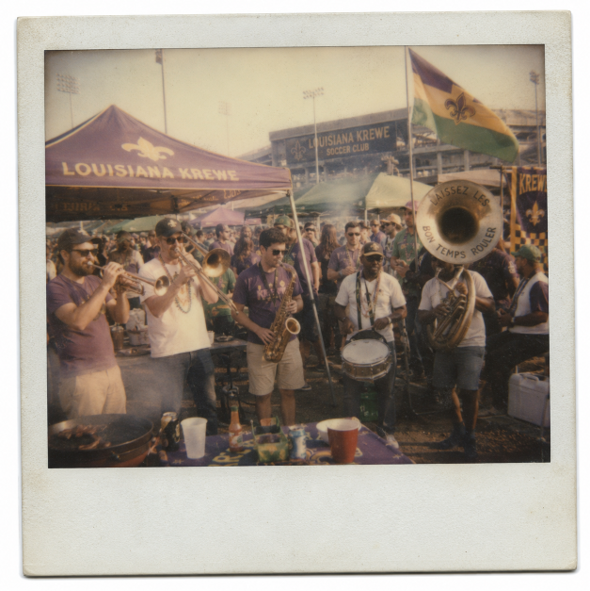
There weren’t many chances. Louisiana Krewe scored through a winger whose finish briefly lifted the crowd into full voice before Little Rock Rangers answered later through a midfielder arriving almost unnoticed from deeper on the field. The match settled into long stretches where possession changed hands without urgency, interrupted by moments of genuine quality that seemed all the sharper because they emerged so rarely. I found myself watching less for systems or formations – which still meant very little to me – and more for the small negotiations taking place between players and weather, between ambition and exhaustion. Football, I was beginning to suspect, was often a game of adapting to circumstances rather than overcoming them.
After the final whistle nobody seemed in a hurry to leave. Families lingered on the concourse. The music outside started again almost immediately, as though someone had merely paused the evening for ninety minutes. Walking back across the parking lot I passed the same tailgates I’d seen before kick-off, only now paper plates had replaced anticipation and conversations had shifted effortlessly from the match to work, church, fishing and next weekend. The result – a draw neither side would remember for long—had already become secondary to the gathering itself.
The drive out of Lafayette took me past darkened bayous and scattered porch lights reflecting softly across still water. Somewhere on the radio a fiddle gave way to jazz, then to silence as the station slipped beyond its range. I remember thinking that I still didn’t know very much about soccer. I couldn’t have explained why one team pressed higher than another or why supporters applauded one substitution and questioned the next. But I was beginning to understand something adjacent to the game, something perhaps more important. Everywhere I had travelled so far, football seemed to borrow its character from the place that hosted it. In Tampa it had carried the rhythm of the waterfront. In Chattanooga it belonged to the river and the mountains. In Lafayette it smelled faintly of wood smoke and gumbo, arrived accompanied by fiddles and accordions, and settled naturally among people who treated heritage not as history but as everyday life.


 The Gaffers Lounge
Leave a comment