

A few weeks in and I finally feel like I’m coaching instead of introducing myself.
The first month at a new club is strange because everyone keeps asking what your football looks like before you’ve had enough training sessions to actually show them. You answer the same questions over and over again, you shake a lot of hands, you learn thirty names before breakfast, and then you spend the evening wondering whether the players have understood anything you’ve tried to teach them. Slowly, though, little habits begin to appear. The distances get shorter. The pressing starts arriving together instead of one player at a time. Somebody rotates into a space without you having to stop training and point at it. That’s when you know ideas are becoming instinct instead of instructions.
The move to Greenville forced me to grow up a little as a coach. At Knoxville I built almost everything around a back four because that’s what suited the squad we had. Here, the structure already existed. Zach Prince had assembled a group that believed in three centre-backs, aggressive wing-backs and controlling matches through possession, so the challenge wasn’t to impose my favourite shape. It was to understand theirs deeply enough that it could still become my football. That’s probably why Gabriel Milito has been living in my head more than anyone else these last few weeks. He never talks about formations as fixed ideas. He talks about relationships, movements and creating superiority wherever the opponent least wants it. The shape is only the photograph. The football happens before and after the picture is taken.

People ask who I try to copy. I don’t think that’s the right question. If I copied Bielsa, I’d always be one step behind Bielsa. If I copied Gallardo, Milito or Scaloni, I’d only ever produce a worse version of coaches who already exist. Instead, I steal. Coaches have always stolen. We all do it. One pressing trigger from Rosario. One build-up pattern from Buenos Aires. One way of controlling tempo from a World Cup. Then you throw them together, test them on a training pitch in South Carolina, discover half of them don’t work with the players in front of you, and start all over again.
These four men probably explain more about the coach I’m trying to become than any coaching licence ever could.
Marcelo Bielsa – Football Begins When You Lose the Ball
 Everyone knows Bielsa because of the pressing. That’s always the headline. Run more. Press higher. Man-mark everywhere. Madness. But honestly, if that’s all you see, you’ve missed the whole point.
The first thing I ever wrote in one of my coaching notebooks wasn’t about formations or build-up or rotations. It was one sentence from Bielsa: football begins when you lose the ball. That changed everything for me because suddenly defending wasn’t the interruption between attacks. It was the first attack. If we’ve just lost possession, why would we retreat? They’re disorganised too. They’re looking for the next pass, not expecting eleven people to come hunting them. So we attack the ball, not the space around it. We don’t admire our pressing shape. We sprint towards the problem. The nearest man goes, the next man gives him an extra body around the duel, and if we can’t win it back then at least we make sure their first pass is uncomfortable.
The thing I probably stole most shamelessly is the courage. High line. Man-orientated first pressure across the pitch. Winning duels because that’s simply the admission price for playing this way. We set up so that we have specific targets for each shape that we face – each player marking specific man against each shape that we can face up against. People think it’s about fitness, and of course you’ve got to run, madre mía, you’ve got to run, but the running isn’t the philosophy. It’s the consequence. If your ideas demand that players arrive first, then they’d better be physically capable of arriving first. Every session I design starts there. Can we create one more man around the ball? Can we counter-press inside five seconds? Can we force them into a decision they didn’t want to make? If the answer’s yes, the rest usually takes care of itself.
Marcelo Gallardo – Freedom Inside Structure
 Gallardo taught me something Bielsa never really tried to. What happens after you’ve won the ball?
I love watching River because nothing ever feels rigid, even though you know there’s enormous structure underneath it. That’s the trick. People talk about positional play as if players have to stand on painted squares all afternoon, but Gallardo’s teams occupy spaces, not positions. That’s a massive difference. Centre backs build up as wide defenders. A left-back might end up where the ten started, the striker might drop into midfield, the winger suddenly appears inside, and somehow it never feels chaotic because everybody understands why they’re moving. The rotations aren’t rehearsed dances. They’re solutions.
The other thing I come back to all the time is patience. Not slow football. Patient football. La pausa. Hold the ball one second longer than feels comfortable. Invite the press. Tempt them. Let one midfielder jump out, let one centre-back get curious, and then suddenly you’ve created superiority somewhere else. That’s when you play forward from the back. That’s when the game accelerates. We don’t circulate possession because we enjoy passing sideways. We circulate until the opponent gives us permission to attack. You’ll see the majority of our completed passes coming deeper and you’ll see me moving my ball-players backwards in order to better facilitate this.
And if you’re going to commit bodies forward like that, you’d better think about what’s behind the ball too. Gallardo’s rest defence is probably the most underrated thing about his teams. Everybody remembers the combinations. I remember the players who didn’t move. The two or three who quietly stayed connected so the attack could survive if it broke down. That’s football for me. Every beautiful attack begins with someone doing something sensible.
Gabriel Milito – Structure Creates Freedom
 Milito is probably the coach I steal from the most and the one people notice the least.
You’ll hear even the most tactically-nuanced commentators say, “they’ve changed to a 3-2-5,” but Milito would probably laugh at that. The formation never changed. The movements did. That’s what fascinated me. His teams arrive at these incredible shapes because individuals solve problems. A centre-back steps into midfield because nobody closes him. A full-back comes inside because the pivot is marked. Suddenly it looks like a completely different formation even though nobody’s been told to change system.
That’s why I spend so much time talking about numerical superiority. Every exercise we do has the same question underneath it. Where’s the spare man? If we can find him, we play him. If we can’t, we move until we create him. Our front three naturally move into channels but we can change that to pin a defender or a full back and overload there/ Sometimes it’s the centre-back carrying through the first line. Sometimes it’s the wing-back holding the touchline so wide that their back four has to stretch. Sometimes it’s simply a midfielder arriving one second later than everybody else. Football gets easier when you’ve got one more player than the opponent where the ball actually is.
What I love most is how compact everything stays. The distances never explode. Attackers remain connected to midfield, midfield remains connected to defence, so when possession disappears everybody’s already close enough to hunt it again. The pressing structure almost mirrors the attacking one. That’s beautiful to me because it means the transition isn’t really a transition at all. It’s just the next phase of the same idea.
Lionel Scaloni – Principles Over Systems
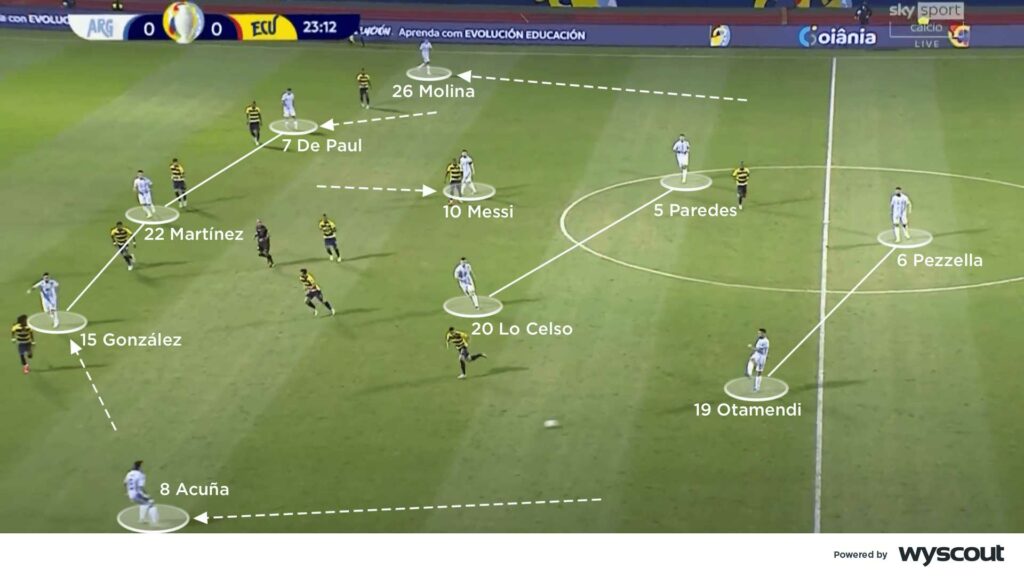
Scaloni reminds me not to become a prisoner of my own ideas.
It’s funny because people always compare him to Bielsa, but I think the biggest lesson he learned from Bielsa was what not to copy. Bielsa would rather lose his own way than win somebody else’s. Scaloni keeps the principles and changes almost everything else. The shape moves because the opponent changes. The identity doesn’t. That’s much harder than people realise. When we face a two striker system, we build up with a back three – one extra man: Bielsa, eat your heart out – but when it’s a sole striker, we move into a 2-2-6 shape. Opponents dictate but we control and we play how we play.
I think coaches fall in love with systems because systems make us feel clever. The players don’t care what we’ve called the shape. They care whether they understand the next picture. Scaloni is brilliant at giving them those pictures. Sometimes Argentina pressed from a 4-3-3. Sometimes it looked more like a 4-4-2. Sometimes three at the back appeared. It never felt confused because the players knew the behaviours before they knew the formation.
The biggest thing I’ve taken from him is game state. Not every minute should feel the same. Some moments demand chaos. Others demand complete control. Sometimes you’ve got to accelerate. Sometimes you’ve got to put your foot on the ball and say, tranquilo. That’s where la pausa comes back again. It’s not slowing the game because you’re frightened. It’s slowing it because you know exactly what’s about to happen next. That’s the coach I hope I’m becoming. Not someone obsessed with one shape, but someone obsessed with recognising the right solution before everyone else does.




Leave a Reply