

Prologue: Introduction
I am Iñaki Arriola, and this is my story.
It isn’t one you’ll find in record books or newspaper headlines, but it lives in the places football has taken me – the dressing rooms, the bus rides, the long evenings under floodlights where silence says more than any crowd. You won’t learn everything at once. My past comes in fragments: a gesture here, a name there, the echo of a song in a stadium I no longer visit. What matters is not where I began, but what the game made of me – and what I tried to make of it in return.
This is a story about the weight of belonging, the search for identity, and the thin line between loyalty and change. You’ll see what I’ve seen, meet those who shaped me, and understand how the world of football – that strange theatre of pride, failure, and hope – became both my refuge and my test.
Prologue: Part One
I was born in Zarautz, a Basque coastal town famous for its surfers and long Atlantic beaches, in the summer of 1985. My family, the Arriolas, have always been proudly and unapologetically Basque. My father, Jon, worked in the local fisheries co-operative, while my mother, Ane Mendizabal, was a schoolteacher who taught Euskara (the Basque language) with a deep conviction that preserving it was part of our cultural duty. Our home was steeped in tradition: evenings filled with bertsolaritza (improvised sung poetry), the rhythms of the txalaparta, and stories of shepherds and smugglers crossing the Pyrenees. Yet, we also looked outward. My uncle, Xabier Mendizabal, had emigrated to Switzerland in the late 1960s, finding work in Zürich’s construction boom and later in the Grisons. From there he sent stories of the mountains – quiet villages, bilingual signs, and a language called Romansh that, like Basque, fought to survive against the weight of bigger tongues.
My great-aunt, Miren “Mila” Mendizabal, was a legend in our family. Born in the 1930s in Jaca, she became a cross-country skier, training in secret during Franco’s years when Basque identity was suppressed. Against all odds, she qualified for the 1968 Winter Olympics in Grenoble as part of Spain’s small ski delegation. She didn’t win medals, but she broke barriers – the first Basque woman to represent Spain at the Winter Olympics. For us, she was a symbol of resistance, pride, and proof that mountain people – Basques or Swiss alike – could define themselves through resilience and passion. I grew up with Mila’s Olympic photo on the mantelpiece and her ski poles kept like relics in our attic.
As a boy, I was torn between football and the mountains. I played for Zarautz KE, a local club where I was a tireless midfielder with more heart than flair. My coaches praised my leadership but doubted my professional ceiling. Summers were for Switzerland, travelling with my uncle Xabier through the valleys of the Grisons. I fell in love with their stubbornness to preserve Romansh and began to see the parallels with home: the Basque Country had the sea, the Grisons had the Alps, but both fought to keep their soul alive. By my late teens, I knew I wouldn’t become a professional footballer. Too young to remember Javier Clemente’s Athletic Bilbao of the 1980s, I absorbed their story through tapes, books, and endless conversations with older fans. Those teams – their rigid 4-4-2s, ferocity in duels, and unity of players drawn only from their homeland – became formative to me. They were proof that collective resilience could overcome individual weakness, that discipline and belonging could rival flair.
Football, I realised, wasn’t just about players – it was about people, culture, and identity. I studied History and Education at the University of the Basque Country while playing semi-professionally in the Tercera División. My thesis, Football as a Guardian of Minority Identities: The Basque Country, Wales, and the Grisons, became my first attempt to put into words what I had long felt – that sport could defend identity.
You can read an exert of it, below:
Football often functions far beyond mere sport – it embodies identity, culture, language and community. In regions where minority identities wrestle with larger national narratives, football can serve as a powerful guardian and amplifier of that identity. Examining the cases of the Basque Country, Wales and the Canton of Grisons (Switzerland) reveals how football becomes a social institution that stakes a claim for distinctiveness, preservation and pride.
In the Basque Country, football clubs such as Athletic Bilbao have long operated as symbols of Basque identity, culture and community. The Basque region has its own language, history of autonomy and a strong sense of regional distinctiveness. Football here is not simply entertainment, but a cultural mirror. Athletic Bilbao’s self-imposed “cantera” policy – recruiting only players native to or trained in the Basque Country – anchors the club firmly in its local society and heritage. For Basque supporters, their club is intertwined with their identity: it is Basque first, football club second. Through its stadium (the iconic “San Mamés” in Bilbao), its culture of youth promotion, its red-white colours and the constant emphasis on Basque roots, the club helps preserve regional pride. Critically, football becomes a medium for Basque history, language, community values and resistance to homogenising national forces. In this way, the Basque case shows how football protects minority (or sub-national) identity by giving it visibility, consistency and social structure.
Wales offers a parallel yet distinct example of how football can safeguard and express minority identity. The country, with its own language (Welsh / Cymraeg), culture and sense of separate nationhood within the United Kingdom, uses football as a stage for asserting that identity. The national team, commonly referred to by the Welsh name “Cymru”, and the visual use of the dragon, the Welsh language in communications, and the symbolic “Red Wall” of supporters all reflect a conscious effort to present a united Welsh identity to the world. Football provides a global platform for Wales to articulate itself as more than a constituent part of Britain – it becomes “Wales on the world stage”. The surge in football success for Wales (notably qualification for major tournaments) has coincided with heightened national self-confidence, and the sport has helped knit together disparate communities around a unified flag, anthem and set of symbols. In that sense, football is a locus of identity formation, societal reflection and cultural assertion.
The case of the Canton of Grisons (Graubünden) in Switzerland adds another layer to this dynamic: a region with linguistic plurality, a historic minority language (Romansh), and a sense of regional distinctiveness within a multilingual Swiss nation. The Romansh people number only a few tens of thousands, and their language is one of Switzerland’s smallest national languages. In this mountainous region, football has emerged via entities such as the Raetia football team (representing the region in the non-FIFA umbrella organisation CONIFA) as a way for the community to express regional pride, heritage and identity beyond the overshadowing Swiss German majority. Although the scale is smaller than the Basque or Welsh examples, the logic is the same: football becomes a forum for minority identity, a means to resist invisibility and to declare “we exist, we matter”.
In all three cases, certain themes recur. First, football establishes a collective symbol of minority identity: club, national-team or regional-team become monuments of belonging. In the Basque Country, Athletic Bilbao’s badge and success are intertwined with Basqueness; in Wales, Cymru and the Welsh dragon and anthem become rallying points; in Grisons, the Raetia team connects a scattered minority by shared sporting identity. Second, football gives visibility and voice to communities whose language, culture or history may otherwise be overshadowed. Walking into a stadium in Bilbao, or seeing the Welsh team play in a major tournament, or noting a small match for Raetia in CONIFA competition, people realise that these communities are present, visible, proud. Third, football contributes to continuity and transmission of identity across generations. Youth academies, supporter culture, language usage in matchday chants or club communications all help pass on identity. In Wales, the FA’s online branding emphasises Cymru and Welsh language usage. Fourth, football becomes a site of resistance: resisting assimilation, resisting erasure of language or culture, resisting the idea that the minority should simply blend into the national majority. For the Basques, the club’s policy resists globalised transfer markets. For Wales, football allows Welsh identity to resist being subsumed under English culture. For Grisons, a small linguistic minority uses football to claim a place.
Yet the three cases also illustrate different scales, challenges and dynamics. Athletic Bilbao’s model is deeply institutionalised, historically rooted, and highly visible in one of Europe’s major leagues. The trade-off is high expectations, scrutiny and occasional critique of exclusivity. Wales is a full national association with representation in FIFA/UEFA, so football here serves both as internal identity anchor and international brand. By contrast, Grisons via Raetia exists outside the mainstream FIFA structures, operating in the “minor leagues” of identity football. Its challenge is making an impact, securing resources and visibility. But that does not diminish its symbolic importance.
Importantly, these examples show how football operates not only in the realm of sport but interacts with wider social, cultural and political currents: language revitalisation, regional autonomy, youth development, community cohesion and national recognition. In each region, football becomes a mirror through which the minority watches itself and signals itself to the wider world. It ties local schools, academies, fans, flags, chants and rituals into a coherent cultural project.
Moreover, football brings together internal cohesion and external projection. Inside the community, the sport fosters social ties, local pride, youth aspiration and common purpose. Outside the community, it offers visible representation: the badge on jerseys, the anthem in stadiums, the regional colours on broadcasts – all contribute to a sense of “we exist” beyond our borders. For Wales, seeing their team on the global stage elevates national prestige; for the Basques, Athletic’s presence in La Liga broadcasts Basque culture internationally; for Grisons, Raetia’s participation in CONIFA gives minority visibility in a global field.
At the same time, one must recognise the limitations and tensions. Being a footballing standard-bearer for minority identity can create pressure: the club or team must represent more than just sport, and can be burdened with expectations of moral leadership or cultural authenticity. In some instances, identity-based clubs can struggle to adapt in a commercialised globalised football world. Athletic Bilbao’s policy, for example, limits access to the global player pool and can affect competitive potential. Similarly, minority identity teams outside mainstream federation structures may struggle for recognition and resources. Minority groups also face internal divisions – language dialects, generational changes, migration – so football cannot solve all identity issues.
Nevertheless, the overall thesis remains: football is a potent guardian of minority identities. Where languages, regional cultures or historical communities face assimilation or invisibility, football offers a structured, ritualised, internationally legible arena for identity expression, inter-generational continuity and community pride. The Basque Country, Wales and the Canton of Grisons each illustrate this dynamic in different ways, from top-tier professional clubs to under-the-radar regional teams. Through the rhythms of match-days, youth academies, fan culture, branding, colours and language, football weaves minority identity into the everyday and global landscapes of sport. In doing so, it helps ensure that communities are not just spectators of modern globalisation but active participants claiming their place on the map, both culturally and sporting.
Prologue: Part Two
In my twenties, I worked with youth academies across the Basque Country, from small clubs in Gipuzkoa to community projects in Bizkaia. I became obsessed with one idea:
“Etxea da indarra” – home is strength.
A football club should reflect the people, the culture, and the land it comes from. I admired Athletic Bilbao’s cantera policy but also studied how smaller clubs like Eibar and Real Sociedad preserved their identity while adapting to modern football. By thirty, I had completed my UEFA coaching badges, but I wasn’t chasing the professional spotlight. I wanted to recreate what we Basques had built: a club that is a flag for its region. My methods always had a cultural thread – team talks began with proverbs in Euskara, my players learned the story of Athletic Club’s identity, and every match, win or loss, was framed as part of something bigger – representing a people.
My path took a new turn when I was offered a youth coaching exchange in Switzerland. I worked with clubs in Zürich and the west of the country; I fell in love again with its blend of German, Italian, and Romansh cultures – a mirror of the Basque Country’s linguistic complexity. I saw parallels everywhere: Bilbao’s pride reflected in Chur’s Alpine stubbornness; the echoes of Euskara in Romansh; and the small, tight-knit communities that refused to be swallowed by larger powers.
Between 2018 and 2022, I worked within two of Switzerland’s most respected youth development environments – FC Zürich (2018–2020) and FC St. Gallen (2020–2022) – experiencing first-hand the contrasting philosophies of two clubs that, while sharing a deep commitment to producing homegrown players, approached the process through distinct tactical, structural, and cultural frameworks. Across both posts, my core focus was on the holistic development of academy players aged 14–19: improving their technical proficiency, game intelligence, physical robustness, and psychological readiness for senior football, while aligning every age-group curriculum to the tactical and methodological demands of the respective first-team setups.
At FC Zürich, my coaching tenure coincided with Ludovic Magnin’s time as first-team manager (2018–2020), a period in which the club’s football identity centred on dynamic pressing, quick transitions, and high-intensity collective play. This philosophy cascaded down the entire academy structure, and my role involved translating those senior principles into age-appropriate, developmental formats. Sessions were built around three pillars: pressing coordination, positional intelligence in rest-defence, and vertical attacking play. Our youth sides trained in tactical shapes mirroring Magnin’s 4-2-3-1/4-4-2 hybrid system, with a particular emphasis on counter-pressing triggers and rapid exploitation of space immediately after turnovers.
Working daily with players in the U17–U21 age bracket meant managing individual development plans and ensuring that the most promising players could transition seamlessly into Zürich II (the U21/reserve team) and, ultimately, senior training. Among the standout academy prospects during this period were Lindrit Kamberi – a commanding young centre-back who would later make his senior debut – and Wilfried Gnonto, who joined the club in 2020 as part of a long-term youth integration project. In practice, coaching involved small-sided game design, repetition of pressing and recovery patterns, positional games aimed at teaching compactness, and video analysis sessions using GPS and tracking data to refine off-ball movement and tactical awareness. The club’s training centre at Heerenschürli encouraged integration between youth and senior departments, and daily feedback cycles between academy and first-team staff were the norm, ensuring alignment on technical metrics, physical data, and load management.
By early 2020, the global outbreak of COVID-19 reshaped the operational environment entirely. Strict Swiss FA and club protocols meant the academy structure shifted to small-group training, no-contact technical sessions, and digital education. I helped design remote technical and conditioning programmes using video feedback and GPS tracking data. Sessions were delivered through online platforms, with tactical theory lessons replacing traditional team meetings. Once in-person training resumed under phased return protocols, our emphasis switched to re-building aerobic capacity, re-establishing technical fluency, and safeguarding mental health. Cohort systems were established, with each small training group operating as a contained “bubble” to minimise risk. Communication with families, schools, and club welfare officers intensified, and the role of a coach expanded into that of a mentor and support network.
In 2020, I transitioned to FC St. Gallen, joining their academy at a time when the club was in resurgence under head coach Peter Zeidler. Zeidler’s first team was known for an energetic, proactive style – a modern pressing system inspired by German Red Bull schools of thought – and this tactical identity set the blueprint for youth development. As a youth coach within this system, I was responsible for ensuring that technical and tactical training at U16–U21 levels reflected the same intensity, structure, and principles as the first team: coordinated high pressing, verticality in possession, and adaptability across 4-3-3 and 3-4-2-1 shapes.
At St. Gallen, the integration between academy and first team was particularly close. Weekly pathway meetings, shared training resources, and cross-departmental analysis sessions ensured that the best youth players were constantly exposed to senior football methodology. Among the academy cohort during my time were forward Alessio Besio (born 2004), who emerged as a key youth prospect, and midfielder Jordi Quintillà, who served as a model professional and occasional mentor for younger players. Individualised work was crucial – especially for technically gifted players adapting to the tempo and physicality of Zeidler’s football. I ran positional clinics focused on transitional decision-making, body orientation in pressing, and intensity metrics, aligning closely with the club’s data and sports science staff to monitor workload.
The pandemic continued to cast its shadow into the 2020–21 season. St. Gallen implemented highly structured protocols: temperature checks, routine testing, rotational scheduling to avoid cross-team contact, and limited match travel. Training plans were modular – each unit designed to be executed in small groups if regulations tightened again. I contributed to the academy’s “Resilience Plan,” which documented contingency drills and psychological support frameworks. We found that the crisis reinforced the importance of communication, empathy, and adaptable pedagogy: players needed reassurance as much as tactical instruction.
Beyond the daily training work, my role at both clubs involved coordination with the education department, scouting input on trialists, and coaching education sessions for younger academy staff. I also contributed to the continuous development programme for local coaches in the St. Gallen region, presenting workshops on periodisation, game-model alignment, and the use of video analytics in youth environments. Collaboration with physical preparation staff was particularly strong; our joint approach linked technical sessions with load-based conditioning to mirror the intensity demands of first-team football.
By the end of 2022, my four-year span across Zürich and St. Gallen provided a full spectrum of Swiss youth development: from Zürich’s urban, multicultural academy with its emphasis on adaptability and transition play, to St. Gallen’s more regional, identity-driven structure rooted in intensity, work ethic, and tactical synchrony. In both settings, the work demanded not just technical acumen but cultural sensitivity, organisation, and a clear sense of pedagogy – qualities reinforced further by the unprecedented challenges of the COVID era. It was a period that deepened my appreciation for youth development as both an educational and human enterprise, showing that success depends as much on resilience and relationships as on tactics or talent.
Prologue: Part Three
My tactical base became the 4-4-2 – a clear structure giving players defensive reference points. My teams defended in tight banks of four, strikers closing passing lanes intelligently, every player knowing their zone. But with the ball, the system unfolded into a 3-2-5 – occupying the pitch with width, height, and control.
When I began tracing the tactical lineage from Javier Clemente’s Athletic Bilbao of the 1980s to modern Basque-influenced managers like Unai Emery and Andoni Iraola, I realised that their football, though separated by decades and shaped by different contexts, shares a clear philosophical thread. It is a story of evolution rather than departure – the transformation of Clemente’s hard-edged collectivism into the fluid, adaptive positional systems of Emery’s Villarreal, Sevilla, and Aston Villa, and the intense, transitional football of Iraola’s Bournemouth. Beneath the changes in structure and tempo lies the same Basque obsession with organisation, resilience, and clarity of purpose: football built from collective conviction, not individual flair.
When I look back at Clemente’s Athletic, I see the roots of a mentality that has defined an entire region’s approach to football. His 1980s Bilbao side were unapologetically functional – a team that embraced defensive compactness and emotional ferocity as tactical virtues. Their play was characterised by low blocks that became mid-blocks when triggered, aggressive pressing once the opponent was forced wide, and fast, vertical transitions built on second balls and direct running. Clemente’s influence wasn’t aesthetic; it was structural. He taught his players that shape, discipline, and trust in the system could overcome technical inferiority. It was football of the forge – made to withstand pressure and deliver under duress. That industrial pragmatism, shaped by Basque identity, became the soil from which a new generation of tacticians would later grow.
Unai Emery, though far more sophisticated in his use of structure and space, carries that same DNA of controlled intensity. When I studied his Sevilla side from 2013 to 2016, what stood out was how Emery’s football modernised Clemente’s principles without abandoning their essence. Sevilla under Emery were masters of mid-block organisation – disciplined in their spacing, compact between lines, and patient in waiting for the trigger to counter. Just like Clemente’s Athletic, they rarely sought sterile possession; instead, they thrived on forcing turnovers and exploiting transitional chaos. Emery’s pressing schemes were less man-to-man and more zonal, his full-backs more adventurous, but the emotional underpinning was the same: resilience first, control through structure, and the manipulation of rhythm to unsettle opponents.
At Villarreal, Emery refined this philosophy into a kind of controlled tension. The 4-4-2 block he deployed in the Champions League runs was reminiscent of Clemente’s deep, horizontally tight structures – both sides compressed the central corridor, inviting opponents to play wide before snapping into challenges. But where Clemente’s team attacked directly into aerial duels, Emery’s used technical progression through the half-spaces. Players like Dani Parejo or Giovani Lo Celso operated as metronomes who could break lines calmly once the press was evaded. The principle remained the same – defend in numbers, attack with precision – but Emery’s version was layered with rehearsed automatisms and positional rotations that reflected the evolution of modern football. What Clemente achieved through instinct and discipline, Emery achieved through pattern and repetition.
I found similar echoes in Emery’s Aston Villa. His Premier League system – a 4-4-2/4-2-2-2 hybrid with a compact midfield box and inverted full-backs – feels like a modern reinterpretation of Clemente’s territorial football. Villa’s structure compresses the pitch vertically, prioritising control of the central zones and quick counter-movements when possession turns over. Their pressing is deliberate, not frantic, with clear triggers when opponents circulate into wide or backward areas – precisely the same type of “trap pressing” that Clemente’s Athletic used in the 1980s. The difference is aesthetic: Emery’s Villa break with surgical precision through passes, whereas Clemente’s Bilbao surged forward through raw momentum and physical presence. Yet both teams play within the same emotional architecture – discipline first, expression second.
Andoni Iraola, meanwhile, represents another branch of the same lineage, adapted to the tempo and demands of modern transitional football. When I watched his Bournemouth and earlier Rayo Vallecano teams, I saw Clemente’s spirit refracted through a contemporary lens: high-intensity pressing, direct transitions, and a deep belief in collective work ethic. Iraola’s teams compress space vertically just as Clemente’s did, but rather than sitting deep, they push the line up and hunt aggressively in packs. His Bournemouth side underload possession deliberately, seeking quick turnovers to attack before opponents can reset. The principles – compactness, collective energy, territorial control – are the same, but the tools have changed. Where Clemente relied on physical duels and aerial battles, Iraola relies on pressing triggers, synchronised runs, and short, vertical combinations.
What fascinates me most is how all three – Clemente, Emery, and Iraola – express different evolutionary stages of the same tactical philosophy: a Basque belief that football is not about freedom of individuals, but the liberation of the collective through structure. Clemente’s football was raw and reductionist, Emery’s is structured and adaptive, Iraola’s is explosive and transitional. Yet in all of them, I found the same tactical grammar – the obsession with compactness, the manipulation of pressing zones, the orchestration of transitions, and the emotional authenticity that comes from collective sacrifice. It’s a cultural throughline: Athletic’s shipyard football reborn through Emery’s meticulous pattern play and Iraola’s modern chaos.
Even their emotional registers align. Clemente’s Athletic played as if every duel were personal, every tackle a declaration of identity. Emery’s teams channel that same intensity into tactical focus – his sideline micro-management mirrors Clemente’s fierce control of detail. Iraola’s Bournemouth, on the other hand, weaponise energy itself – pressing, covering, rotating, almost in a trance of collective commitment. In all cases, Basque football’s defining virtue remains intact: tactical unity as a moral value.
What I ultimately learned is that Clemente’s influence was not confined to a moment in the 1980s; it set a cultural precedent for an entire coaching tradition. His compact, aggressive, collectivist model provided the scaffolding for Emery’s controlled positional football and Iraola’s high-octane transitional pressing. Across forty years, the vocabulary of Basque football evolved – the long ball became the vertical pass, the sweeper became the inverted full-back, the deep block became the mid-block – but the grammar remained the same. From the steel of San Mamés to the data rooms of the Premier League, the soul of Clemente’s Bilbao still lingers: football forged in discipline, defined by structure, and always, always built around the unity of the team.
Prologue: Part Four
July 14, 2025 – Zarautz
The sea smells the same as it did when I was a boy. That mixture of salt, kelp, and iron from the harbour walls – a scent that belongs only to this coastline. When I step out onto the promenade in the mornings now, before the sun cuts through the mist, I feel as though I’ve never really left. It’s been six weeks since I came back from Switzerland. My father’s health began to fade faster than I expected, and after years abroad – youth pitches in St. Gallen, cold mornings in Zürich – the decision was simple. There are moments when football must wait. The man who taught me to love this game deserves my full attention now.
He spends his days in the old house on the hillside, the one with the view of the Cantabrian Sea and the church bell that marks every hour like an old metronome. Sometimes, when he’s awake enough, we talk about the Athletic side of the ’80s – Clemente’s lions, Goikoetxea’s tackles, Dani’s goals. He tells me how those men played with a kind of conviction he doesn’t see anymore, and I find myself agreeing more than I’d like to admit. For him, football was always about belonging; for me, it still is.
I walk down to the beach most evenings after he’s fallen asleep. The air is heavy and warm now – Basque summers always carry a quiet melancholy, that stillness before a storm. I carry a notebook with me, pages already filled with half-formed ideas. A system, a structure, an obsession. A 4-4-2 that breathes. Defend in lines, attack in waves. Compactness, conviction, collective purpose – words that have become more than notes; they’re reminders of who I am.
Sometimes I catch myself drawing parallels between my father’s decline and my own career. Both quiet, both unnoticed. I left Switzerland without fanfare, without offers waiting. But I don’t feel lost. There’s something liberating in starting from nothing again. If Clemente could build champions out of local steelworkers and fishermen, then surely I can rebuild from the soil of my own homeland.
This isn’t an ending; it’s a recalibration. I know I’ll manage soon – somewhere small, somewhere that still believes football is about more than money and metrics. A place where players still play for the town that raised them. Until then, I’ll study, I’ll walk, I’ll care for my father. And I’ll listen to the sea. It reminds me that even tides return after they retreat.
Prologue: Part Five
December 29, 2025 – Zarautz
The house is quiet now. Too quiet. Three months have passed since Jon died, but the silence hasn’t softened. It lingers in the corners, in the hallway where his walking stick still rests against the wall, in the empty chair by the window where he’d watch the tides roll in. I’ve spent most of these months in stillness – walking, writing, listening to the waves crash against the rocks as if they were speaking a language only we understood.
I didn’t expect to work again this soon. When the call came from Juan José Pradas, the president of Gernika Club, I almost said no before he’d even finished his sentence. A team fighting to stay afloat in Segunda Federación, modest resources, a short-term contract until June. It didn’t sound like an opportunity; it sounded like a distraction.
But then, that night, I listened again to Guernica by Brand New – a song I hadn’t heard since my coaching days in Zürich. “Nobody plans to be half a world away at times like these, so I sat alone and waited out the night…” The words carried a strange echo of my own past few months just as they had done for lead singer, Jesse, as he wrote about the cancer diagnosis his dad recieved. I’ve spent too many nights like that – sitting alone, waiting for a dawn that never quite arrived. Maybe this offer, modest as it is, is that dawn.
Gernika is only eighty kilometres east of Zarautz, a little more than an hour by car. Close enough that I can still feel the salt of the same sea, close enough that Jon would have approved. But Gernika is not just any town. It carries the weight of history – April 26, 1937, when the sky fell and the earth burned, when the Luftwaffe turned a Basque market town into an open wound. Picasso painted the pain; the Basques lived it. Gernika became more than a place – it became a symbol of endurance, of rebuilding after destruction.
And maybe that’s what draws me now. Rebuilding.
I realise, with some irony, that my first step into management begins in a town defined by both tragedy and resilience. Perhaps that’s no coincidence. The Basque spirit is made of such contradictions – stoic and fiery, scarred but unyielding. To manage Gernika, even for a few months, feels like an act of remembrance as much as a job.
Jon used to say, “Every man needs a forge – somewhere to test his steel.” Maybe this is mine.
So, I called Pradas back this morning. I accepted. Politely, calmly, as if it were a simple business matter. Hands off, initially – and, for a good reason. But as I put the phone down, I felt something shift. The silence in this house no longer felt like absence. It felt like space – space to begin again.
In a few days, I’ll drive east along the coast road, through Getaria, Zumaia, Deba, Mutriku – all those small ports that cling to the rocks like stubborn memories – and finally inland toward Gernika. A new town, a new team, a new chapter.
My first senior job.
A short-term contract.
A chance to move forward.
A way to honour where I’ve come from.
And perhaps, in Gernika – a town that once burned and rebuilt – I’ll find a way to do the same.

Prologue: Part Six
29th December 2025 – Gernika
First day in the office.
The rain hasn’t stopped since I arrived. It’s the kind of fine, constant drizzle that turns the Basque countryside into a patchwork of mist and green. Gernika smells like wet grass and iron – industrial and pastoral all at once. It feels fitting. Today wasn’t about training pitches or introductions. It was a data meeting. Numbers, graphs, charts – the bones of this team laid bare on a screen. Football stripped of emotion, which in a way, I find comforting. Data doesn’t lie; it simply waits to be understood.
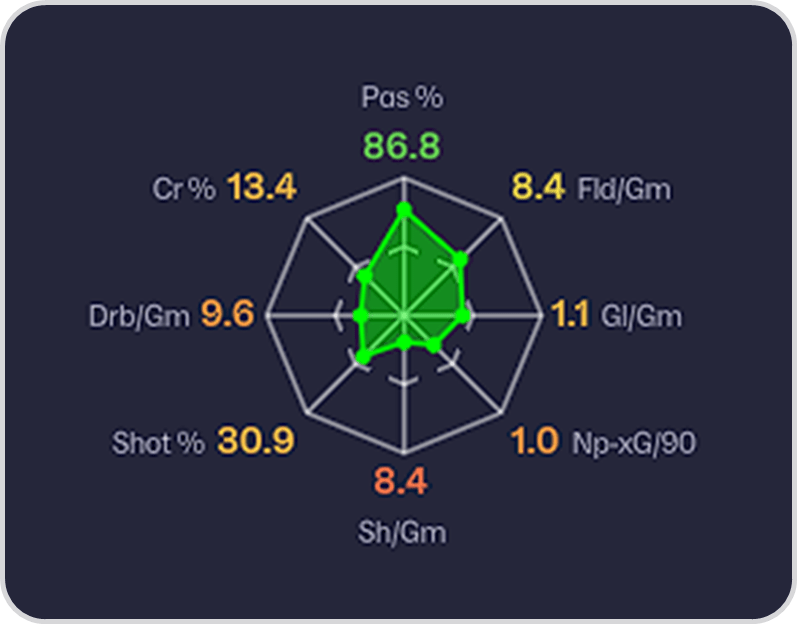
The analysts walked me through the basics: the side sits deep, works hard, but leaks control in key phases. Possession won per game – 99.8. Impressive, but misleading. We’re winning the ball, yes, but not keeping it. Our pass completion is 86.8%, yet our final third entries at over ninety per game yet a creation of just eighteen high quality chances in eighteen games tell me we’re rushing transitions. The structure is disconnected – too many vertical breaks without lateral support.
Still, there are sparks.
Xabi Arberas, a centre-half, stood out: 6.21 aerials attempted per 90, 5.46 of the headers won. over 1.8 shots blocks a game. Strong, grounded, disciplined. I like defenders who see duels as moral acts. Although, in time – I’m sure I’ll want more brains than brawn in this area. Less last man heroics and more clever pressing traps. Manex Agirre – an inverted winger with flair statistics through the roof: 4.17 dribbles per 90, 0.26 xG/90, but a conversion rate of exactly 0%. The analysts say he frustrates fans, but numbers tell a story of potential chaos – the kind that can unbalance defences. He, like a lot of the team, need to find confidence to get on the scoresheet again.
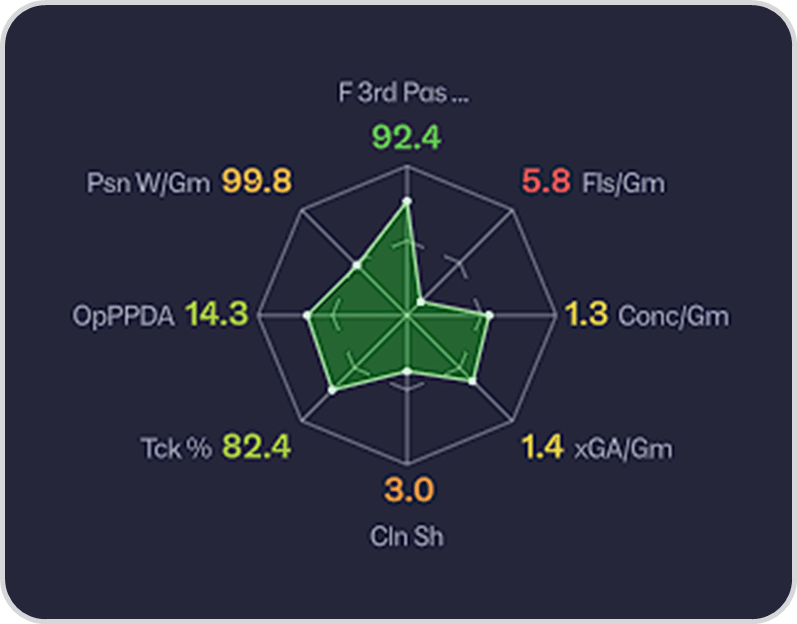
The radar charts revealed more than I expected. Tackling success at 82.4% – solid fundamentals. Each of the players attempting more than one tackle a game are winning over 85% of them, Agirre aside. But we’re conceding 1.3 per game, with only three clean sheets. High duels, low stability – a contradiction that speaks of fatigue or confusion. The full backs are losing the ball more than they win it – nearly 50% more in some cases, and the midfielders, collectively, are winning less than a quarter of their duels. Again – note taking on last ditch defending. Miles from Emery’s organised defensive structure or Iraola’s pressing traps.
Offensively, the side averages 8.4 shots per game, with a 30.9% shot accuracy, not bad conversion for a relegation-threatened team, but it’s clear the build-up isn’t cohesive leaving our top scorer – Okolo – on just six goals. Ten players have assists, but nobody, bar Agirre, is doing so at a rate of more than one every five games. Iker Morales is converting 1.3 key passes into 0.39 chances per ninety but held back by the final piece, 0.08xA and 0.00 assists per ninety for the creative midfielder.
In the room, I could feel the unease of staff who’ve sat through too many of these meetings without direction. The previous manager chased possession for its own sake and it didn’t work. I won’t. All but the keepers sat with a pass completion of over 80% yet a team average possession that also sits in the relegation zone – just 46%. My intended philosophy will bring order first – compression, references, shape. From there, we’ll build transitions that mean something. We will not be docile. We will attack with the intent of an Iraola side and the cleverness of an Emery one yet we will not continue to leak goals. My notes became scrawled; my thoughts became clear.
When the session ended, Pradas clapped my shoulder and said, “Bienvenido a Gernika.” Welcome to Gernika. I smiled, but my head was already in next week’s training schedule.
There’s something raw here – a team that doesn’t yet understand its own effort. But I do. I see a structure that can be rebuilt. Just as this town once was.
Tomorrow, I meet the players.
Sports Interactive Forum
_Ben_ also posts his save updates on the SI Forums, If you would like to keep track of his mini updates and engage in conversation click this link:
https://community.sports-interactive.com/forums/topic/594550-fm26-the-alpine-ascent



 The Gaffers Lounge





Leave a reply to The Alpine Ascent: The Prologue II – The Gaffers Lounge Cancel reply