

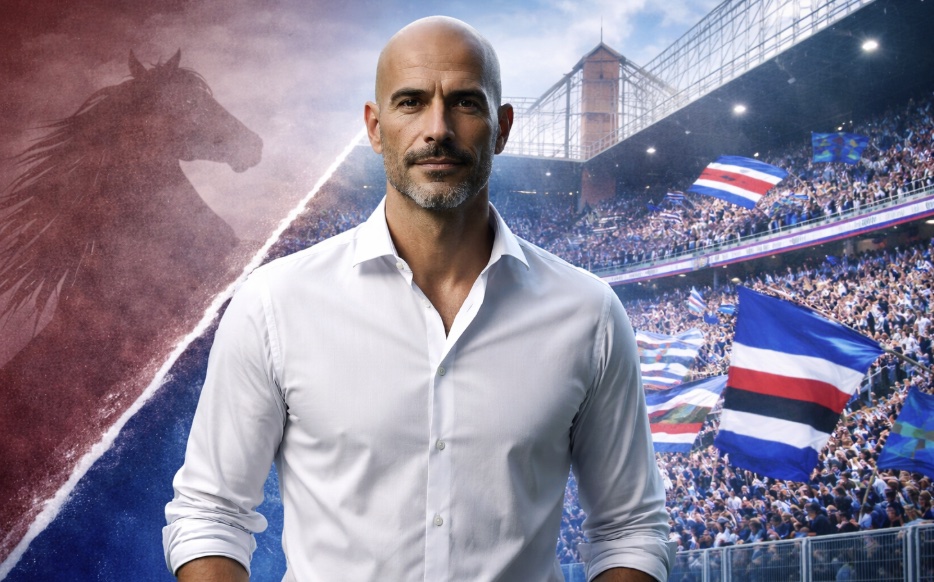
I came across the following piece earlier this week while reading a Spanish tactical blog – one of those late-night dives that start with a single article and end three hours later with far too many tabs open. It was a roundup of Spanish coaches working abroad, and nestled near the top was a name that, here in Switzerland, has become increasingly familiar to us over the last few seasons: Iñaki Arriola of FC Chur.
What struck me was not just the praise, but the tone. This was not an article written from proximity or routine coverage. It came from distance and curiosity – from a journalist who admits he did not know much about Arriola, and who felt compelled to learn more because the football itself demanded attention. That perspective felt worth sharing.
Swiss football is often discussed internally, framed by our own references and assumptions. Seeing Chur – and Arriola’s work – interpreted through a foreign tactical lens offers something different. It reminds us that what is being built here is not only effective in domestic terms, but increasingly legible to a wider European audience that values structure, coherence, and long-term ideas.
For that reason, we are republishing the article below in full. Not as validation, but as reflection – a view of Swiss football, and one of its most intriguing projects, seen from the outside looking in.

The Quiet Basque in the Alps: Why Europe’s Tactical Corners Are Beginning to Look at Iñaki Arriola
There is a certain pleasure, almost a professional obligation, in discovering a coach you should have known about earlier. Not the obvious ones – the prodigies already being courted by elite clubs – but the quieter figures, working far from the spotlight, shaping coherent teams over years rather than months. This season, while compiling a roundup of Spanish managers abroad who are quietly excelling, one name kept resurfacing in my notes: Iñaki Arriola, currently third in our top ten – and perhaps the one I knew least about when I began.
Arriola is nearly fifty. He is not an “up-and-coming” manager in the modern sense, nor a social-media tactician with a recognisable brand. He does not bounce between clubs. Instead, he has done something increasingly rare: stayed, built, refined. Today he is eight years into a project at FC Chur, and after nine matches of the Swiss Challenge League season, his team sit top – unbeaten, dominant, and statistically commanding.
—
Arriola’s roots are unmistakably Basque. He grew up in Zarautz, a town where football identity is shaped as much by culture as by results. Like many Basque coaches, his worldview was formed early: structure, collective responsibility, emotional restraint, and a deep respect for defensive order. What makes Arriola less familiar to Spanish audiences is what happened next. During his youth, he spent extended periods in Switzerland, experiences that seem to have left a permanent mark. The Swiss game that he took in – disciplined, system-oriented, often undervalued tactically – appears to have complemented his Basque education rather than diluted it. Before Chur, there was a brief but telling stop: one season at Gernika. Not long enough to define a career, but enough to hint at a coach comfortable working within limits, focusing on cohesion over spectacle.
Then came the move that would shape everything: Chur.
In an era obsessed with rapid turnaround, Arriola’s eight-year tenure stands out. This is not romantic loyalty for its own sake; it is methodological patience. Chur have evolved under him, but never lurched. The underlying data tells an even clearer story. This season, Chur lead the league in points per game, goals, non-penalty xG, chances created, shots, shots on target, dribbles and high-intensity sprints. Defensively, they concede the fewest goals, make the fewest clearances, and allow remarkably little final-third penetration. Watching Chur, one begins to recognise the lineage. Arriola’s football feels like a continuation of a Basque tradition that stretches from Javier Clemente’s compact Athletic through to the more contemporary interpretations of Unai Emery, the current Slovenia manager – and Andoni Iraola, who is at Napoli. There is a clear defensive reference structure – often a 4-4-2 – but in possession the team morphs, frequently into a 3-2-5 shape or a 2-3-5-that allows width, height, and numerical superiority between the lines. Pressing is coordinated rather than manic. Transitions are vertical but measured. Strikers defend intelligently. The block is compact, but not passive. What stands out is how unforced it all feels. Chur do not overwhelm opponents with individual quality; they suffocate them with organisation and rhythm. That they went to St. Gallen, held their own, and returned with a draw feels entirely consistent with this identity.
It begs the question: why are we only noticing now? Perhaps the most interesting question is why Arriola has remained largely unknown outside Switzerland. The answer likely lies in geography and perception. We are accustomed to scanning the 2. Bundesliga for ideas, or the Championship for emerging managers. The Swiss second tier has rarely been framed as a tactical laboratory. That may be changing. As Europe’s coaching conversation broadens, there is a growing curiosity about well-run teams operating below the obvious radar. Chur, under Arriola, now belong to that category – a side analysts want to understand, not merely admire from afar.
—
For me, this article began as a simple ranking exercise. It ended as a reminder that good coaching does not always announce itself loudly. Sometimes it waits, patiently, in the Alps – until the numbers, the performances, and the coherence become impossible to ignore. Iñaki Arriola may not be a rising star. But he is something rarer: a mature coach whose ideas have found the right environment – and are now, quietly, demanding a wider audience


 The Gaffers Lounge
Leave a comment