

From a distance, Chur remain easy to define. The team sheet still reads 4-2-3-1, the double pivot still anchors everything, and the build-up still resolves itself into a back three with one full back stepping inside and the opposite side released aggressively to stretch the pitch. Yet to stop there is to miss the point. Under Iñaki Arriola, structure has never been about rigidity. Over the past twelve to eighteen months, Chur have evolved into a side whose attacking framework is stable but whose defensive identity is deliberately fluid, shaped less by formation than by opponent behaviour, spacing and threat.
In possession, the attacking shape is now largely settled. The inverted full back tucks in to form a three with the centre backs, creating a platform that allows the right back to surge forward and complete a five-lane frontline. This provides natural width on one side and layered occupation of the half spaces on the other, particularly when Andrea Favara or Zidan Tairi drift inside to connect play. There is still flexibility here, notably when Dion Cakolli is unavailable. In those moments, Arriola has not hesitated to deploy a false nine, deliberately vacating the central lane and encouraging runners to attack the space left behind. It is a reminder that while the framework is consistent, the attacking mechanisms remain opponent-specific rather than dogmatic.
Earlier this season, Arriola briefly leaned further into central congestion, experimenting with three narrow attacking midfielders behind the striker in an attempt to dominate progression between the lines. That phase has softened with Matteo Gambardella’s return to form, allowing Chur to regain more natural width from the left without sacrificing central presence. The result is an attacking unit that looks coherent and recognisable week to week, capable of adjusting roles within the same structural shell rather than redrawing it entirely.
Where Chur truly distinguish themselves, however, is out of possession. Arriola’s defensive philosophy has become increasingly pragmatic, underpinned by a clear principle: wherever possible, Chur will defend with at least one more player than the opposition’s attacking line. This approach owes a clear debt to Marcelo Bielsa, whose time at Athletic Club left a lasting impression on Arriola. Bielsa once framed it “the partial Libero,” Despite the man-marking system, Bielsa always ensures numerical superiority in the central defence by having a designated ‘spare man’ (libero) who is not tied to a specific opponent. This player provides cover, balances the defence, and mops up any potential breaches caused by a teammate losing their individual duel. The system adapts formations to maintain this advantage. Chur’s defensive adaptations can be read through precisely this lens.
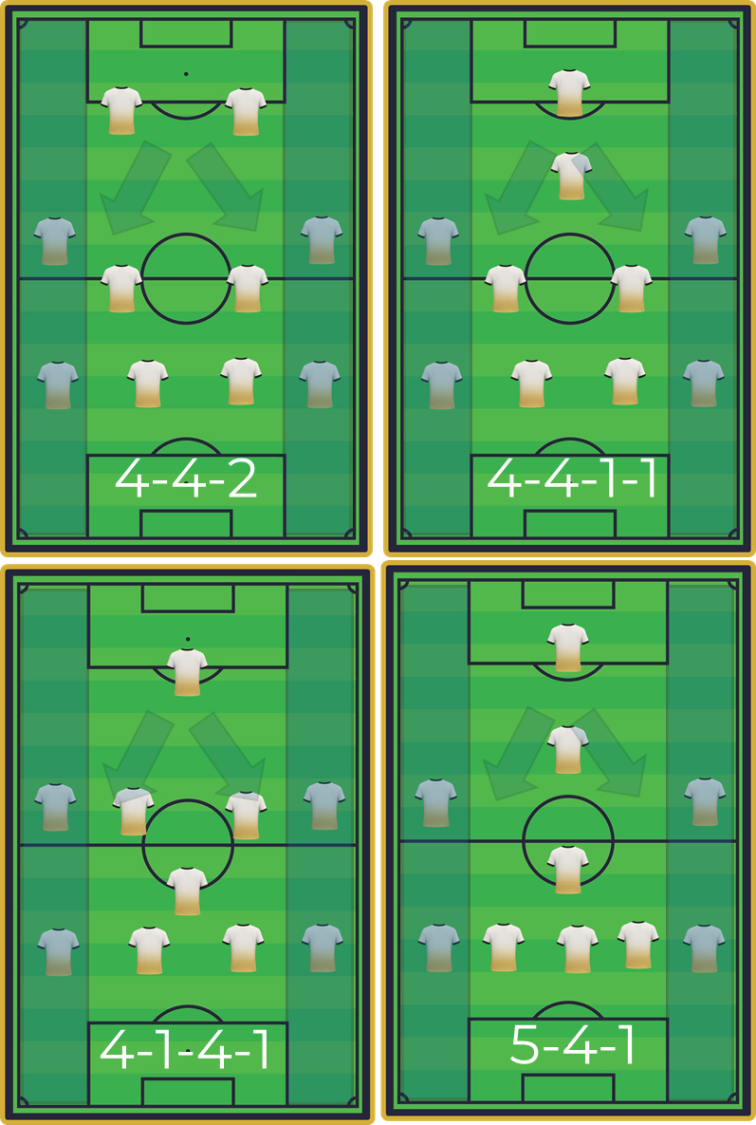
The default out-of-possession structure is a compact 4-4-2, most commonly used against teams operating in a 4-2-3-1 or those relying on inverted wingers. The aim is clear: shut off central passing lanes and force circulation wide. The attacking midfielder steps up alongside the striker to form the first line of pressure, targeting either the centre backs or the opposition double pivot, depending on build-up cues. Behind them, the block remains narrow and disciplined, with wide midfielders holding their shape rather than jumping early. It is a press designed to compress space rather than to hunt recklessly, prioritising compactness over volume of defensive actions.
Against opponents with a more progressive central midfielder or a structure that demands additional protection between the lines, Chur frequently morph into a 4-4-1-1. Superficially similar, the difference lies in intent. Here, the attacking midfielder operates as both presser and tracker, capable of dropping onto an opposition playmaker if required. This shape is particularly effective for generating turnovers around zone 14, where a hard press from the attacking midfielder can immediately release the striker as an outlet. It is slightly more conservative, but it offers greater security against teams whose central pivot threatens to dictate tempo.
When faced with sides that overload midfield or deploy aggressive number eights in a 4-3-3, Arriola has shown a willingness to collapse the structure further into a 4-1-4-1. This adjustment allows Chur to match central numbers more comfortably and makes man-for-man references clearer across the midfield line. In these moments, Chur are often happy to sit off, inviting pressure before breaking quickly into the space left behind. The shape naturally encourages counter-attacking opportunities, particularly when opponents commit full backs high and narrow.
The most conservative of all is the 5-4-1, typically reserved for matches against two-striker systems with aggressive wide threats, or for closing out games late on. By adding an extra centre back, Chur ensure numerical superiority in the last line and protect the box more effectively against crossing-heavy opponents. While this inevitably limits their counter-attacking potential, it preserves an out ball and suits scenarios where territorial control is less important than defensive resilience. It is a pragmatic tool rather than a default stance, deployed situationally rather than ideologically.
Taken together, these shifting defensive faces reveal the true nature of Arriola’s Chur. The attacking structure provides continuity and rhythm, but the defensive organisation is elastic, reactive and deeply informed by opponent profiling. This is not a team that defends in one way because it always has. It is a team that defends in multiple ways because it understands why it must. In that sense, Chur are no longer defined by a formation, but by a principle: control space, maintain numerical advantage, and adapt without losing identity.
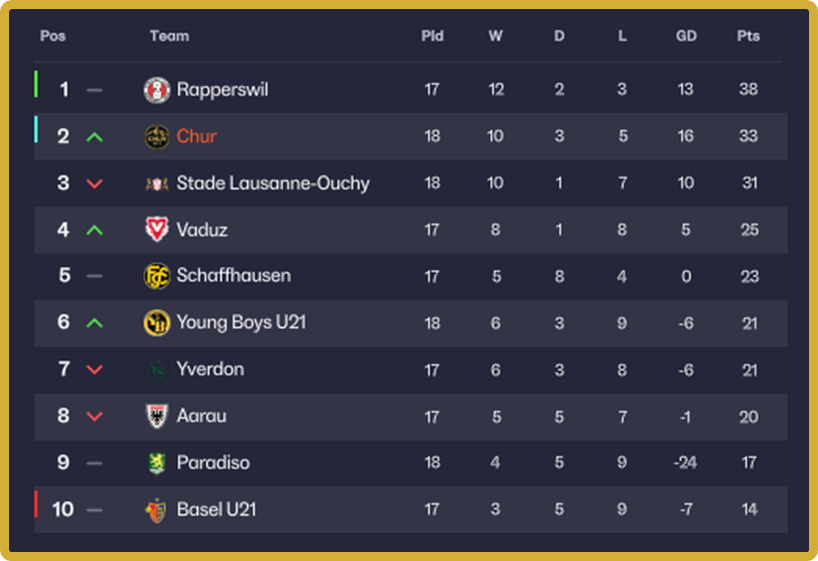
These ideas have served Chur well as they reach the halfway mark of the Challenge League season, sitting in second place, five points behind leaders Rapperswil. It was against them that their strongest showing of the season came – a 4-0 demolition with goals from Favara, Farinas and Tairi. There have been some lower points – a loss to Vaduz, draws to Aarau, somehow struggling following their relegation to this level last year, and Schauffhausen, who also beat them in the first round of fixtures. Yet, these cannot be considered ‘bad’ results, given Chur’s rise to prominence against some of the more established teams in this division. Yes, there is the uncertainty and volatility of the U21 sides: Basel, normally a strong outfit, are languishing at the bottom, whilst Young Boys do not look like repeating their title challenge to go with previous title wins at this level.
With the winter break at transfer window coming, Chur will enjoy a well earned rest, recuperate and begin their plans to cement themselves as a strong team at this level.



 The Gaffers Lounge
Leave a comment