
Inside Iñaki Arriola’s Most Complete Chur Side Yet


Fifteen games into Iñaki Arriola’s sixth season at Chur, continuity has become as much a competitive advantage as any tactical mechanism. At this level, where churn in the dugout is often the norm rather than the exception, Arriola now stands as the second longest-serving manager in the division. That stability has been reinforced off the pitch as well. Simon Hofer’s re-election for a second term as club president was followed almost immediately by a symbolic and practical gesture: Arriola was brought in and secured on an eighteen-month extension. Coming after a season in which public discourse around the manager had at times been strained, the reaction from the stands was notably warm. Supporters recognised the alignment between long-term planning and on-field coherence, even if Arriola himself chose a more understated response, measured and cautious but unmistakably satisfied to extend a project that now bears his fingerprints in every phase of play.

That sense of evolution rather than reinvention has also shaped recruitment. The departure of Ibrahim Babayev, the once heralded ex-Barcelona prospect, ultimately choosing to drop down a level on a free transfer, marked the end of a certain attacking profile. In his place arrives Adriano Onyegbule, a 25-year-old midfielder whose pedigree speaks to the club’s increasingly confident positioning. A product of the RB Leipzig academy and a long-standing presence in Swiss football through Basel’s U21 side, Onyegbule brings technical quality and creative security rather than headline flair. His arrival represents a significant coup for a club at this level, strengthening depth in key attacking zones while maintaining the stylistic demands Arriola insists upon: clarity of thought, speed of execution and an ability to function within structured freedom.
On the pitch, the numbers reflect a side that has matured into its role as a frontrunner. After fifteen matches, Chur sit top of the league with eleven wins, three draws and a single defeat, holding a five-point cushion over Cham and an eight-point gap to Étoile Carouge, the only team to have beaten them so far. With thirty-five goals scored, they lead the division in output, even accounting for Delemont’s statistical spike from an eight-goal outing against Baden. Defensively, they remain among the league’s most reliable units, joint second best with just fourteen conceded. It is a profile of dominance that feels earned rather than inflated, built on repeatable behaviours rather than episodic brilliance.
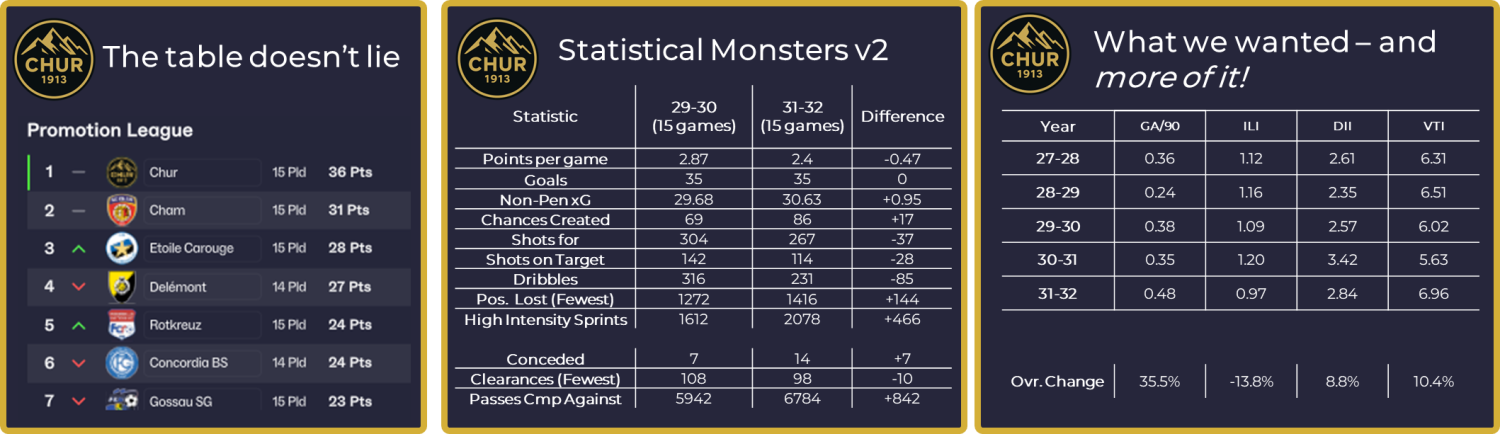
A deeper comparison with the season that brought promotion to this level is particularly revealing. Chur have accrued slightly fewer points at the same stage, yet the underlying performance indicators point toward a more refined attacking process. They are generating significantly more expected goals and higher-quality chances from fewer overall shots, a sign of improved shot selection and more effective access to central zones. Finishing remains imperfect, but inefficiency now stems from volume of opportunity rather than scarcity. The stylistic shift is also evident in ball carrying and physical output. Dribbles have decreased notably, while sprint numbers have surged, reflecting a move away from reliance on individual ball carriers and toward collective passing-and-moving sequences to destabilise defensive blocks. Defensively, Chur concede marginally more than before, but this has coincided with early-season tactical adjustments and a deliberate reduction in reactive, last-ditch defending. Opponents are allowed more sterile circulation, but panic has been replaced with positioning.
Over a five-year arc, the evolution is even clearer. Intensity load has gradually declined, not through reduced effort but through greater efficiency. The team now operates at higher speeds for shorter bursts, sprinting more and jogging less, particularly in transition. This shift has sharpened Chur’s counter-attacking threat while preserving energy across matches. Tackle volume has increased compared to last season, but so too has defensive intelligence, especially when contrasted with the promotion year. Verticality, once expressed largely through dribbling, is now achieved through direct, progressive passing. The presence of a designated “quarterback” within the pivot has allowed Chur to connect lines more cleanly, isolate channels earlier and break pressure without overcommitting numbers.
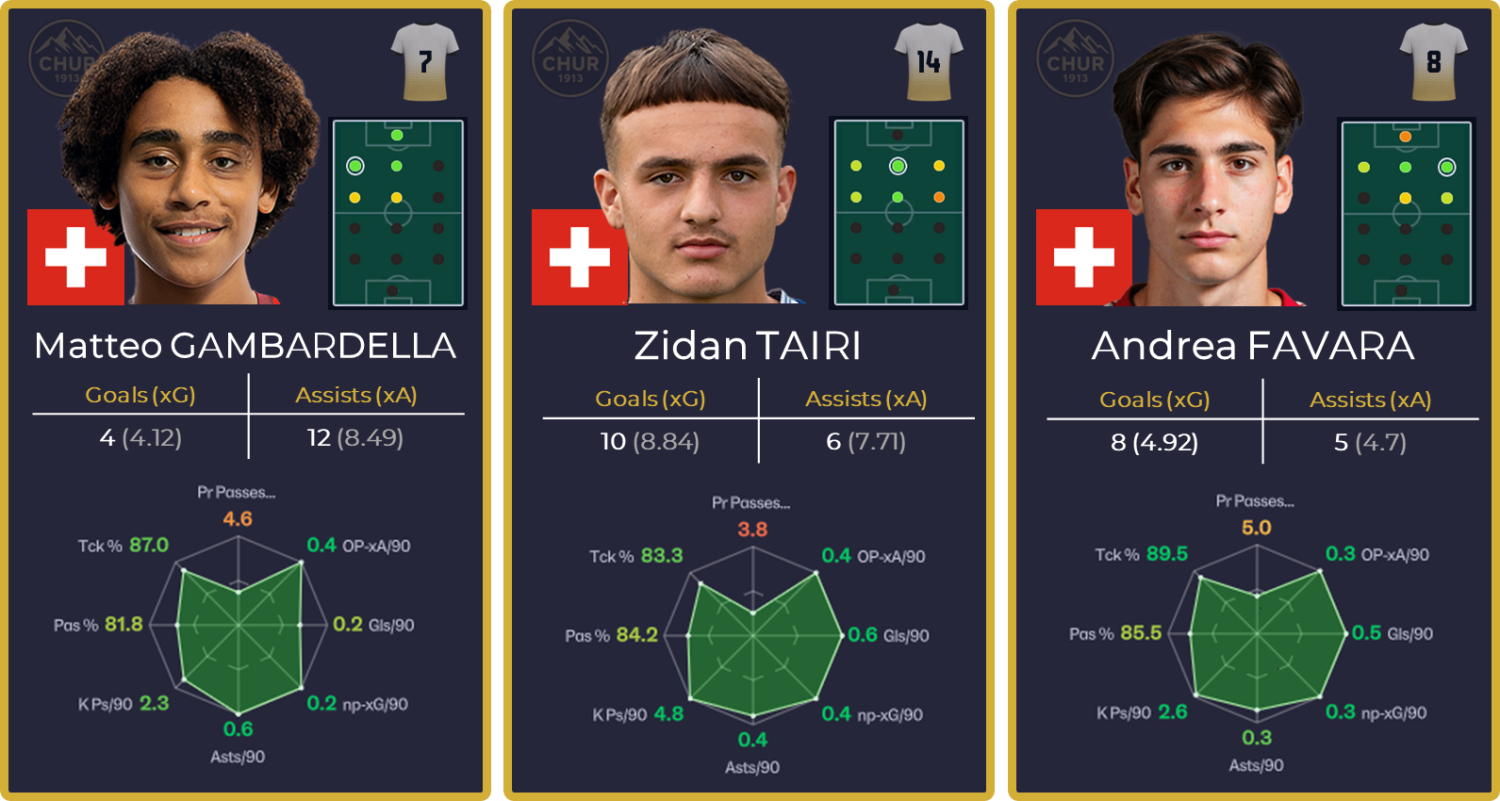
Nowhere is this clearer than in the attacking structure. Three attacking midfielders have combined for an extraordinary forty-five goal contributions in the opening phase of the campaign. Dion Cakolli has been the primary beneficiary, scoring seventeen goals as chance after chance is engineered around his movement. Behind him, Andrea Favara and Zidan Tairi operate as dual tens, drifting into half-spaces, rotating responsibilities and repeatedly unsettling defensive reference points. On the narrow left, Matteo Gambardella has effectively become a second striker, arriving late to finish moves or providing the decisive pass or cutback that completes them. The balance between roles is precise: central overloads create access, wide restraint maintains structure, and timing does the rest.
With nearly half of the season complete, the picture is unambiguous. Chur are not merely leading the league; they are shaping it according to a clear tactical identity forged over years rather than months. Stability in leadership, targeted recruitment and an increasingly sophisticated interpretation of intensity and verticality have placed them in a commanding position. Promotion to the second tier is no longer a distant aspiration but a tangible objective, one grounded in process as much as results. If the opening fifteen matches are any indication, this iteration of Chur is not peaking early – it is operating exactly as designed.
 The Gaffers Lounge
Leave a comment