


Part One – The Blueprint:

There is a quiet confidence to the way Chur’s new setup has been assembled, not in the sense of revolution but refinement. The underlying philosophy remains recognisable: territorial control through a mid-block, an assertive defensive line, and an insistence on decision-making over automation. What has changed is the degree of freedom afforded within that structure. With a squad now populated by players who have repeatedly shown an ability to choose the right action at the right time – when to roam, when to dribble, when to risk the pass and when to reset – the emphasis has shifted toward controlled creativity. This evolution has required a recalibration without undermining the collective balance. Pressing, once a more overt tool of disruption, has been softened into something more selective. The block remains intact, the line still steps up when triggers appear, and wide traps are still a feature, but there is less insistence on pure volume of pressure. Instead, the pressing structure now bends rather than stretches, ensuring that as players move more freely into unfamiliar zones, the team is not pulled apart in transition.
Out of possession, the structure remains familiar but subtly refined. Chur continue to defend primarily in a 4-4-2 shape, with Zidan Tairi retreating from his advanced role in the initial press to add a crucial extra body in midfield, ensuring central density without sacrificing the ability to spring forward. The block is compact and deliberately narrow, prioritising protection of the half-spaces and the corridor in front of the centre-backs. Rather than chasing the ball aggressively, the two banks slide laterally in unison, angling pressure to shepherd opponents toward the flanks where options become predictable and space runs out more quickly. Wide players are shown outside rather than engaged immediately, buying time for the full-back and near-sided midfielder to double up while the rest of the line holds its distances. It is a system built on restraint rather than reaction, one that values collective spacing over individual duels and seeks to control where the opponent can play, not simply when they lose the ball.
Offensively, the changes are subtle but telling. The framework remains stable, but patterns have been tightened to reflect the qualities of specific individuals. Tairi’s repositioning as an attacking midfielder is central to this. Rather than occupying a fixed zone, he is tasked with moving into channels, destabilising defensive references while still contributing to the interior presence that defines Chur’s build-up. On the right, Andrea Favara becomes the fulcrum of that interiority, cutting inside as a playmaking winger who drifts, carries and provokes defensive choices. His movement allows the box midfield to remain intact even as roles rotate, ensuring continuity in central overloads. On the opposite side, Matteo Gambardella’s transition into an inside forward role is less about positional fashion and more about efficiency. His finishing instincts are now brought closer to goal, forming a narrow front pairing with Dion Cakolli that prioritises shot quality over volume. Rather than flooding the box with numbers, Chur now attack it with timing, trusting movement and spacing to do the work that sheer presence once did.
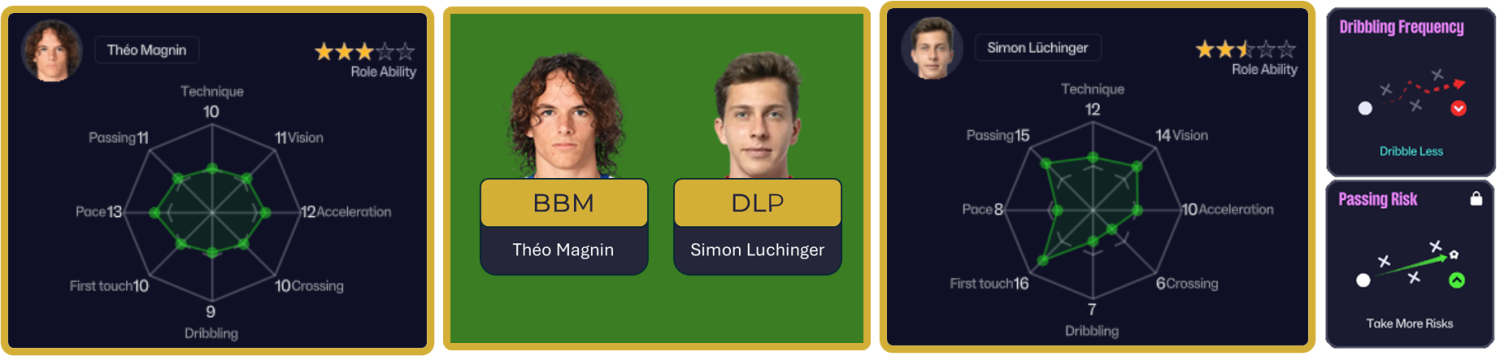
The most meaningful transformation, however, sits at the heart of the team. The pivot has been reimagined not as a pair of mirrored functions but as a deliberate contrast. Theo Magnin’s journey from cover full-back to central midfielder reflects this thinking perfectly. He is not a playmaker and not a ball-carrying specialist, but a physical reference point who moves relentlessly between boxes. His influence comes through presence rather than invention, arriving in zones where duels matter and second balls decide momentum. As a converted full-back, his spatial awareness allows him to interpret central areas with a defender’s instinct, giving the team vertical continuity without sacrificing rest defence. This, in turn, unlocks Simon Luchinger. Freed from the need to shuttle or dribble under pressure, he is now positioned as the true quarterback of the side. His role is to receive, scan and distribute, accelerating play through risk rather than movement. The addition of traits such as preferring the ball into feet and an increasing emphasis on long-range passing are not cosmetic changes but functional ones, preparing him to dictate rhythm and direction from deeper zones.

Such expression in midfield demands compensation elsewhere, and Chur’s defensive adjustments reflect a clear understanding of that trade-off. The introduction of Diallo has enabled a structural shift that prioritises security without retreat. Llumnica’s move to left-back is emblematic of this approach. He is not asked to advance aggressively or overlap in the traditional sense, but to sit deep, recycle possession and provide positional certainty. On the opposite side, similar restraint is applied, with full-backs tasked with protection first and contribution second. Henchoz remains the stabilising axis, operating as the third centre-back and the primary conduit across the defensive line. The intention is clear: circulate the ball horizontally across the back line, draw pressure, and only then feed Luchinger in conditions that favour progression rather than recovery. Diallo and Llumnica staying back at all times is less about conservatism than prevention, ensuring that counter-attacks are met with numbers and angles rather than emergency sprints.
What emerges from this setup is a team that is less rigid but more intelligent, less frenetic but no less intense. Chur are not abandoning the principles that brought them success; they are contextualising them. Creativity is no longer something to be forced through volume, and pressing is no longer measured by its frequency alone. Instead, the game model now hinges on trust – trust in players to interpret space, trust in structure to absorb movement, and trust in the idea that control can be asserted in more than one way. It is a setup that reflects a club growing into its identity, comfortable enough to adjust without losing itself.
Part Two – In action:
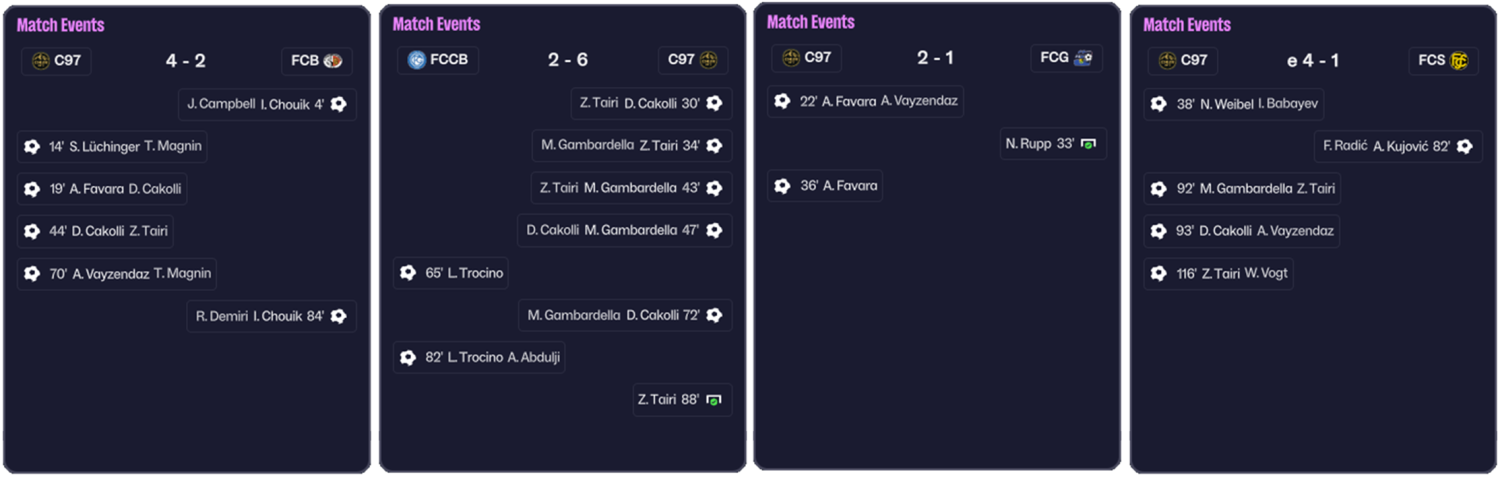
Results of Chur’s opening three league fixtures and first round Schweizer Cup tie.
With the opening weeks of the season now in the books, Arriola has been able to move from conceptual design to practical audit. The first matches have been pored over in detail, not for outcomes but for behaviours: how the block shifts under sustained pressure, where spacing holds under transition, and which pressing cues actually trigger collective movement rather than individual impulse. This second part draws directly from that analysis. It breaks down the recurring structures and in-game mechanisms that have already begun to define Chur under his guidance, examining how his ideas translate when exposed to real opponents, real fatigue and real moments of disorder. What follows is a tactical reading of those early matches, focused less on what Chur are trying to be, and more on what they are already showing themselves to be.

The early build-up phase has quickly revealed a clear three-two structure, with Chur positioning themselves centrally and with intent. The back three are comfortable circulating possession between themselves, even under light pressure, and there is a noticeable calmness in how they invite opponents forward. Both pivot players show a willingness to receive on the half-turn despite pressure arriving from behind, a detail that speaks to trust rather than risk-taking for its own sake. At times, the defenders have even been seen deliberately pausing on the ball, studs resting momentarily on top, subtly baiting the press and testing the opponent’s discipline. When faced with a single pressing forward, Chur remain composed, understanding that the opponent is caught between lines and cannot fully commit. However, this confidence has been challenged when teams commit three or more players to the press. In those moments, hesitation has crept in, with the back line occasionally caught between continuing to play short or breaking lines more decisively. Several turnovers have emerged from this indecision, particularly against high-intensity pressure, highlighting an area where clarity of choice will need to sharpen as opponents become bolder.
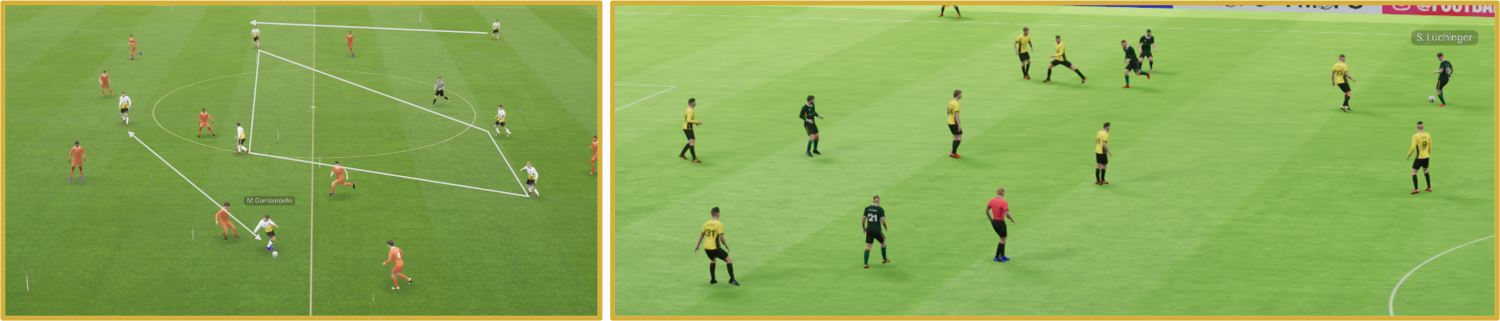
Further forward, the attacking structure continues to revolve around the creation of a box shape, supported by a line-hugging runner to stretch the pitch horizontally. In earlier phases of transition, the double pivot remains closely aligned, prioritising rest defence and circulation rather than immediate penetration. It is only once Chur settle into sustained possession or enter the final third that Magnin, or one of the more aggressive number eights, begins to break forward with intent. Central to all of this is Simon Luchinger, who is repeatedly entrusted with possession on the half-turn or even facing goal with a dense block of opposition players ahead of him. Chur’s willingness to funnel play through him under pressure underlines his importance as the team’s tempo-setter, a role he has justified with an impressive 89 percent pass completion rate. The movement ahead of him is constant and purposeful, creating passing lanes that allow him either to accelerate play or to recycle and draw the press before exploiting the space left behind. In effect, Luchinger does not just receive the ball; he controls the rhythm of the game.

That control, however, has not fully extended to Chur’s man-for-man tendencies in both defensive and attacking thirds, which have at times exposed structural vulnerabilities. The opening goal conceded against Breitenrain offered a clear example. Facing a 4-2-4, Chur were drawn into individual match-ups without adequate cover, leaving space unprotected as Breitenrain circulated the ball with ease before finishing. This approach has also created problems in the initial defensive phase, particularly when Chur have gone man to man on opposition defensive midfielders while neglecting the centre-backs. The result has been a series of simple long balls played forward without pressure, bypassing the midfield entirely. This pattern has disproportionately affected the left side, where Gambardella and Llumnica have found themselves overloaded and stretched, forced to defend space rather than opponents and often arriving too late to regain control.

Those defensive issues were again evident in the goals conceded against Concordia, both of which felt preventable. While the new pivot has functioned effectively in possession, its defensive balance remains a work in progress. Magnin has not been caught out by reckless positioning, but his role as a screen in front of the defensive line has left him isolated. With Gambardella instructed to stay high and wide and Tairi initiating the press from advanced positions, there is little immediate protection when play breaks down in the left half-space. Both goals originated there, exploiting the gap between midfield and defence before cover could arrive. If Chur are to tighten this area, an adjustment seems necessary. Shifting toward a clearer screening mechanism – potentially by pushing Magnin wider to provide support – would reduce the burden on the central defenders and offer greater protection without undermining the attacking structure that has otherwise shown encouraging signs.
Taken together, the early match analysis paints a picture of a side in transition rather than contradiction. The new ideas introduced this summer, supported by signings chosen for intelligence and adaptability rather than volume, are already visible in Chur’s structural behaviours: a build-up that invites pressure, a midfield that prioritises decision-making over movement for movement’s sake, and an attack built on spacing, timing and trust in key individuals. Where the system has faltered, it has done so at the margins – in moments of collective hesitation under intense pressure, or in defensive phases where role definition has not yet caught up with increased freedom elsewhere. These are not flaws of principle but of calibration. As new personnel settle into their responsibilities and the balance between creativity and security is refined, the framework looks less like a gamble and more like a deliberate evolution. The foundations are clear, the intent coherent, and the summer recruitment already feels aligned with a model that is being shaped not by impulse, but by observation, adjustment and belief in the long term.




 The Gaffers Lounge
Leave a comment