

Before we get into the latest blog, I want to thank everyone for the amazing feedback on the blog so far. If you weren’t aware I have now started a Twitter Thread where I update frequently and then will do these blogs as well for those who prefer to read them over scrolling a thread. Right back to the journey then!
The champagne had barely dried on the Northern Premier League Division One Midlands trophy when the first rumblings of change began.
Under New Ownership
The takeover, rumoured for months, finally became reality in the summer of 2027. A fans trust, spearheaded by local businessman James Harvey, completed the acquisition of Atherstone Town Community Football Club. Harvey, a lifelong supporter who had watched from the terraces through the dark days and the glory years alike, now held the keys to Sheepy Road.
The move represented something significant for a club that had always prided itself on community roots. This wasn’t a faceless consortium or an overseas investment group chasing vanity. This was local money, local passion, local ambition. Harvey spoke at length about preserving the identity that had made Atherstone special while providing the resources needed to compete at step three. Maria Beale, who had overseen the most successful period in the club’s modern history, stepped aside with dignity and grace. The transition felt seamless, organic even.
For Paul Howarth, it meant fresh backing and renewed confidence that the project he’d built could continue to grow.
A Painful Goodbye
Not everyone would be part of that growth.
Nathan Haines, the assistant manager who had steadied the ship when Mitch Thomson departed and delivered three wins from three as caretaker, declined the offer of a new contract. The news landed heavily around Sheepy Road. Haines had been there through it all—the promotions, the title race, the nervy final day at Coleshill. His decision to move on, whatever the reasons, left a void that wouldn’t be easily filled.
In his place came Matt Tootle, a man whose CV spoke for itself. Over two hundred Football League appearances across spells at Crewe Alexandra, Shrewsbury Town, and Notts County. A right-back who understood what it took to perform at levels Atherstone were only just reaching. Howarth needed experience beside him in the dugout, and Tootle provided exactly that.
The Changing of the Guard
The squad overhaul that followed was extensive, perhaps inevitable given the step up in quality awaiting them.
Callum Gudger, Diego Lattie, Ryan Quinn, Nathan Rowe, Henry Sims, Cian O’Connor, Kalvin Taylor, and Emeka Akukwe were all released. Some of those names had contributed significantly to the back-to-back promotions. Lattie’s goal and assist in that September derby against Nuneaton felt like yesterday. Quinn’s penalties had earned vital points throughout the title run. But step three demanded more, and Howarth had made his assessment.
Mitchell Woakes, scorer of that unforgettable playoff semi-final winner against Lutterworth, joined Lewis Collins at New Milton Town. Another farewell that carried weight.
Fresh Faces
The recruitment team had been busy. Seven new arrivals, all free transfers, each bringing something different to the squad.
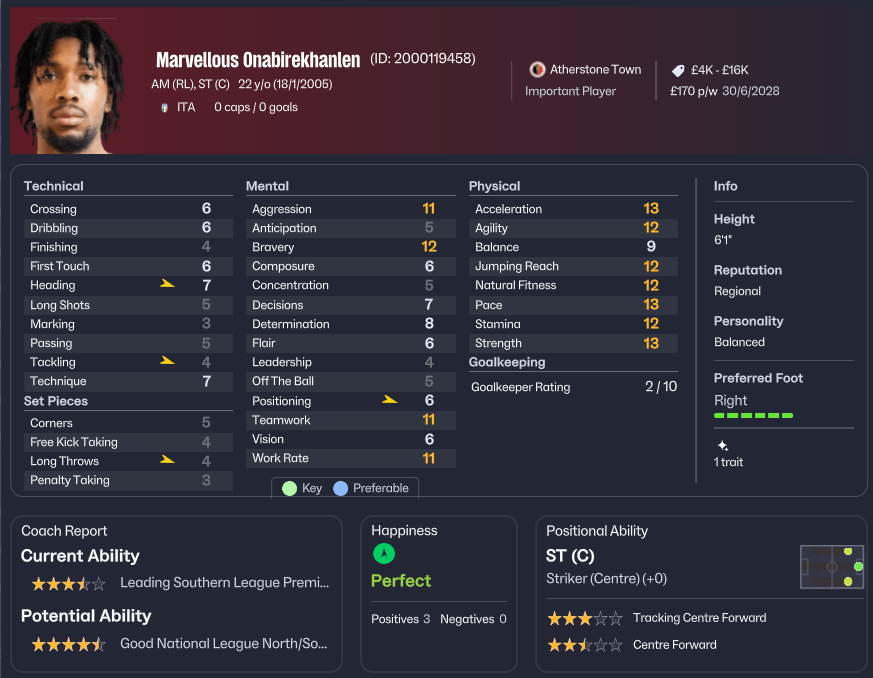
Marvellous Onabirekhalen — the name alone demanded attention. The 22-year-old Italian striker arrived from Coleshill Town, the very side Atherstone had dismantled 5-2 on the final day of the season. He’d been their top scorer with seventeen goals for a team that barely survived. At 6’1″ with pace (13), acceleration (13), and strength (13) to burn, he offered a physical presence that would trouble step three defences. His potential ceiling, according to the scouts, sat at National League North/South level. An important player from day one.
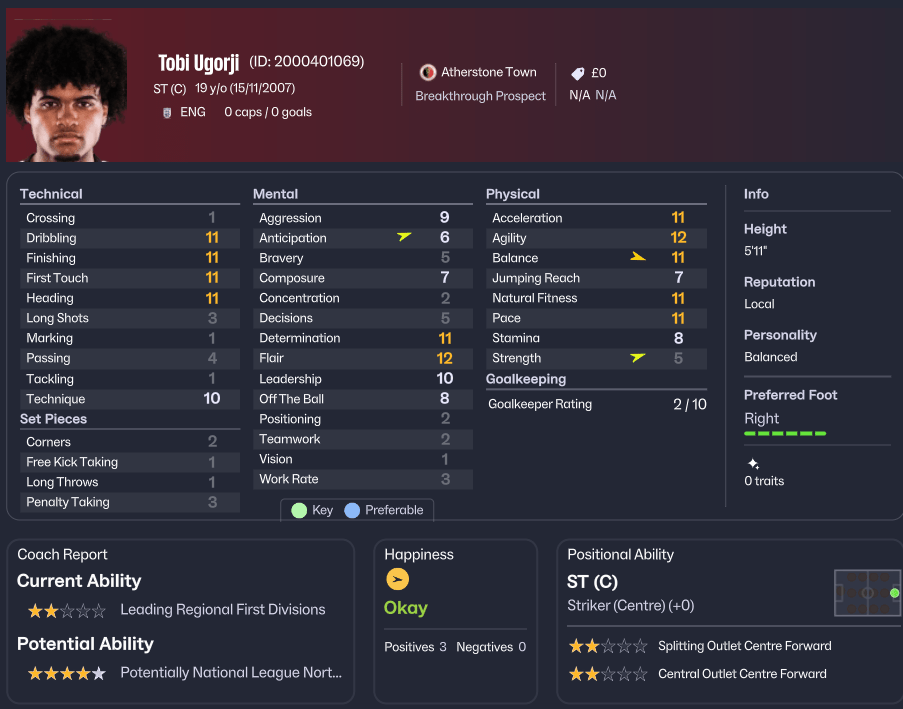
Tobi Ugorji joined from Birmingham City. A 19-year-old striker with technical gifts that looked almost too good for this level. Dribbling (11), finishing (11), first touch (11), heading (11), and technique (10) painted the picture of a forward comfortable with the ball at his feet. His flair (12) and leadership (10) suggested personality to match the ability. A breakthrough prospect with a ceiling that could take him to National League North/South.
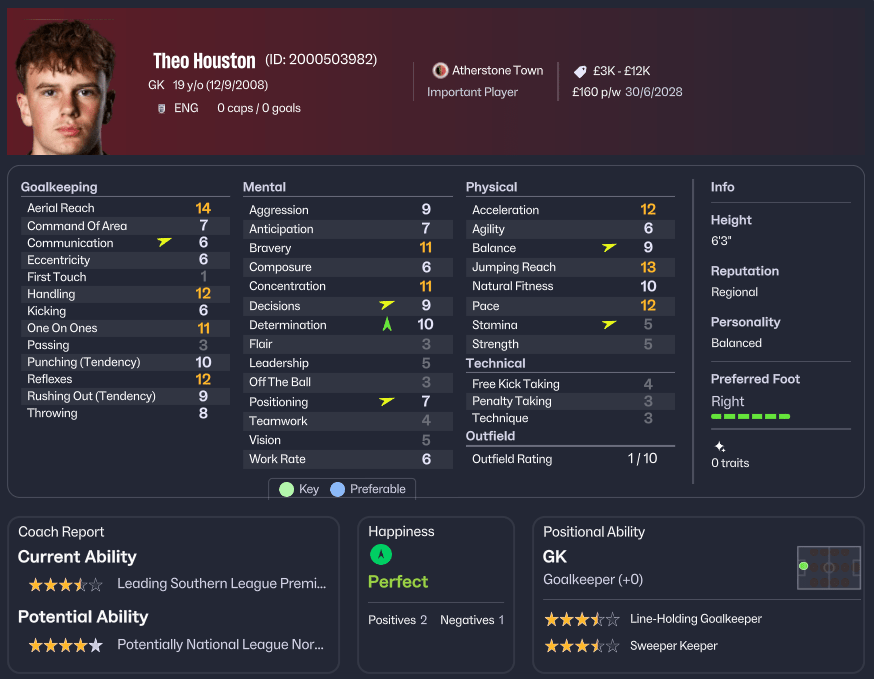
Theo Houston solved the goalkeeper problem that had plagued Atherstone since Auton’s mid-season departure. The 19-year-old arrived with aerial reach (14), handling (12), reflexes (12), and one-on-ones (11) that immediately made him first choice. At 6’3″ with a jumping reach of 13 and pace of 12, he possessed the physical tools to dominate his area. Current ability sat at Leading Southern League Premier standard; potential stretched to National League North/South. The number one jersey was his to lose.
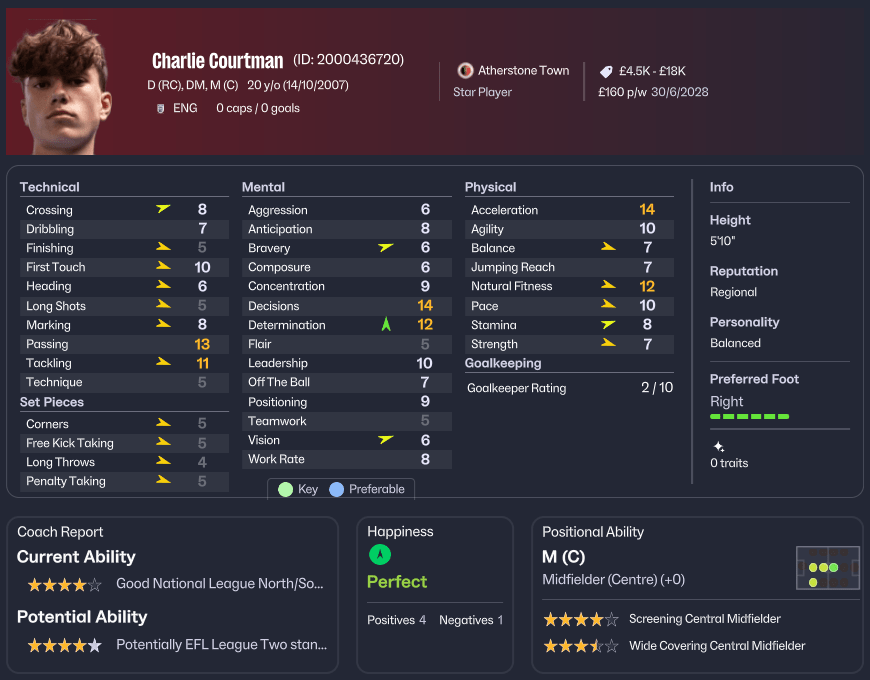
Charlie Courtman represented perhaps the most exciting signing of the summer. A 20-year-old central midfielder already assessed as Good National League North/South standard—a level above where Atherstone currently played. His potential? EFL League Two. The actual Football League. Passing (13), tackling (11), first touch (10), marking (8), and acceleration (14) made him the complete midfield package. Star player status from the moment he walked through the door.

Cayden Cole, a 19-year-old left-back from Sierra Leone, brought physical presence and mental fortitude. Determination (16), aggression (13), pace (12), and marking (10) suggested a defender who wouldn’t be pushed around. At 6’1″ with a jumping reach of 13, he could handle the aerial battles that step three would bring. Another star player, another signing with room to grow significantly.
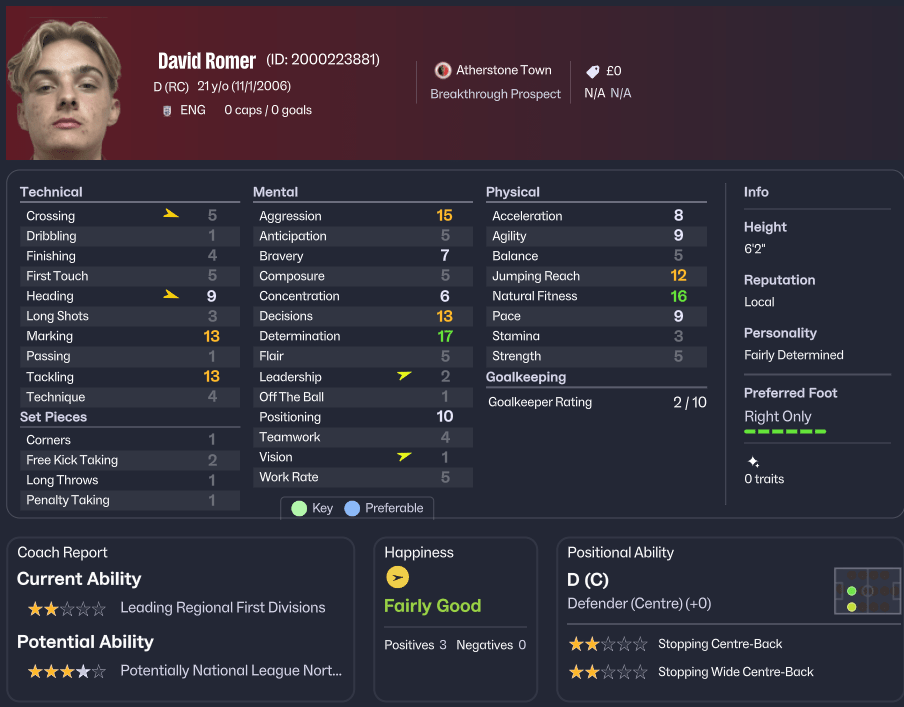
David Romer added depth at centre-back. The 21-year-old stood 6’2″ with determination (17), aggression (15), marking (13), and tackling (13). Currently assessed as Leading Regional First Divisions standard, but his potential reached Southern League Premier level. A breakthrough prospect who would push for opportunities.
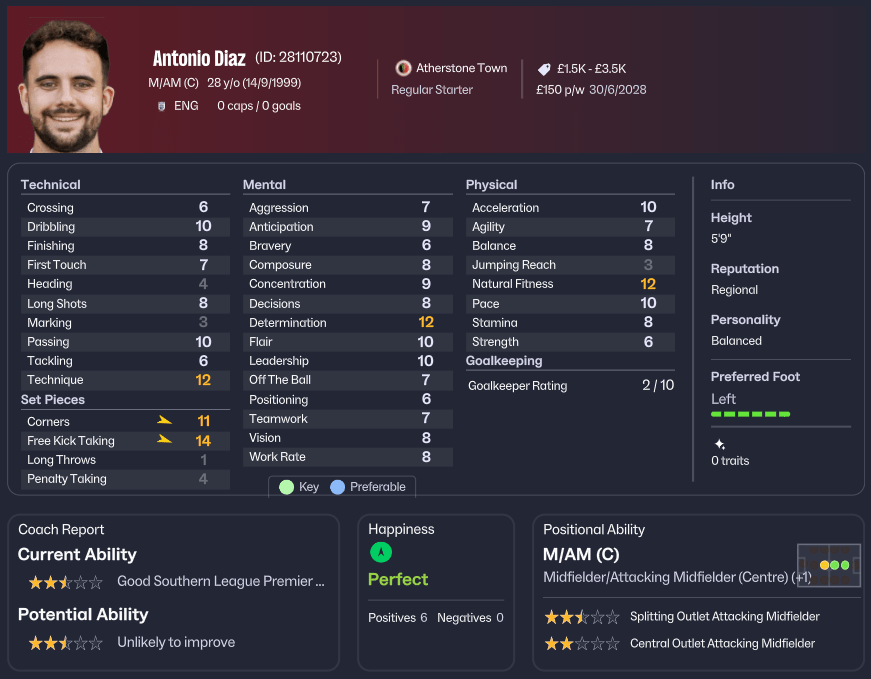
Antonio Diaz completed the summer business. The 28-year-old central midfielder offered something different—experience. With technique (12), dribbling (10), passing (10), and flair (10), he provided creativity from deep. His set-piece ability stood out: corners (11) and free kick taking (14) gave Atherstone a genuine threat from dead ball situations. Current ability sat at Good Southern League Premier standard. He wouldn’t develop further, but he didn’t need to. Diaz was ready now.
Seven players in. Zero transfer fees. Combined potential value pushing towards six figures. The recruitment had been surgical.
Step Three: The Learning Curve
The Southern League Premier Central. A division littered with former Football League clubs, established non-league outfits, and budgets that dwarfed anything Atherstone had worked with before. The pundits, predictably, tipped the Adders for an immediate return to step four. Howarth and his players had other ideas.
Opening Day Nerves
The campaign began at home to Leiston on the final day of July. A 1-1 draw felt like a fair result—neither side deserving more, neither deserving less. A point on the board, a marker laid down. This level could be competed at.
Rugby Town Away: A Statement Win
Four days later came the first genuine test. Rugby Town away, Butlin Road, a Wednesday evening under the floodlights.
What followed was a performance that announced Atherstone’s arrival at step three.
Charlie Courtman, the summer signing who had arrived with such lofty expectations, delivered on every one of them. His cross on 30 minutes found Will Houghton, and the striker did what he’d done so many times the previous season—buried it. 1-0 to the visitors at the break, and the xG told its own story: Rugby 0.52, Atherstone 2.79. This wasn’t smash and grab. This was dominance.
The second half continued in similar fashion. Steve Thorpe, one of the academy graduates Howarth had been nurturing, picked out Chris Cowley on 64 minutes. The midfielder made no mistake. 2-0. Twenty-two shots to Rugby’s twelve. Eleven on target to their six. Seventy percent possession. Eighty-seven percent pass completion. A thoroughly professional dismantling.
Courtman’s 8.73 match rating underlined his influence. Houghton contributed a goal and an assist, Cowley added a goal to his tally. The away end—small but vocal—celebrated long into the evening.
The Inconsistency Sets In
If Rugby suggested Atherstone belonged at this level, the results that followed offered a more complicated picture.
Needham Market visited Sheepy Road and left with all three points after a 1-2 defeat. A harsh lesson in step three ruthlessness. A 1-1 draw at Corby Town steadied nerves, before home draws against Stratford Town (1-1) and a thrilling 3-3 with Hednesford Town hinted at both the attacking quality and defensive vulnerability within the squad.
The 2-0 home victory over Hemel Hempstead Town offered encouragement, but a 3-0 win at Alvechurch was followed immediately by inconsistency once more.
Cup Runs and Replays
The FA Cup provided welcome distraction. A 2-0 victory at Ilkeston Town in the First Qualifying Round set up a Second Qualifying Round tie with Belper Town. The first meeting ended 1-1 away, but the replay at Sheepy Road produced a comprehensive 4-1 victory.
Chester arrived for the Third Qualifying Round and held Atherstone to a 1-1 draw at home. The replay at Chester, though, saw the Adders progress with a hard-fought 1-2 win. Four rounds in, and the FA Cup dream remained alive.
The FA Trophy run began in emphatic fashion—a 4-1 demolition of Hednesford Town away in the Third Qualifying Round. A statement victory on the road that suggested this competition might yet yield something. A 4-0 home win over Hyde United in the First Round proper kept that momentum going.
September and October: Finding Their Feet
The league form remained a mixed bag. A 1-0 defeat at Banbury United was followed by a superb 3-1 victory at Stamford. The visit of Leiston for the Fourth Qualifying Round of the FA Cup produced a 2-0 win, keeping the cup run alive.
Barwell Away: The Complete Performance
Tuesday, 12 October 2027. Kirkby Road Sports Complex. Breezy conditions and a pitch that demanded composure.
Atherstone delivered one of their most dominant displays of the season.
Marvellous Onabirekhalen, the summer signing from Coleshill who had been steadily finding his feet at this level, provided the assist on 11 minutes for Steve Thorpe, the 16-year-old academy product who continued to impress whenever called upon, provided the assist. The youngster’s 8.21 match rating would prove the highest on the pitch.
The statistics painted a picture of total control. Seventy percent possession. Twenty-one shots to Barwell’s eight. Eight on target to their two. An xG of 2.76 against 0.33. Four clear-cut chances created to Barwell’s zero. Eighty-eight percent pass completion against seventy-five percent.
Barwell simply couldn’t cope. Atherstone’s pressing suffocated them, the passing carved them open repeatedly, and only some wayward finishing prevented a more emphatic scoreline. Theo Houston, the young goalkeeper, was barely troubled. The defence, marshalled by Cayden Cole (7.3 rating), looked impenetrable.
The 1-0 scoreline flattered the hosts. This was men against boys.
The Bigger Picture
A 3-0 home win over Evesham United kept momentum building, but a 2-0 defeat at Northwood brought everyone back down to earth. The cup exploits continued with that Hyde demolition, but inconsistency remained the theme.
Where Things Stand
Seventeen league games played. Eight wins, five draws, four defeats. Twenty-nine points. Fourth place.
Rugby Town led the division on thirty-three points from eighteen games, their ten wins setting a pace that would challenge anyone. Lowestoft Town sat second on thirty-two, Needham Market third on thirty-two as well. Atherstone, on twenty-nine from seventeen, occupied fourth.
Below them, Corby Town lurked on twenty-eight points. Stratford Town on twenty-seven. The chasing pack remained tightly bunched, but the Adders had given themselves a platform to build from.
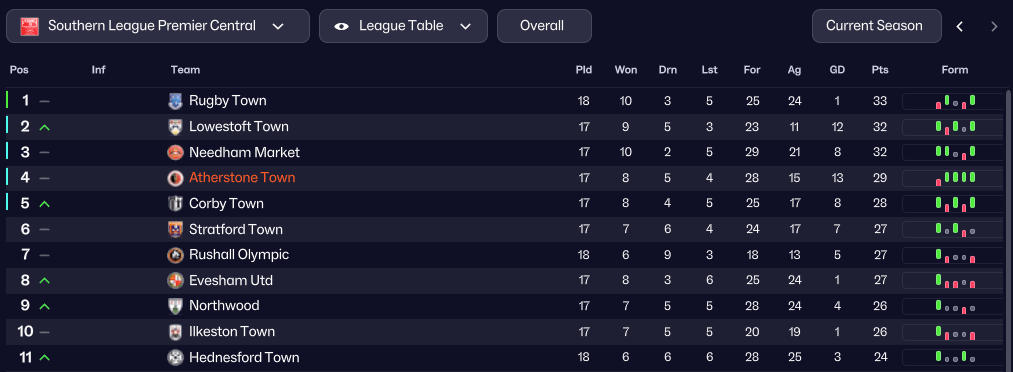
At the bottom, Hitchin Town and St. Ives Town were already looking nervously over their shoulders. Hemel Hempstead Town’s minus fifteen goal difference told its own story of struggles.

For a side tipped for relegation, fourth place represented a remarkable achievement. But Howarth knew better than anyone that the season was barely halfway through. The hard work was only just beginning.
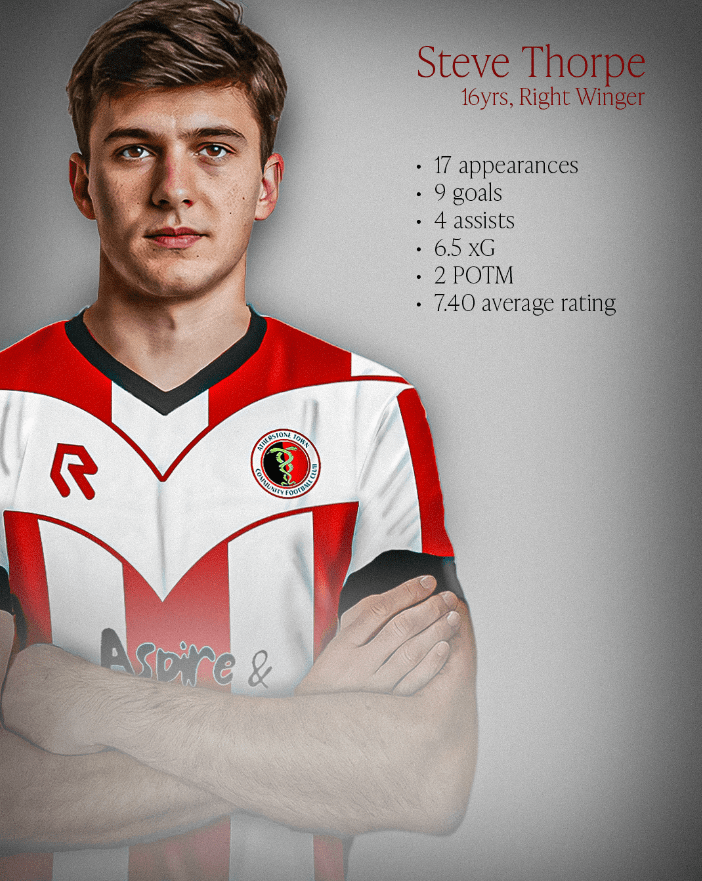
The Breakthrough: Steve Thorpe
If there was one story that captured the imagination during the opening months of the season, it was the emergence of Steve Thorpe.
Sixteen years old. Seventeen appearances. Nine goals. Four assists. An average rating of 7.40. Numbers that seemed almost too good to be true for a player who had only recently been plying his trade in the youth setup.
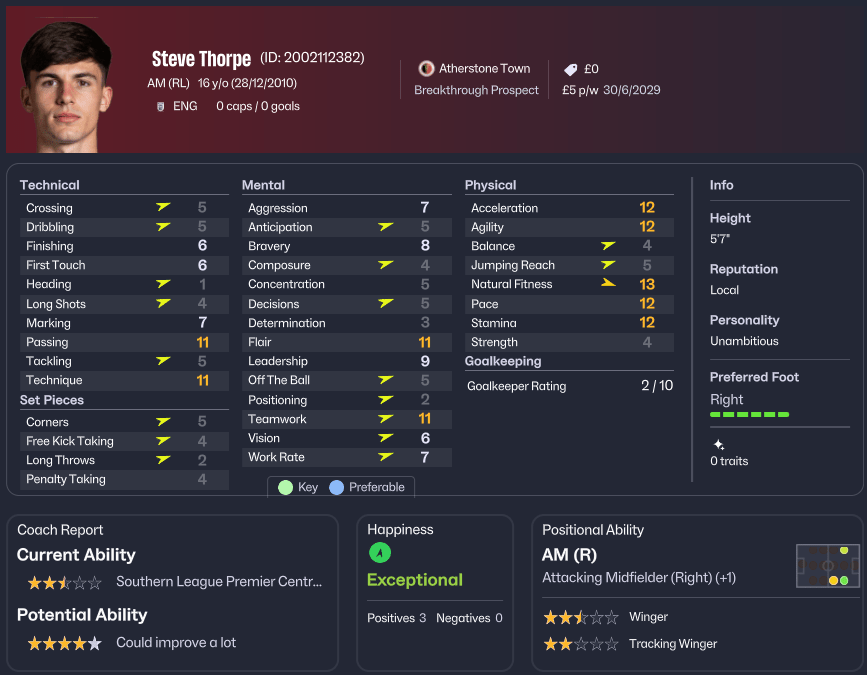
Thorpe had been identified as a breakthrough prospect during pre-season, but few could have predicted the impact he would make so quickly. The right-sided attacking midfielder possessed the physical attributes to compete at this level—acceleration (12), agility (12), pace (12), and natural fitness (13) meant he could match seasoned professionals stride for stride. But it was his technical ability that truly set him apart. Passing (11), technique (11), and flair (11) gave him the tools to unlock defences, while his teamwork (11) and leadership (9) suggested a maturity beyond his years.
Standing just 5’7″, Thorpe wasn’t going to win aerial battles, but he didn’t need to. His game was built on movement, on finding pockets of space, on delivering the final ball when it mattered most.
The coaching staff had assessed his current ability as Southern League Premier Central standard. At sixteen. Playing in the same division as clubs with budgets ten times the size of Atherstone’s. His potential ceiling? The scouts believed he could improve significantly, possibly reaching National League level with the right development.
Howarth had been careful not to overburden the youngster, rotating him sensibly and protecting him from the physical demands of a long season. But when Thorpe played, he delivered. Nine goals from seventeen appearances represented a return that any established forward would be proud of, let alone a teenager making his first steps in senior football.
The future, it seemed, was already here.
The Magic of the Cup: Rotherham United Away
Saturday, 30 October 2027. AESSEAL New York Stadium. The FA Cup First Round Proper.
Atherstone Town, a club that had been playing step five football just two seasons earlier, walking out at a League One ground in front of 4,814 spectators. This was what the FA Cup was all about.
Rotherham United, sitting comfortably in the third tier of English football, were expected to dispatch their non-league visitors with minimal fuss. The game, as it turned out, would be anything but straightforward.
The first half was a cagey affair. Atherstone, set up to frustrate, matched their hosts in possession and refused to be overawed by the occasion. The players in their changed navy and blue away kit looked like they belonged, pressing intelligently, maintaining their shape, and creating moments of their own. At the break, it remained goalless. The travelling supporters, tucked into a corner of the New York Stadium, allowed themselves to dream.
Three minutes into the second half, reality intervened. Christian Capone, Rotherham’s wide forward, found space on the left and delivered a close-range volley that gave Theo Houston no chance. Neil Freeman provided the assist, and suddenly the League One side had breathing room. 1-0.
Three minutes later, it was two. An error from Charlie Kirk—uncharacteristic but costly—allowed Sam Nombe to pounce. The centre forward finished into the bottom left corner from close range. 2-0 after 51 minutes, and the tie looked settled.
But Atherstone weren’t finished. On 85 minutes, Charlie Courtman picked out Steve Thorpe, and the teenage sensation did what he’d been doing all season—found the net with a well-timed close-range finish. 2-1. The away end erupted. Five minutes plus stoppage time to find an equaliser and force a replay.
It wasn’t to be. In the 92nd minute, Liam Donnelly rose highest to meet a cross and headed home from close range. Freddie Okoronkwo claimed the assist. 3-1. The cup dream was over.
The statistics told the story of a match closer than the scoreline suggested. Rotherham edged possession 52% to 48%. Shots were level at thirteen apiece, though Rotherham had eight on target to Atherstone’s five. The xG read 2.19 to 2.58 in Atherstone’s favour—proof, if any were needed, that poor finishing had cost the visitors dear. The match report would later note exactly that: “Poor finishing costs Atherstone Town dear in 3-1 defeat.”
Courtman, operating at right-back and delivering an assist, earned a 7.4 rating. Thorpe’s goal continued his remarkable breakthrough season. But ultimately, the gulf in resources—not necessarily quality on the day—had told.
The Bigger Picture
Defeat stung, but the occasion had delivered something far more valuable than a cup run.
The gate receipts totalled £89,000. Eighty-nine thousand pounds for a club operating on a shoestring budget, for a side that had been scrapping in the United Counties League not so long ago. Add the £15,000 prize money for reaching the First Round Proper, and Atherstone walked away from the New York Stadium with over £100,000 to reinvest in the project.
That money would fund contracts, improve facilities, and provide the platform for continued growth. The FA Cup, even in defeat, had changed the landscape for Atherstone Town.
Howarth gathered his players in the away dressing room after the final whistle. They had acquitted themselves with distinction against a side operating three levels above them. They had scored, created chances, and for long periods matched their hosts. There was no shame in this defeat—only pride in what had been achieved.
The league campaign awaited. Fourth place, the FA Trophy still alive, and a future brighter than it had ever been.
The Adders were going places. Rotherham had merely delayed the journey.




 The Gaffers Lounge
Leave a comment