

Thirty games down. Twelve to go. And somehow, against all the odds, Atherstone Town were still in the hunt.
Third place. Fifty-five points. The same tally as Corby Town in second, separated only by goal difference. Long Eaton United had pulled clear at the top with fifty-six points, but the chasing pack remained tightly bunched. Grantham Town and Bedworth United lurked on fifty-three points, RC Warwick on fifty. Even Nuneaton Town, who had looked certain promotion contenders back in September, had slipped to seventh on forty-seven points. The division had turned into a dogfight, and the Adders were right in the middle of it.
The second half of the season had not been straightforward. Defeats had come—painful ones, unexpected ones—but so too had moments of genuine quality. And through it all, Paul Howarth had kept his side believing.
Rumblings Off the Pitch
Before the football, there were other matters demanding attention.
Whispers had begun circulating around Sheepy Road about a potential change in ownership. Chair Maria Beale had been engaged in preliminary discussions with an unnamed local businessman, while the Supporters Trust had also expressed interest in exploring options. Nothing concrete had materialised—these things rarely move quickly at this level—but the mere fact that conversations were happening suggested the club’s trajectory had caught people’s attention. Step four football, a title challenge, and a ground that was slowly but surely being improved. Atherstone Town were becoming a proposition worth investing in.
Beale, characteristically measured in her public comments, refused to be drawn on specifics. The focus, she insisted, remained on the pitch.
A Wanted Man
Howarth’s stock, meanwhile, had risen considerably.
Two approaches arrived during the winter months. The first came from Dulwich Hamlet’s women’s team, competing in the FA Women’s National League Division One South East. The Hamlet, a club with a devoted following and genuine ambitions, saw something in Howarth’s work at Atherstone—his commitment to youth development, his tactical flexibility, his ability to build something from limited resources. It was flattering, genuinely so.

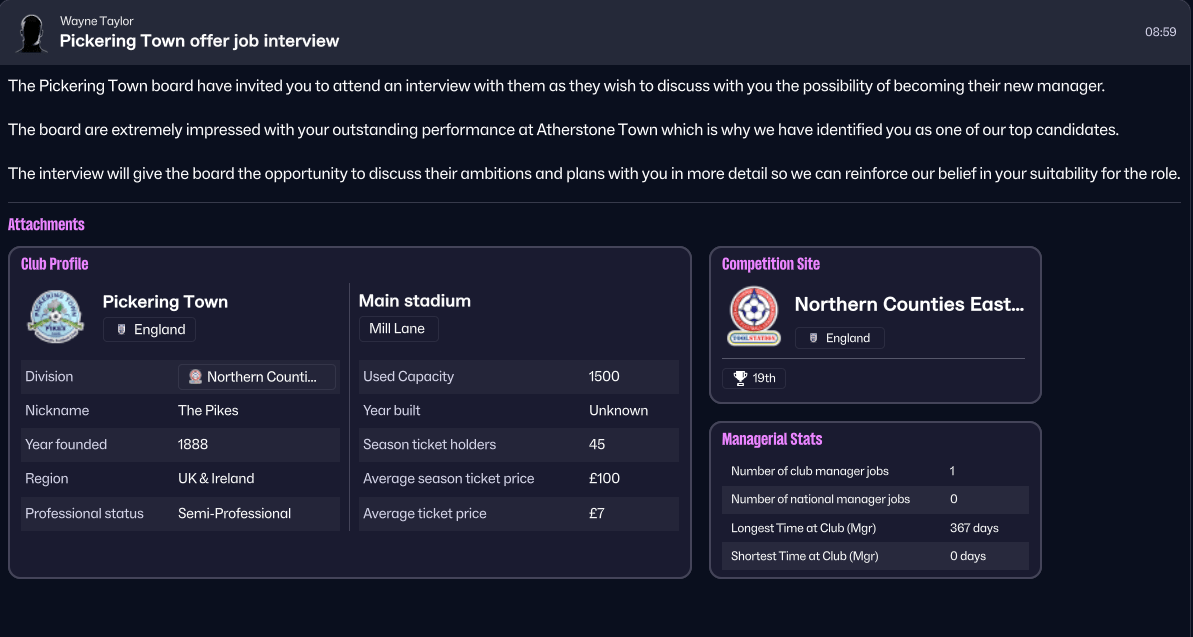
The second approach came from Pickering Town, a men’s side in the Northern Counties East League. Another club impressed by what was happening at Sheepy Road, another opportunity to test himself in a different environment.
Howarth politely rejected both. The timing wasn’t right. There was unfinished business in Warwickshire, a promotion race to fight, a group of players who had bought into everything he was trying to build. Walking away now would have felt like betrayal. The approaches were noted, filed away, and the focus returned to what mattered: the next game, the next three points, the next step towards something special.
Comings and Goings
The January window brought movement, as it always does.
Lewis Collins, who had been such an important figure during the promotion campaign from step five, departed for New Milton Town in a deal worth £800. It wasn’t a fortune, but at this level every penny counted. Collins had found opportunities limited in the first half of the season, and a move to the Wessex League Premier Division offered him regular football. Since arriving at his new club, he’d notched two goals in five appearances—proof, if any were needed, that he remained a capable player at this level. Howarth wished him well and meant it.
Jack Worrall followed Collins out the door, joining Barking on a free transfer. The move happened late in the window, and he was yet to feature for his new side.
Coming the other way was Jack Swales, a twenty-year-old right-back with potential written all over him. The coaching staff had been tracking him for some time, and when the opportunity arose in early January, Howarth moved quickly. Swales had made two appearances since arriving, looking composed and confident in both. At 6’1″ with pace to burn and a heading ability that belied his age, he looked like a player who could develop into something special. His potential ability had been assessed as Regional Premier Division standard—a significant step up from where Atherstone currently found themselves. If the club could hold onto him, they might have unearthed a gem.

The Run-In Begins
November had ended with a professional 1-0 victory at Coleshill Town, Chris Cowley’s 78th-minute strike proving the difference. The kind of ugly, scrappy away win that promotion-chasing sides simply have to grind out. A hundred and nineteen travelling supporters made the short trip to Pack Meadow, and they were rewarded with three hard-earned points.
A frustrating 1-1 draw at home to Loughborough Students followed. Luke Murphy gave Atherstone the lead on 15 minutes, but Alan Carey’s equaliser on 48 ensured the points were shared. Two hundred and twenty-nine souls braved Sheepy Road that afternoon, and most left feeling the Adders should have done better.
Atherstone Town 3-3 Shepshed Dynamo

Saturday, 19 December 2026. A match that had everything.
Mitchell Woakes opened the scoring after just 5 minutes, a finish that had Sheepy Road believing an early Christmas present was on its way. But Shepshed hit back through Jude Collins on 15 minutes, and suddenly it was game on. Andrew Jones-Woods restored the advantage on 20 minutes, and at 2-1 the hosts looked comfortable.
They weren’t. Cyprien Mtenga equalised on 40 minutes, and four minutes into the second half, Cuba Meyer converted from the penalty spot to give Shepshed a 3-2 lead. The home faithful, two hundred and fifty-three of them packed into the ground, fell silent.
What followed was forty-five minutes of siege warfare. Atherstone threw everything at Shepshed, wave after wave of attacks, but the visitors held firm. Until the 90th minute. Will Houghton, who had been threatening all afternoon, finally found the breakthrough. 3-3. A point rescued from the jaws of defeat, but two points dropped from a winning position. Howarth’s emotions were mixed, to say the least.
The festive period brought better fortune. A trip to AFC Rushden & Diamonds on Boxing Day produced a comprehensive 3-1 victory. Luke Murphy opened the scoring on 16 minutes, Charlie Filer doubled the advantage on 48, and although Jordan Graham pulled one back for the hosts on 61 minutes, Filer’s second of the afternoon on 75 minutes sealed a comfortable away win. Four hundred and eighteen spectators watched the action at Chelveston Road, with nine brave souls making the journey from Atherstone.
The new year began in spectacular fashion. Mickleover visited Sheepy Road on 2 January 2027, and Charlie Kirk put on a masterclass. Goals on 38 and 39 minutes—a quickfire double that left the visitors shellshocked—had the home crowd on their feet. Andy Dales pulled one back on 54 minutes, but Charlie Filer added a third on 74 minutes to seal a 3-1 victory. Two hundred and forty-one supporters were in attendance, and they witnessed Kirk at his devastating best.
Darlaston Town 4-2 Atherstone Town
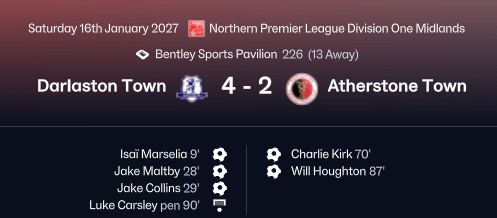
Saturday, 16 January 2027. A harsh return to reality.
The trip to Bentley Sports Pavilion started disastrously. Isaï Marselia gave the hosts the lead on 9 minutes, and when Jake Maltby added a second on 28 minutes, alarm bells were ringing. Jake Collins made it 3-0 a minute later, and the game was effectively over before half-time.
Howarth’s half-time team talk clearly had some effect. Charlie Kirk pulled one back on 70 minutes, and Will Houghton added a second on 87 minutes to make the scoreline more respectable. But Luke Carsley—yes, that Luke Carsley, son of England Under-21s manager Lee Carsley—converted a penalty on 90 minutes to round off a chastening afternoon for the visitors. 4-2 the final score, and plenty for Howarth to address in training the following week.
A week later, Eastwood visited Sheepy Road and inflicted more pain. Lloyd Smith scored twice, on 48 and 56 minutes, and although Rio Connell’s stoppage-time strike on 90+2 gave the scoreboard a more flattering look, it couldn’t disguise a 1-2 home defeat. Two hundred and thirty supporters left Sheepy Road that afternoon wondering where the Atherstone side from earlier in the season had gone.
The answer, of course, was that they were still there. They just needed reminding.
The Oval: A Derby Day Statement
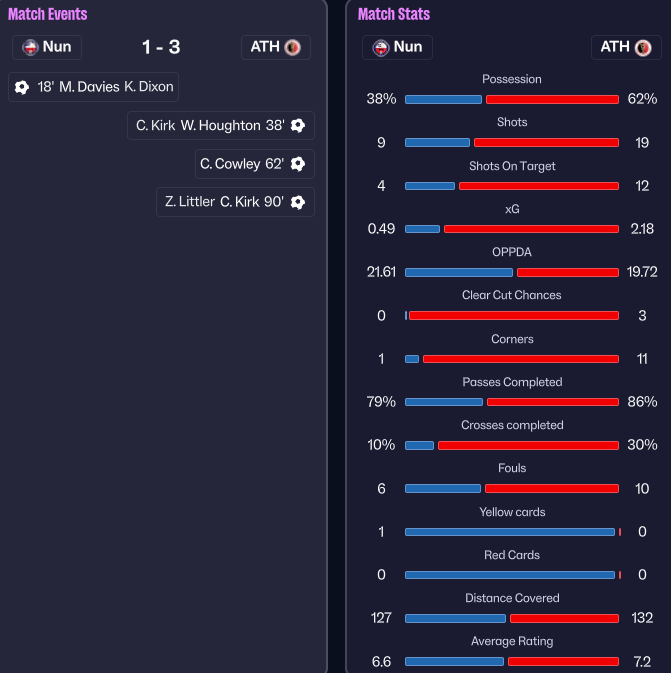
Nuneaton Town 1-3 Atherstone Town
Saturday, 30 January 2027. The Oval. Eight hundred and forty-four spectators crammed into the ground, one hundred and thirty-seven of them in the away end, their green and white scarves a defiant splash of colour in a sea of blue.
This was the fixture that mattered. Local bragging rights, yes, but so much more than that. Nuneaton Town, who had sat second in the table when the two sides met at Sheepy Road back in September, had endured a catastrophic collapse. From promotion contenders to seventh place, their season unravelling in a series of inconsistent performances and dropped points. The home crowd arrived expecting a response, a statement, something to suggest the Boro could salvage their campaign.
They got a statement, alright. Just not the one they wanted.
Nuneaton started brightly, and when Max Davies fired home on 18 minutes, the home faithful roared their approval. The young centre-back, taking advantage of a defensive error from Rio Connell, struck an accurate finish from twenty yards. 1-0, and the momentum appeared to be with the hosts.
It didn’t last. Atherstone absorbed the pressure, regrouped, and on 38 minutes found their equaliser. Will Houghton, who had been growing into the game with every passing minute, unleashed a powerful effort from twenty-five yards that gave the Nuneaton goalkeeper no chance. The away end erupted. 1-1, and suddenly Atherstone looked the more likely winners.
The second half was a masterclass in game management. Atherstone controlled possession, restricted Nuneaton to half-chances, and waited patiently for their moment. It arrived on 62 minutes. Chris Cowley, playing in a deeper central midfield role, received the ball on the edge of the box, took a touch to set himself, and placed a shot into the bottom corner from close range. Clinical, composed, and utterly deserved. 2-1 to the visitors.
Nuneaton pushed for an equaliser in the closing stages, but Atherstone’s defence held firm. And then, on 90 minutes, Charlie Kirk applied the finishing touch. The inside forward, who had been Atherstone’s standout performer all season, found himself in space inside the box and made no mistake with a fine header from point-blank range. 3-1. Game over. The away end was a wall of noise.
The travelling supporters sang long into the evening. Four of their last five away games in the league had ended in victory, and this one—against their local rivals, at their place, with so much at stake—tasted sweeter than any of them.
Where Things Stand

Thirty games played. Fifty-five points. Third place.
The numbers told a story of resilience. Sixteen wins, seven draws, seven defeats. Fifty-four goals scored—the joint-highest in the division. Forty-two conceded—more than Howarth would have liked, but acceptable given the attacking philosophy that had served them so well.
Long Eaton United led the way on fifty-six points, their consistency proving the difference at the top. Corby Town, level on points with Atherstone but ahead on goal difference, occupied second. Grantham Town and Bedworth United lurked on fifty-three, RC Warwick on fifty. The promotion places remained wide open.
And Nuneaton? The side who had looked certain to challenge for the title back in the autumn? Seventh, on forty-seven points, their season fading into mediocrity. The contrast with Atherstone’s trajectory could not have been starker.
Twelve games remained. Twelve opportunities to write the next chapter of an already remarkable story. The doubters had predicted relegation. The bookmakers had written them off before a ball was kicked. And yet here they were, in the thick of a promotion race, with everything still to play for.
The Adders were not going away. Not yet. Not without a fight.



 The Gaffers Lounge
Leave a comment