

The summer of 2026 arrived with equal measures of excitement and trepidation. Promotion had been achieved—Atherstone Town were Northern Premier League Division One Midlands footballers now—but Paul Howarth knew the celebrations would need to be brief. Step four represented a significant jump in quality, and strengthening the squad wasn’t optional. It was survival.
The problem? So was everyone else. Every club at this level was scrambling for the same limited pool of talent—released pros looking for one more year, ambitious youngsters stepping up from county leagues, journeymen willing to travel for an extra fifty quid a week. The competition was fierce, the budgets tight, and the rejections plentiful.
Paul spoke to over twenty players during the summer window. Some chose clubs closer to home. Others wanted wages Atherstone simply couldn’t afford—£200, £250 per week for step-four football, money that would cripple a community club operating on modest gates and volunteer labour. A few just plain refused, unconvinced by the project or uninterested in dropping down a level even if it meant regular football.
But Paul persevered, and eventually secured several new faces, all on free transfers.
The New Arrivals
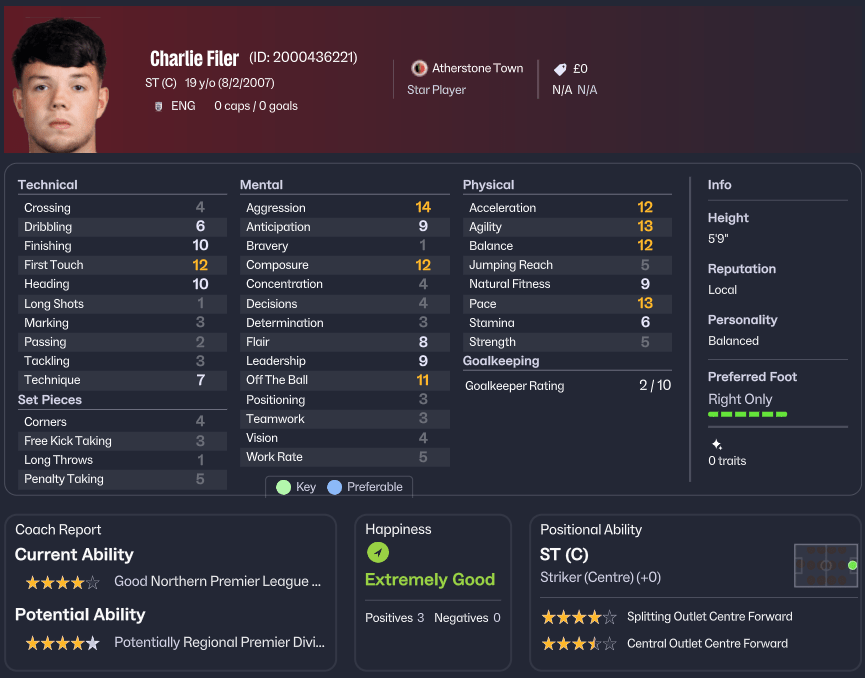
Charlie Filer arrived as a genuine coup. The 19-year-old striker came with a reputation—quick, technically gifted, and with an eye for goal. Standing 5’9″ with excellent first touch (12) and composure (12), he offered something different to the existing forward line. His potential was rated as possibly reaching Regional Premier Division standard, exactly the kind of player who could make a real difference at this level. On a free transfer with no wages attached, it was a no-brainer.
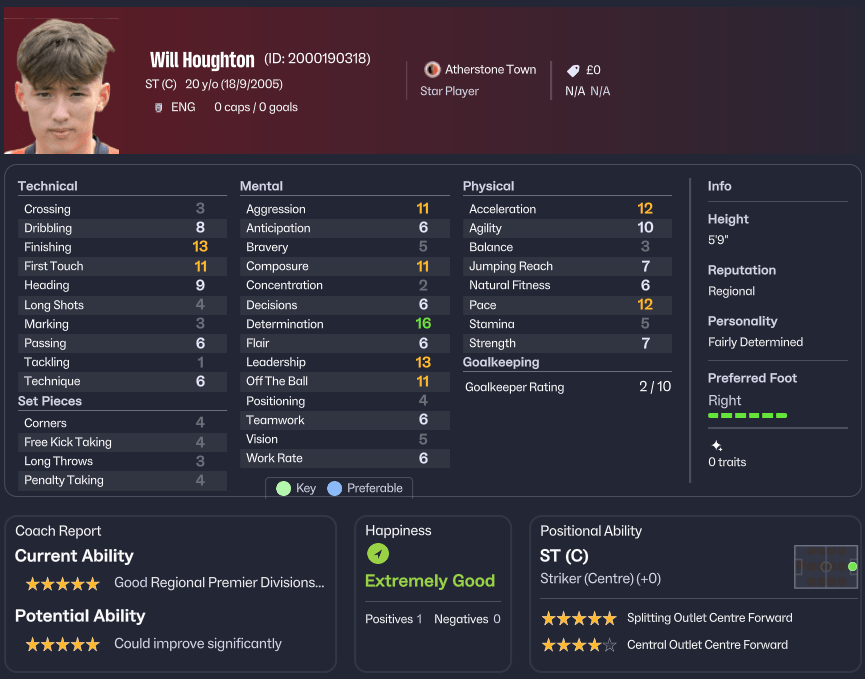
Will Houghton, also 19, joined as another striker option. Standing 5’9″ with decent physical attributes (12 acceleration, 10 agility, 12 pace), he brought energy and work rate. His finishing (13) stood out immediately—unusual for someone his age at this level—and his determination (16) suggested a player who’d fight for every ball. Normally I wouldn’t go for a player with such low natural fitness (6) but I felt he could still do a job. Like Filer, he arrived on a free with no wage demands. Another smart piece of business.
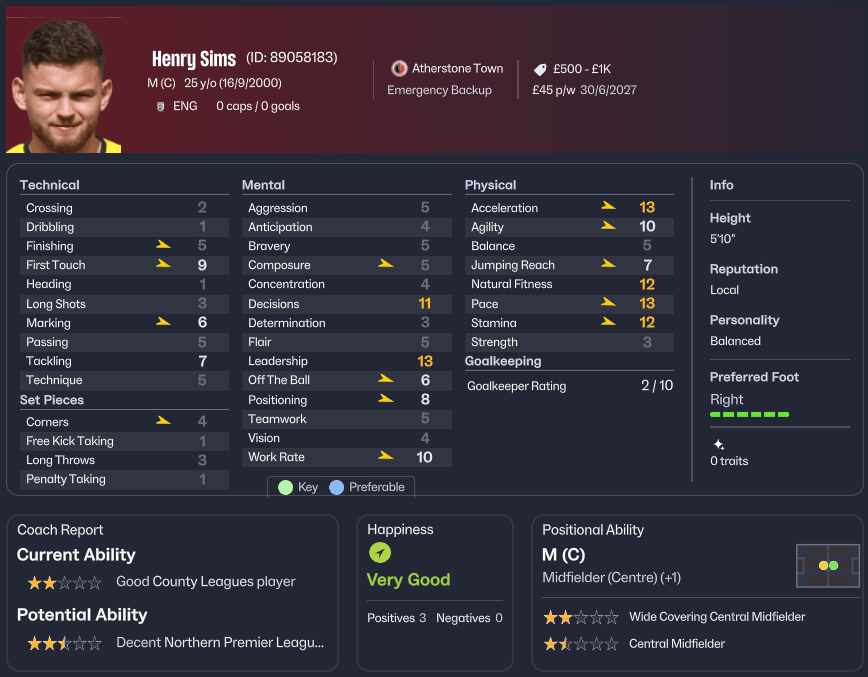
Henry Sims, a 26-year-old central midfielder, added experience and versatility. Standing 5’10” with good leadership (13) and work rate (10), Sims was the kind of player every step-four side needed—reliable, disciplined, capable of filling in multiple positions. His reputation was local, his wages modest, and his attitude exemplary. Exactly what Paul needed to shore up a midfield that looked dangerously thin.
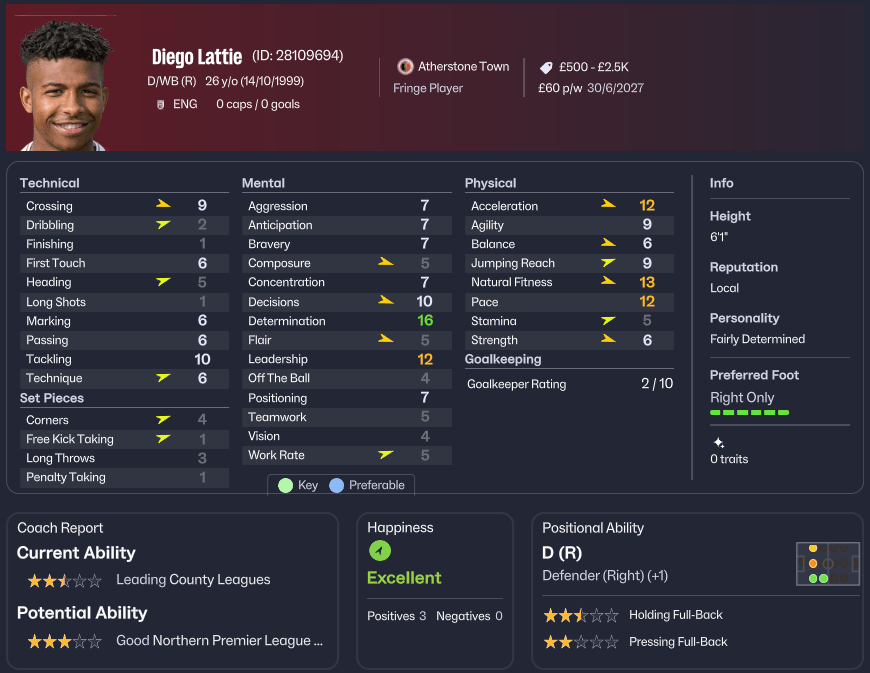
Diego Lattie, a 26-year-old right-back/wing-back, arrived to provide defensive cover. Standing 6’1″ with excellent natural fitness (13) and decent pace (12), he offered physicality down the right flank. His crossing (9) and marking (6) needed work, but at this level, you took what you could get.
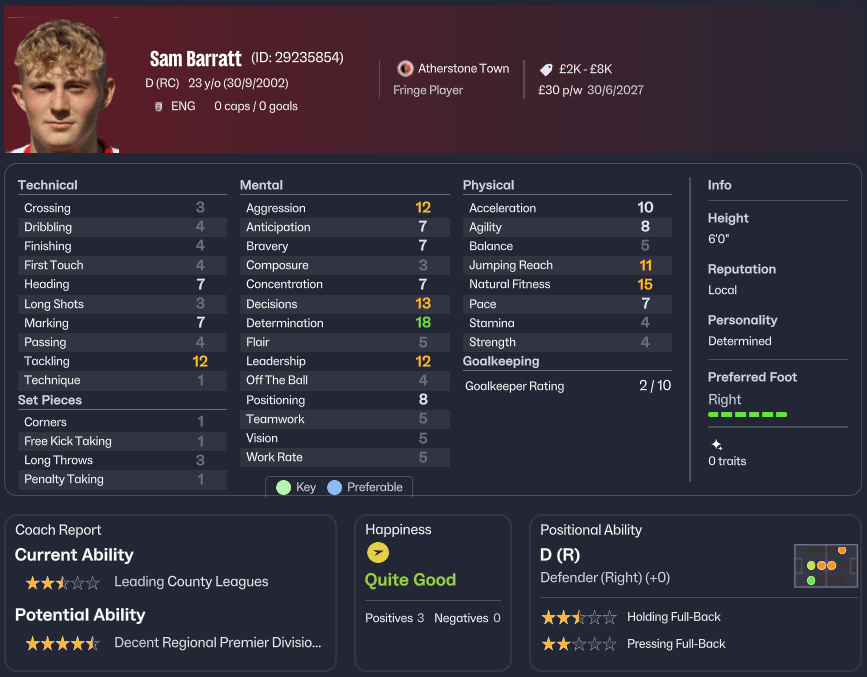
Sam Barratt, a 23-year-old right-back, came in as additional defensive cover. Standing 6’0″ with good natural fitness (15) and jumping reach (11), he was physical, determined (18), and willing to do the dirty work. His tackling (12) stood out—crucial for a defender—and his personality (determined) suggested someone who wouldn’t shy away from the step up. Another free signing on £30 per week.
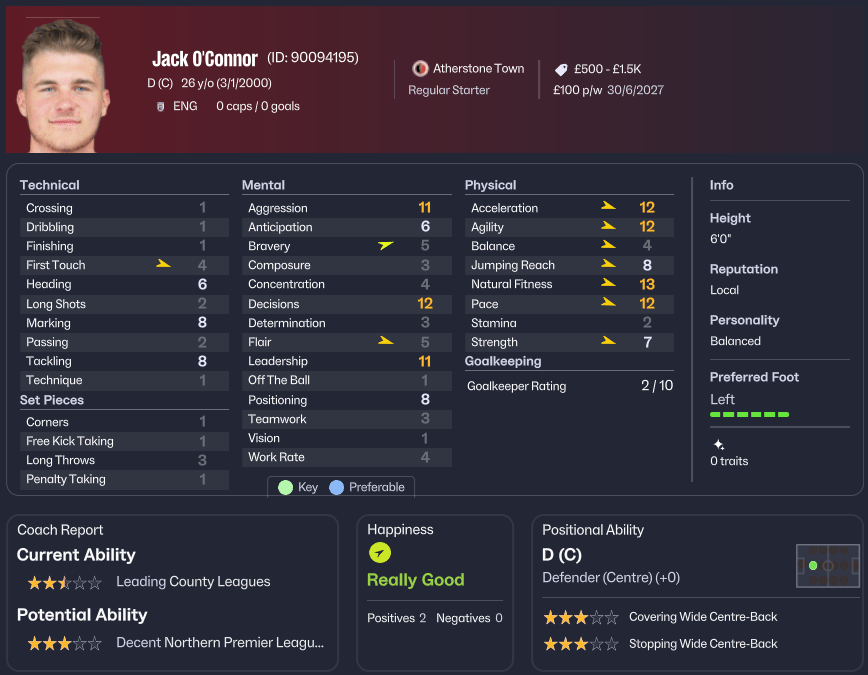
Jack O’Connor, a 26-year-old centre-back, provided experience at the heart of defence. Standing 6’0″ with excellent natural fitness (13), decent pace (12), and good aerial ability (jumping reach 8), he ticked the boxes for a step-four defender. His leadership (11) meant he could organise those around him, and his versatility (able to play right-back in a pinch) offered tactical flexibility. On £100 per week, he was affordable quality.
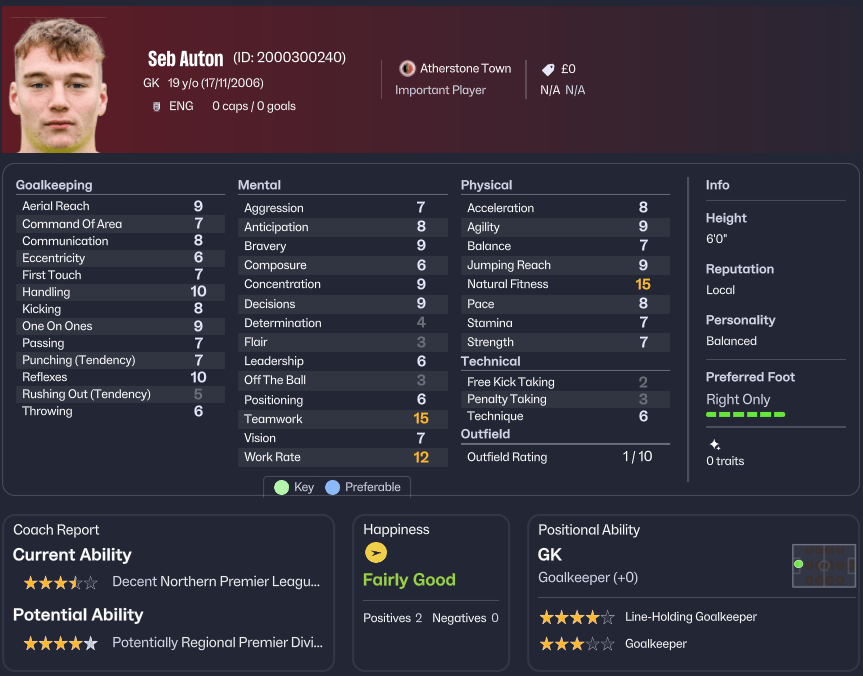
Seb Auton, a 19-year-old goalkeeper, joined as backup to Billy Bishop. Standing 6’0″ with decent reflexes (10) and handling (10), he arrived with potential to develop into a good Northern Premier League keeper. Young, hungry, willing to learn—exactly what you wanted in a number two. On a free with no wages, it was risk-free recruitment.
Seven signings, all free transfers, all on modest wages or none at all. It wasn’t spectacular, but at this level, it didn’t need to be. Paul had identified gaps—defensive depth, midfield options, striking competition—and addressed them within budget. Whether it would be enough remained to be seen.
Pre-Season: A Mixed Bag
Pre-season brought three wins, one draw, and one defeat across five friendlies. Nothing to write home about, but enough to suggest Atherstone wouldn’t be completely out of their depth. The new signings integrated reasonably well, though it was obvious some would need time. Filer and Houghton looked lively up front, Sims added solidity in midfield, and the defensive reinforcements… well, they tried.

The concern was obvious: Atherstone were shipping goals. Even against lower-league opposition in friendlies, defensive organisation looked shaky. The back four struggled to cope with pace and movement, communication was patchy, and Billy Bishop—excellent last season—suddenly looked vulnerable to crosses and set pieces. It was something Paul would need to address quickly once competitive football began.
FA Cup: Ashington Away (Won 3-2)
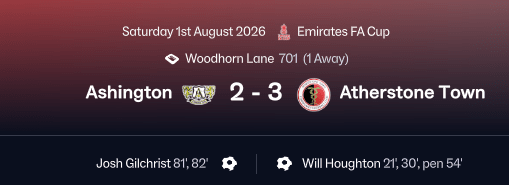
The season opened not with a league fixture but an FA Cup preliminary round tie away at Ashington, a side from the Northern Premier League Division One East—Atherstone’s sister division at step four. It was a chance to test themselves against equivalent opposition before the league campaign began.
For 82 minutes, it looked comfortable. Will Houghton announced himself emphatically, scoring twice—21 minutes and 30 minutes—before converting a penalty on 54 to make it 3-0. Atherstone were cruising, controlling possession, creating chances. Job done.
Then Ashington rallied late on. Josh Gilchrist pulled one back on 81 minutes, and suddenly the away side sensed an unlikely comeback. They grabbed a second immediately on 82 minutes, making it 3-2 and setting up a nervy final few moments. But Atherstone held on, securing passage to the next round despite a wobbly finish.
The final score—3-2 to Atherstone—represented both promise (three goals away from home, Houghton’s hat-trick on debut, progression in the cup) and concern (nearly collapsing from 3-0 up, defensive vulnerability). It was a sign of things to come.

League Opener: Wellingborough Town (Won 1-0)

The opening league fixture brought Wellingborough Town to Sheepy Road on a warm Wednesday evening. The attendance—239—was modest, but the atmosphere was expectant. This was step-four football.
Charlie Filer marked his competitive debut with the only goal on 73 minutes, a composed finish that settled nerves and secured three points. More importantly, Atherstone kept a clean sheet—their first of the season—suggesting perhaps the defensive issues weren’t terminal. The performance was solid if unspectacular, exactly what you needed from an opening-day fixture.
But the signs were there: this was a step up. Wellingborough pressed higher, moved the ball quicker, and exploited space more intelligently than anything Atherstone had faced in the United Counties League. The one-goal margin felt precarious throughout.
Loughborough Students Away (Lost 3-1)
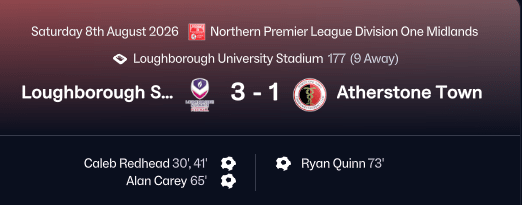
Reality arrived swiftly. Away at Loughborough University Stadium—a proper ground with stands, floodlights, and an attendance of 177—Atherstone were taken apart. Caleb Redhead and Alan Carey ran the midfield, dictating tempo, finding space, and creating chances with ease. Loughborough scored on 30 minutes, 41 minutes, and 65 minutes. Ryan Quinn’s 73rd-minute goal was scant consolation.
Atherstone never got going. They chased shadows for long periods, struggled to retain possession, and looked a level below their opponents. It was a harsh lesson in the margins at step four—one poor performance and you’re three-nil down before you’ve had a chance to breathe.
Anstey Nomads Home (Drew 1-1)
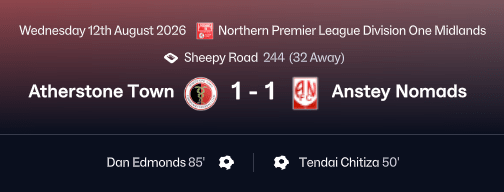
Back at Sheepy Road, Atherstone hosted Anstey Nomads in front of 244 supporters. It looked like defeat beckoned when Tendai Chitiza gave Anstey the lead on 50 minutes, but Dan Edmonds—off the bench—rose highest to head home an equaliser on 85 minutes, rescuing a point.
The draw felt like a miracle, Anstey had performed to a very high standard and we were lucky not to be two or three down by the time we scored.
FA Cup: AFC Rushden & Diamonds Home (Won 5-4)

Then came madness. AFC Rushden & Diamonds visited Sheepy Road for an FA Cup preliminary round tie (attendance: 826—easily the biggest crowd of the season so far), and what followed was ninety-four minutes of absolute chaos.
Mitchell Woakes gave Atherstone the lead on 3 minutes. Tyler Winters equalised on 45+1, right on half-time. Straight from the second-half kick-off, on 46 minutes, Andrew Jones-Woods fired Atherstone back in front. Dan Edmonds made it 3-1 on 61 minutes, Will Houghton added a fourth on 69, and at 4-1 with twenty minutes remaining, the tie looked done.
Then Rushden remembered they were a football team. Carlos Moreira scored on 78 to make it 4-2. Charlie Filer—on as a substitute—extended the lead to 5-2 on 88, surely killing the contest. But Rushden refused to die. Winters scored again on 90+3, Max Beech made it 5-4 on 90+4, and suddenly Sheepy Road was gripped by panic.
Atherstone held on—just—but the match perfectly encapsulated their season so far: thrilling going forward, terrifyingly vulnerable at the back.
League: AFC Rushden & Diamonds Home (Won 2-0)
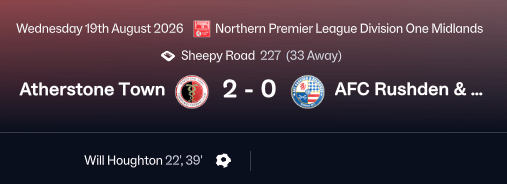
Four days later, the same opponents returned to Sheepy Road for a league fixture. This time, Atherstone delivered a far more controlled performance. Will Houghton scored twice—22 minutes and 39 minutes—and the defence held firm for a 2-0 victory that felt significantly more professional than the FA Cup thriller.
The attendance—227—was considerably smaller than Saturday’s cup tie, but the performance was what mattered. Atherstone looked composed, organised, and crucially, defensively solid. Perhaps the step up was manageable after all.
Early Season Assessment
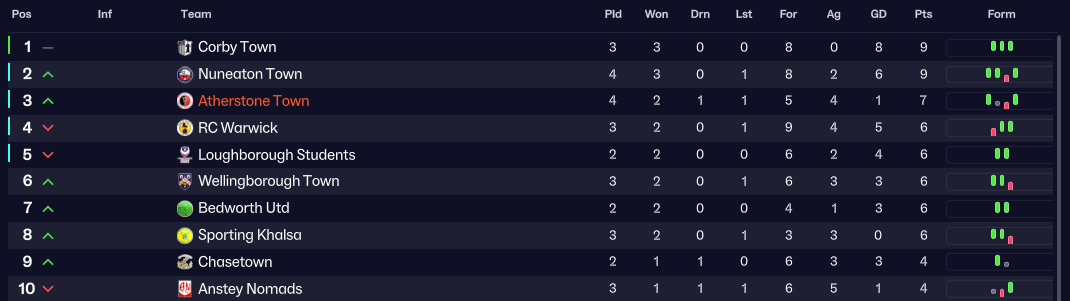
After four league matches, Atherstone sat third in the Northern Premier League Division One Midlands with seven points: two wins, one draw, one defeat. Five goals scored, four conceded. It was… acceptable. Not spectacular, but acceptable.
The step up was noticeable. Opponents were quicker, more physical, tactically sharper. Matches felt faster, margins tighter. Defensive fragility remained a concern—conceding from 3-0 up against Ashington, shipping three at Loughborough, struggling to hold leads—but the attacking quality remained intact. Houghton already had five goals, Filer looked promising, and the midfield was creating chances.
The table told an interesting story. Corby Town led with nine points from three matches—perfect start. Nuneaton Town sat second with nine from four. Atherstone were third with seven from four, ahead of RC Warwick (6 points), Loughborough Students (6), and Wellingborough Town (6). Respectable company.
Pre-season predictions had Atherstone finishing in the bottom two—relegation candidates, out of their depth, punching above their weight. After recruitment, that prediction shifted to 15th—mid-table safety, nothing more. So third place, even this early, represented significant overachievement.
But Paul knew better than to get carried away. It was four matches. Thirty-eight remained. The squad depth was paper-thin—one injury in midfield or defence and they’d be scrambling. The defensive issues needed addressing before they became terminal. And the league was relentless—no easy fixtures, no guaranteed wins, every opponent capable of punishing mistakes.
Still, third place after four matches? Not bad for a club supposedly destined for relegation. Not bad at all.
The challenge now was maintaining it.




 The Gaffers Lounge
Leave a comment