

Sports Interactive’s rebuild has stripped out beloved features while adding tools few asked for. After weeks of frustration, I’ve finally found an approach that works.
I had a save where I was at AC Milan, I went looking for the Development List and couldn’t find it. I spent twenty minutes clicking through menus, convinced I was missing something obvious. Then I checked the forums. Hundreds of other players were asking the same question: where has it gone?The answer, it turns out, is nowhere. It’s simply not there anymore. This feature—which allowed you to flag youngsters for loan consideration and have your staff automatically field suitable offers—has vanished without explanation. No patch note, no acknowledgment, just an empty space where a genuinely useful tool used to live.
This discovery set the tone for my first month with FM26. The game Sports Interactive has built is ambitious, occasionally brilliant, and frequently maddening. Nowhere is this tension more apparent than in youth development, where sweeping mechanical changes have disrupted workflows that players have refined over years. Some of these changes represent genuine progress. Others feel like regression dressed up as simplification.
What follows is my attempt to make sense of it all—to understand what FM26 has given us, what it’s taken away, and how to actually develop young players in this new landscape.
What FM26 Has Stripped Away
Let’s start with the absences, because they shape everything else.
The Development List’s disappearance is the most immediately frustrating. Previously, managing a large youth setup involved flagging players as ‘available for development loan’ and letting your backroom staff handle the grunt work. They’d evaluate incoming offers, filter out the unsuitable ones, and present you with reasonable options. It wasn’t perfect, but it reduced administrative burden significantly. Now, every loan enquiry demands manual attention. If you’re running a save with thirty-plus academy players—entirely normal for a top-flight club—this becomes genuinely tedious.
More significant, though less immediately obvious, is the removal of direct training control for B teams, reserves, and youth squads. In previous editions, obsessives like myself could craft bespoke training schedules for every tier of the club, ensuring that each age group worked on precisely what they needed. FM26 has eliminated this entirely. You can still set individual training focuses for specific players, but the broader schedule—the rhythm of physical conditioning, tactical work, technical sessions—is now handled automatically by your staff.
Sports Interactive’s logic here is presumably about reducing complexity and preventing information overload. But for those of us who derived satisfaction from that granular control, it feels like having a limb removed. The academy was my domain; now parts of it operate behind a curtain I cannot lift.
Where FM26 Actually Improves Things
Complaining is easy. Acknowledging progress requires more honesty. And FM26 does offer genuine improvements to how youth development functions.
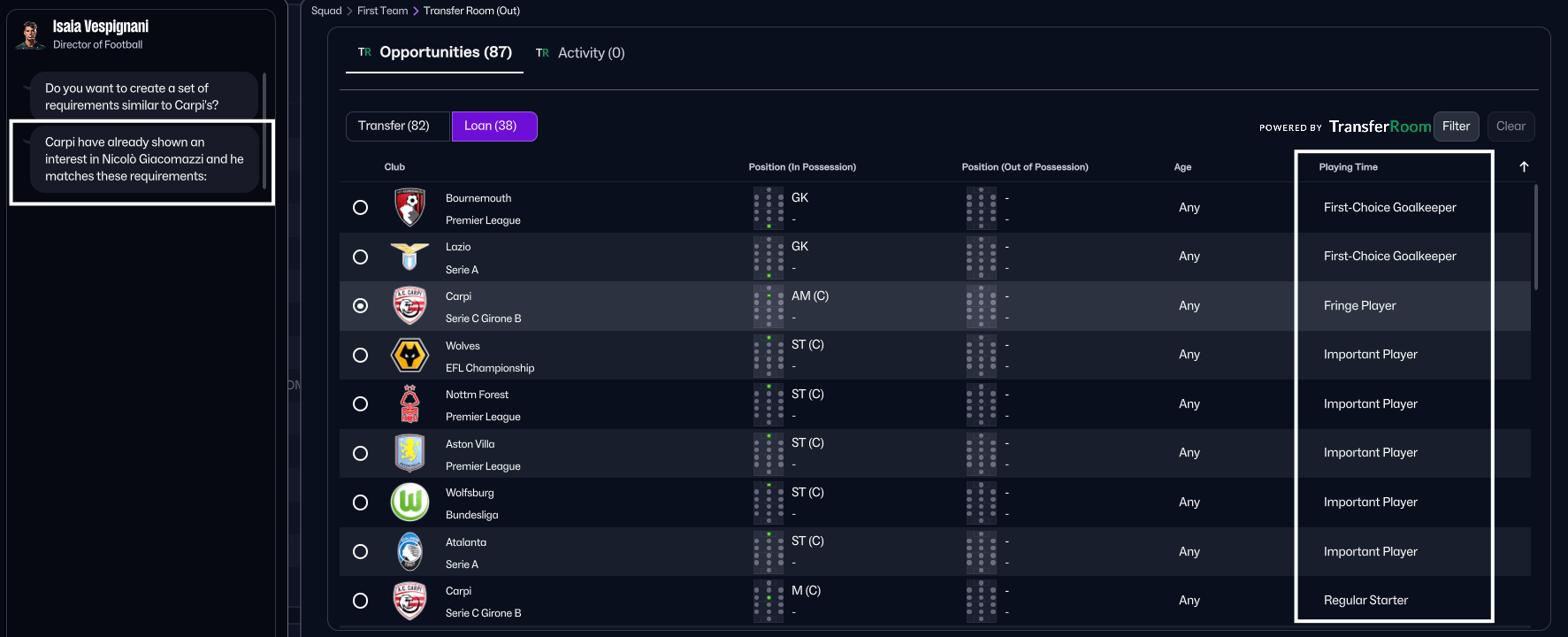
The standout addition is the TransferRoom integration, specifically the Pitch Opportunities feature. This allows you to browse what other clubs are actively seeking in the transfer market—position, role, expected playing time, transfer type—and offer matching players directly. For loan management, this is transformative. Rather than listing a player and hoping someone bites, you can identify clubs whose stated needs align with your available youngsters and approach them proactively.
I’ve found this particularly valuable for those awkward in-between players: the 19-year-old winger who’s too developed for youth football but not quite ready for Serie A. Previously, finding him an appropriate Serie B destination involved guesswork and patience. Now, I can filter for clubs seeking a wide forward on loan, willing to offer regular playing time, and make targeted pitches. The success rate is noticeably higher.
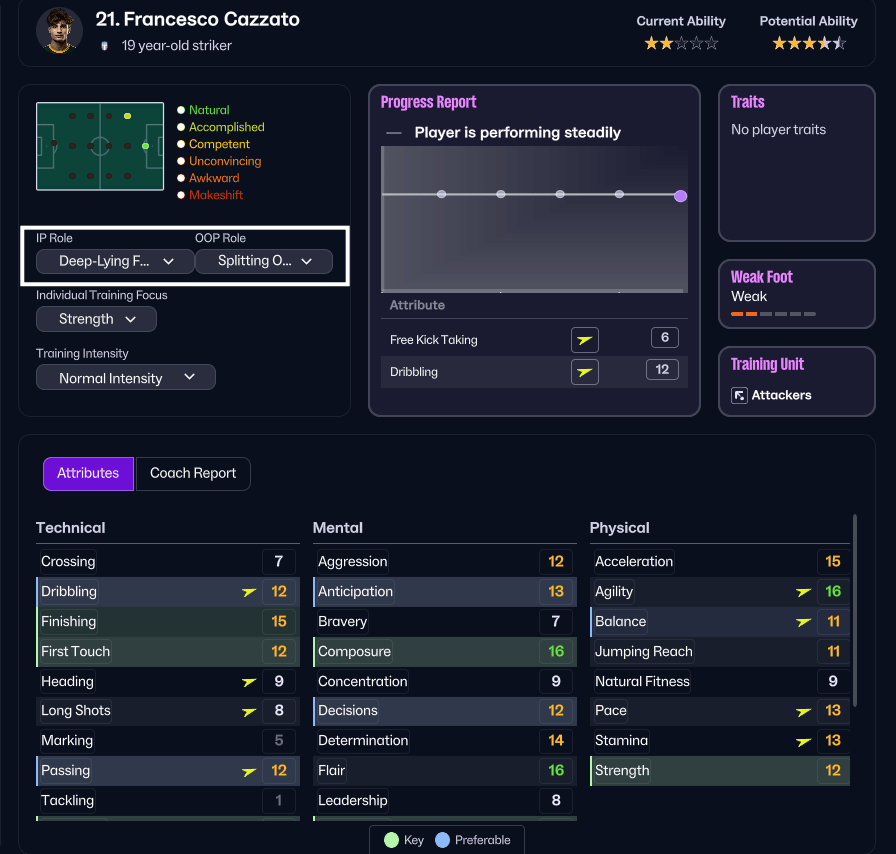
The dual-phase tactical system—setting distinct roles for in-possession and out-of-possession play—extends beautifully into individual training. You can now train a youngster as a ball-playing defender when your team has the ball but as a traditional centre-back without it. This mirrors how modern football actually works, where players occupy different spaces and perform different functions depending on game state. For development purposes, it allows you to build genuinely versatile profiles rather than specialists locked into single roles.
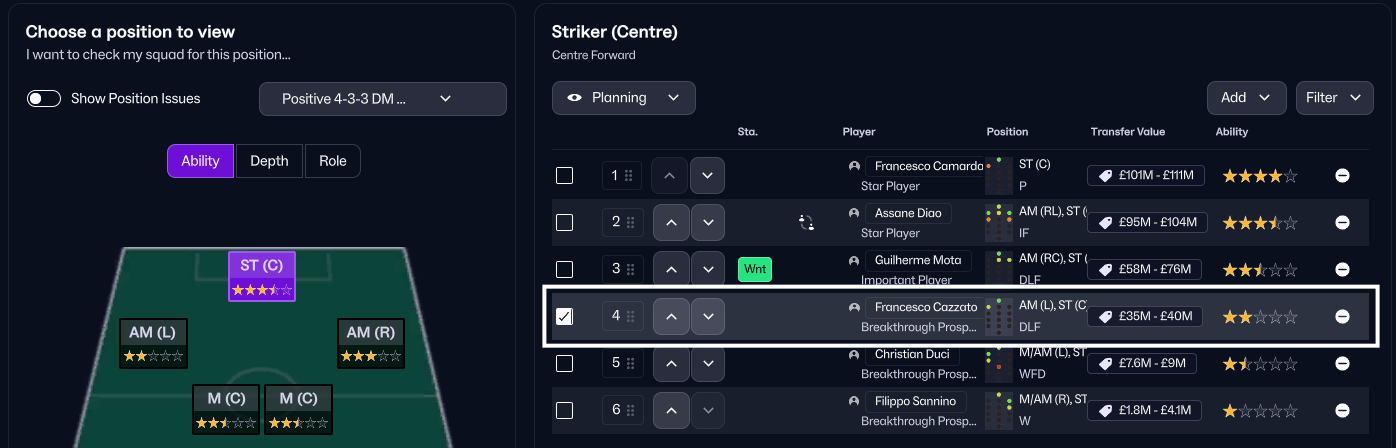
The Squad Planner has also been refined. Dragging youth players into projected future squads, seeing precisely where they’d slot relative to existing options, helps crystallise decisions about who merits continued investment and who might be better served by a move elsewhere. It’s not new functionality, exactly, but the interface improvements make it more intuitive to use as a genuine planning tool rather than an afterthought.
How Development Actually Works Now
Understanding what’s changed is one thing. Adjusting your approach to succeed within those constraints is another. After considerable trial and error, here’s what I’ve learned about nurturing talent in FM26.
Staff Quality Matters More Than Ever
With direct training control removed, the quality of your coaching staff becomes the primary lever you can pull. Every coaching slot should be filled. Every vacancy represents development potential left on the table. Your Head of Youth Development shapes intake profiles—their preferred formation influences what positions emerge each year—so alignment with your tactical philosophy matters. Sports scientists reduce injury risk; physios improve recovery times; both keep youngsters on the pitch where growth actually happens.
I’ve started treating coaching recruitment with the same seriousness as player recruitment. Scouting for a world-class youth coach yields returns over years, not months, but those returns compound. A marginal improvement in daily training quality, multiplied across dozens of players and hundreds of sessions, produces measurably better outcomes.
The Age-Specific Approach Still Applies
FM26 hasn’t altered the underlying mathematics of how attributes develop. Physical attributes peak earlier—typically between 23 and 27—while mental attributes can improve well into a player’s thirties. Technical growth sits somewhere between, steady through the twenties if conditions are right.
This means age-appropriate focus remains essential, even if the tools for implementing it have changed. For the 15-to-17 cohort, I set individual training exclusively on physical attributes. These are the years when athletic foundations are built; neglect them and you’re handicapping everything that follows. I assign positional training—defender, midfielder, forward—rather than specific roles. There’s no point sculpting a trequartista when the body underneath is still forming.
Between 18 and 21, the emphasis shifts to technical refinement and role specialisation. Now is when I assign those dual in-possession and out-of-possession roles, when I address weaknesses in passing or first touch, when I begin shaping players for how they’ll actually function in my system.
Beyond 21, if a player isn’t pushing for first-team involvement, honest conversations are needed—with yourself, if not with them. At this stage, training alternates between mental and technical focuses, and trait acquisition becomes relevant. The specific behaviours that distinguish good players from useful ones—shooting early, playing out of trouble, tracking runners—can be embedded through targeted work.
Loans Have Become Non-Negotiable
Here’s the critical realisation: without control over reserve and youth training, competitive loans have become the single most important development tool available. Players aged 18 and above progress faster through matches than through any training regime. Match ratings accelerate attribute growth in ways that youth football simply cannot replicate.
This makes loan destination selection genuinely consequential. A poorly chosen loan—where minutes are sparse or performance craters—can be worse than no loan at all. I evaluate three criteria before agreeing any deal: Will they play regularly? Is the league competitive enough to challenge them? Are they likely to perform well enough to generate positive match ratings?
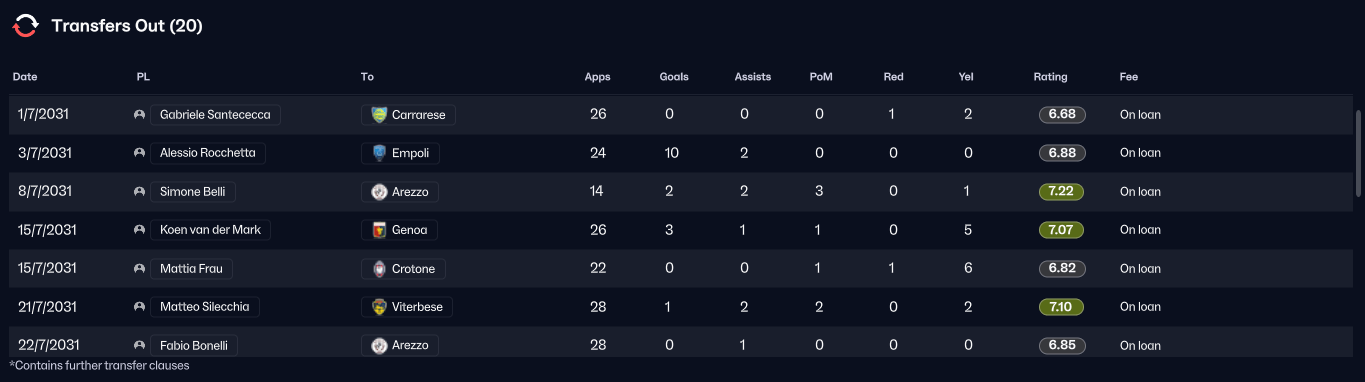
The Pitch Opportunities system helps here, but it’s not a complete solution—especially with the Development List gone. I’ve had to become more proactive, more hands-on, checking loan interest more frequently than I’d prefer. Affiliate clubs provide some automation, and recall clauses are essential insurance, but the administrative burden has undeniably increased.
Personality Screening Saves Years of Wasted Effort
One element FM26 hasn’t changed: personality remains the strongest predictor of whether potential translates into reality. Determination, specifically, correlates more strongly with development than any technical or physical attribute. A moderately talented youngster with exceptional drive will frequently outstrip a gifted player labelled ‘unambitious’ or ‘casual’.
I now screen personality before examining any other attribute during youth intake. ‘Driven’, ‘Model Citizen’, ‘Professional’, ‘Resolute’—these tags warrant attention regardless of current ability. Anything suggesting low ambition or poor work ethic triggers immediate scepticism. You can coach technique; you cannot coach hunger.
Mentoring reinforces this. Pairing impressionable youngsters with determined, professional senior players produces measurable improvements in those personality attributes over time. Rotate the groupings periodically—exposure to different role models broadens influence—but be vigilant about mixing conflicting personalities. One unambitious veteran can poison an entire mentoring group.
The Forgotten Variable
Something I’ve come to appreciate more in FM26 than in previous editions: squad sizes matter enormously for development, and getting them wrong creates invisible damage.
An overstuffed youth squad means nobody receives adequate minutes. If your under-21s contain 28 players, simple arithmetic dictates that most will spend most weeks watching from the bench. Without competitive action, growth stagnates. Yet the instinct—my instinct, certainly—is to hoard promising youngsters, reluctant to release anyone who might eventually develop.I’ve forced myself towards leaner numbers: 15 to 18 players per youth squad, ideally. Enough depth to absorb injuries, trim enough that everyone plays regularly. This requires harder decisions about who stays and who goes, but those decisions need making regardless. Delaying them just wastes developmental runway for everyone involved.
For players who can’t secure loans but don’t fit the trimmed squad—continental youth competitions offer valuable minutes against quality opposition. The UEFA Youth League and its equivalents provide experiences that domestic youth football cannot match. When first-team integration isn’t feasible and external loans aren’t available, these fixtures become the next-best alternative.
Making the Call at 21
Every academy eventually forces a reckoning. By 21, ambiguity should have resolved into clarity: either a player is capable of contributing at first-team level, now or imminently, or they’re not.
The Squad Planner crystallises this assessment. Dragging a 21-year-old into your projected squad reveals precisely where they sit—fourth-choice centre-back with no realistic path to regular minutes, or genuine competitor for a starting role. That information demands action. Sentiment has no place here; blocking a player’s development through misplaced loyalty serves nobody.
What makes this moment particularly interesting in FM26 is the market dynamic. Players at 21 frequently carry valuations exceeding their actual current ability—clubs pay premiums for potential that may never fully materialise. Selling at this age, reinvesting in younger prospects, and restarting the development cycle represents a legitimate strategy. You’re not abandoning these players; you’re recognising that their ceiling might be reached more fully elsewhere, while your resources might be better deployed on the next generation.
For those who do break through, first-team integration requires patience and protection. Late substitutions in comfortable victories; cup starts against lower-league opposition; gradually increasing responsibility as confidence builds. The goal is match sharpness without exposure to pressures they’re not equipped to handle. Get this wrong and you risk damaging players psychologically before they’ve had chance to establish themselves.
Living With the Contradictions
Seven months into that Milan save, a Primavera graduate I’d loaned to Empoli, then brought back and persevered with through a wretched run of form, scored the winner in the Derby della Madonnina. Curled free kick, top corner, San Siro erupting. His story was mine. Every loan negotiation, every training focus, every decision to persist when selling would have been easier—they’d all led here.
This is what youth development offers that the transfer market cannot: authorship. You’re not just assembling a squad; you’re shaping careers, creating histories that wouldn’t exist without your intervention.
FM26 has complicated the process, removed tools I relied upon, forced adaptations I resented making. The Development List’s absence still irritates me. The loss of training control still feels like an unnecessary amputation.
But the fundamental proposition remains intact. Find talent young. Assess character before ability. Build physical foundations early, technical sophistication later. Use loans aggressively once training control is lost. Keep squads lean so minutes flow to those who need them. Make hard decisions at 21 rather than letting sentiment delay the inevitable.FM26 is a game at war with itself—simultaneously more accessible and more frustrating, streamlined in some areas and inexplicably clunky in others. Youth development sits at the heart of that tension. What Sports Interactive has given with one hand, it has taken with the other.
And yet. That moment at the San Siro, that free kick curling in, that academy graduate becoming a legend—FM26 still delivers that. The path there is different now, rougher in places, smoother in others. But the destination remains worth reaching. It always was.

 The Gaffers Lounge
Leave a comment