

Chur’s Relentless Third Act: Structure, Superiority and the Tactical Maturity of a Team Transforming the 1. Liga Classic
Chur’s 2029/30 campaign in the 1. Liga Classic Gruppe 3 has unfolded with a level of control, intensity and statistical dominance that transcends anything produced in the two previous seasons at this level. Under Iñaki Arriola, the club has progressed from an ambitious transitional side into a fully formed tactical machine, one that manipulates space, compresses the pitch and imposes its game model with such clarity that opponents appear trapped in a pre-determined script. The results reflect this with startling simplicity: fourteen wins and one draw from fifteen league matches, twelve successive victories that set a new club record, and performances that are not only cohesive but overwhelmingly territorial, physical and technical. This is not a side surviving the third year of a project; it is one redefining its ceiling.
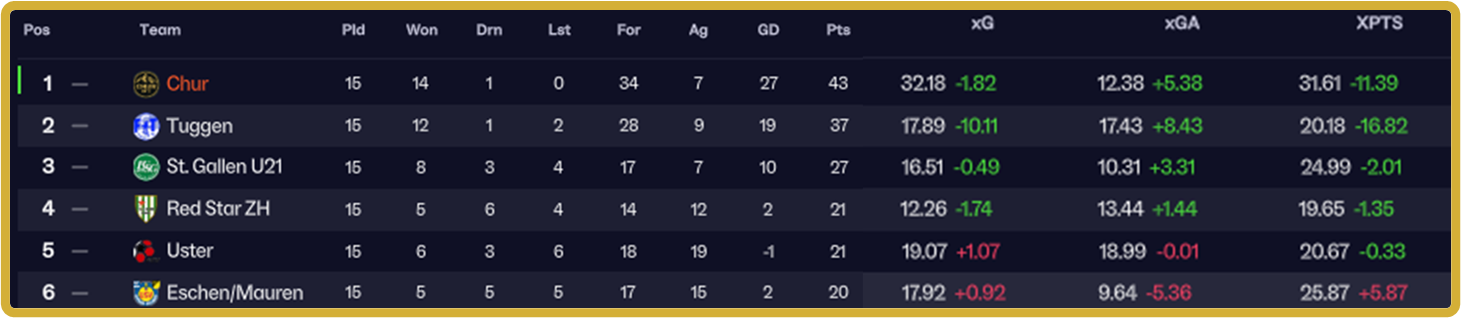
The raw numbers alone sketch a portrait of superiority rarely seen at this level. Chur’s thirty-seven goals exceed their expected total by 1.82, suggesting not a finishing anomaly but a team consistently generating high-quality shots from advantageous positions. At the other end, conceding only seven goals while suppressing over five expected goals demonstrates a defensive structure that no longer relies on reactive interventions but on preventive organisation, intelligent pressing and an ability to control the zones in which opponents are permitted to operate. Their forty-three points represent an overperformance of 11.39 above expected points, a figure that speaks to game state management, the psychological security of early leads and a defensive block that concedes neither territory nor initiative cheaply.
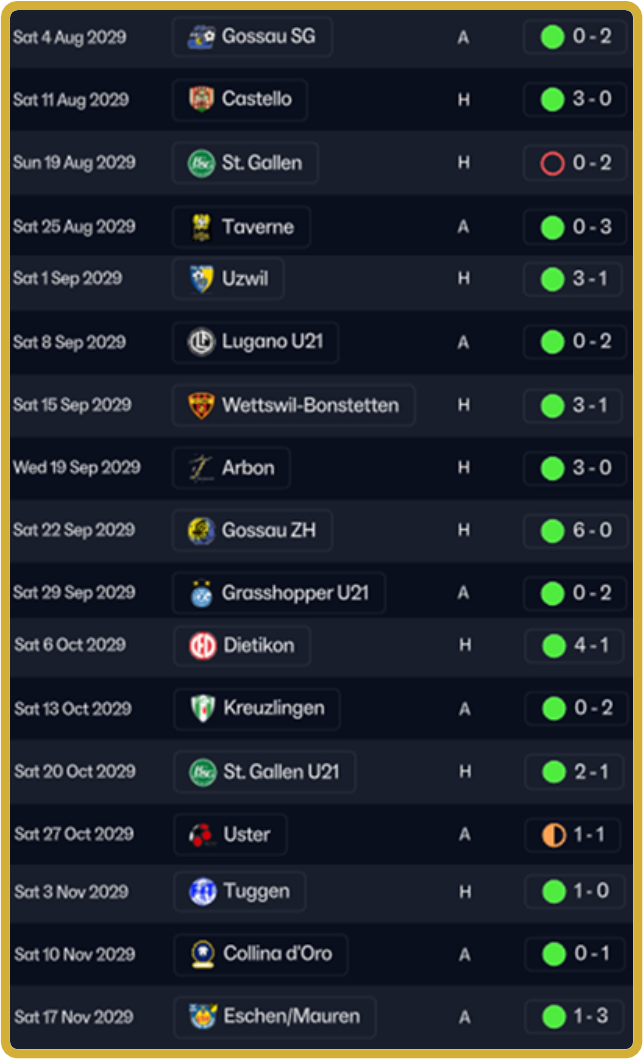
The season’s lone defeat came in the Swiss Cup to St. Gallen’s first team – a full-professional, top-flight opponent whose quality was expected to overwhelm – but Chur’s composed display, particularly in the opening hour, reaffirmed that their tactical principles are robust enough to translate beyond their division. Far from being dissuaded, the squad emerged more convinced of their trajectory, carrying that belief back into the league where the 6-0 home demolition of Gossau ZH and the controlled 3-0 victory away at Taverne marked high points in a campaign already packed with authoritative performances.
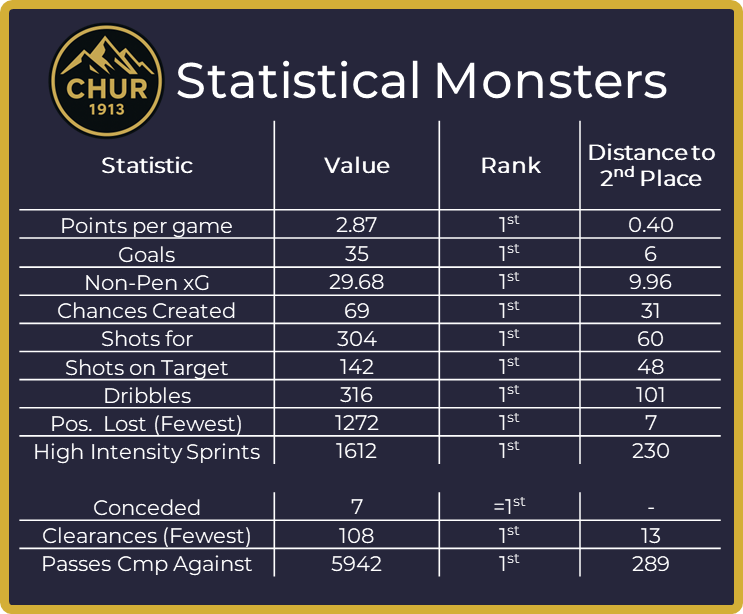
Metrics across the league place Chur not merely ahead of the pack but operating in a different bandwidth of intensity and territorial effectiveness. Their 2.87 points per game outpace the second-placed side by an extraordinary margin of 0.4 points. They lead the league in goals with thirty-five, non-penalty expected goals with 29.68, chances created with sixty-nine, total shots with 304, shots on target with 142 and dribbles with 316. These are not marginal advantages; they are gulfs. Their dribbling differential – 101 more than the second-highest side – reveals a team comfortable in individual duels across all five attacking lanes, a key feature of Arriola’s structure since the wide forwards and advanced full-backs often receive in isolation to force defensive disorganisation. Meanwhile, their low tally of 1,272 possession losses confirms a team that plays at speed but with remarkable technical efficiency, circulating the ball cleanly even while positioned aggressively in the opposition half.
Physically, Chur have separated themselves decisively. Their 1,612 high-intensity sprints, 230 more than the nearest competitor, illustrate a side that has increased its vertical movement and tactical pressing without overextending itself. Despite the elevated sprint numbers, the overall intensity load index has dropped by three percent since 2027/28, a counterintuitive but revealing trend. Chur are expending similar total energy but distributing it more strategically, accelerating in moments that matter – most often in counter-pressing and in the isolated 1v1 actions that define the wide channels. Arriola’s team sprint more, not because they are frantic, but because the structure makes it possible to sprint with purpose.
Defensively, the team has evolved from one that compensated with sheer volume of work to one that shapes the opponent’s choices. The defensive intelligence index has dipped slightly by 1.5 percent over three years, partly because interceptions have declined as Chur press higher, but this is offset by a consistent rise in tackles made in advanced zones. They are recovering the ball more often near the opposition third, reducing transitional distances and controlling rest defence with a far more modern compactness than in the earlier years of the project. Their seven goals conceded – equal fewest in the league – reinforce the point that the defensive block is functioning as a single unit, limiting progression from opponents whose completed passes against Chur total only 5,942, which is significantly lower than the division’s top sides.
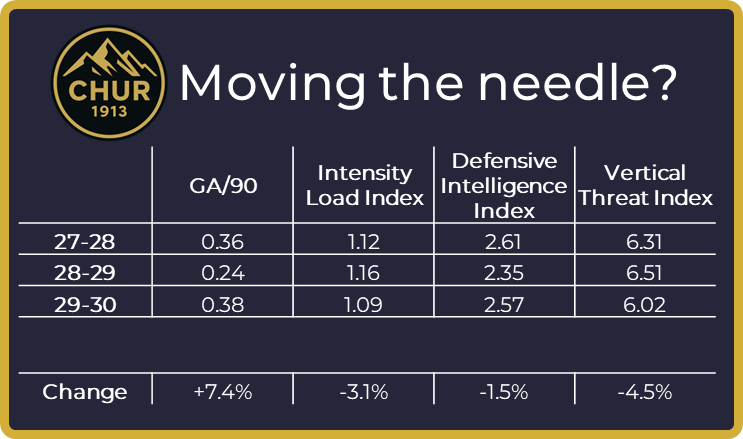
The team’s vertical threat index has decreased by 4.5 percent across three seasons, not through conservatism but because Chur now operate higher by default, meaning the progressive pass count naturally declines when so many sequences begin already inside the final third. When comparing the top four sides, Chur stand apart as the most intense team by a considerable distance. St. Gallen’s second team, often technically tidy in possession, complete far fewer sprints and tend to prioritise circulation over disruption, creating a contrast in game models that only further emphasises Chur’s identity.
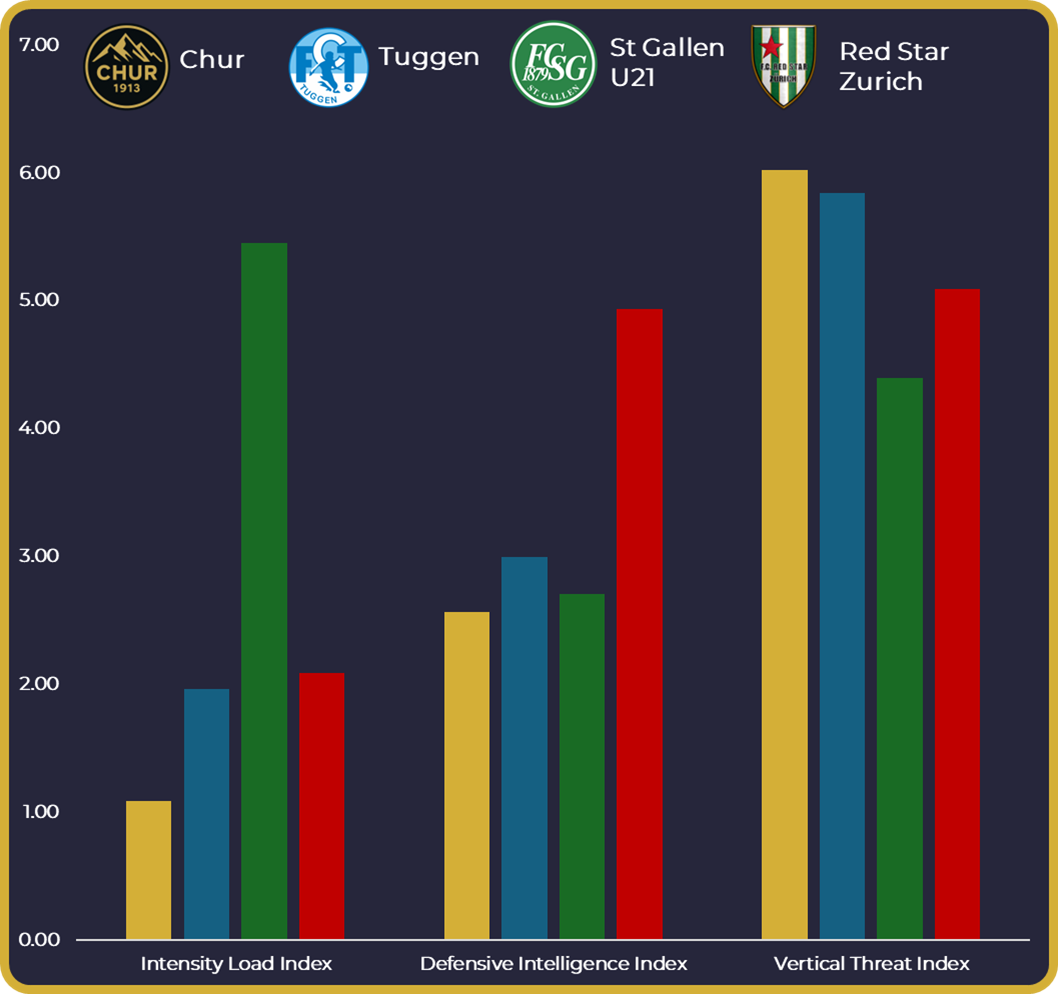
In terms of duelling profile, Chur remain slightly more tackle-reliant than most of their rivals, with volumes comparable to others in defensive zones but significantly higher in offensive areas, where they actively seek to regain possession before opponents can escape the press. Their verticality also surpasses every other side in the top four. While Tuggen rely heavily on wide dribblers and progressive defenders, their final-third progression is far lighter than Chur’s, who consistently place multiple players inside the box during settled possession and maintain structural height through their inverted winger–full-back combinations.
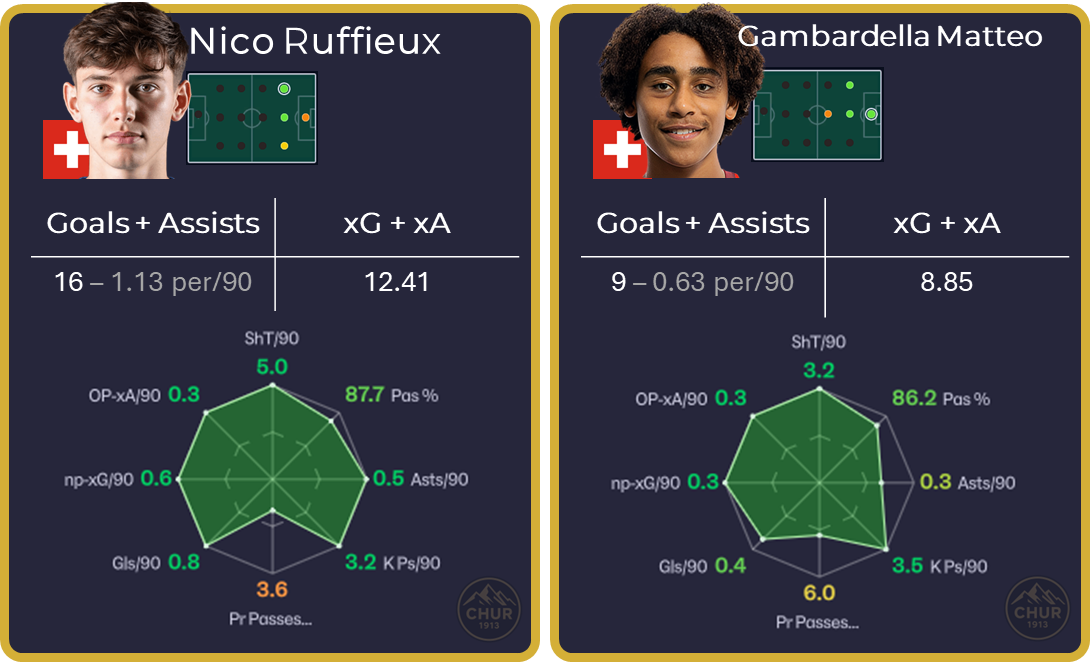
A season of this magnitude inevitably produces standout individuals, and none has defined Chur’s evolution more clearly than Nico Ruffieux. His impact has been immediate and overwhelming, producing over one expected goal contribution per match and accumulating sixteen total goals and assists by the mid-season mark. His versatility within the attacking five allows Arriola to manipulate spacing without sacrificing dynamism, and his metrics – covering progression, threat, shot volume and creative involvement – place him firmly among the division’s elite performers. On the opposite flank, Gambardella Matteo has integrated seamlessly, functioning as the creative counterweight after the departure of Adrian Perez. His ball-carrying, delivery from wide and ability to occupy the interior pocket have restored the balance of Chur’s left-sided rotations, ensuring the system retains its width-to-depth continuity.
As Chur stand at the summit of Gruppe 3, the season reads not as a fortunate surge but as the crystallisation of three years of alignment, conditioning, tactical drilling and incremental evolution. They are more intense than their peers, more vertical, more efficient in possession and more coordinated defensively. Whether this dominance carries them across the line in the title race remains to be seen, but the substance underpinning it is undeniable. Arriola’s Chur have not merely become a winning team; they have become a model, one whose tactical identity is now unmistakable and whose ceiling appears to rise with every match they play.


 The Gaffers Lounge
Leave a comment