


Tactical Clarity, Statistical Cruelty, and the Unfinished Rise of Inaki Arriola
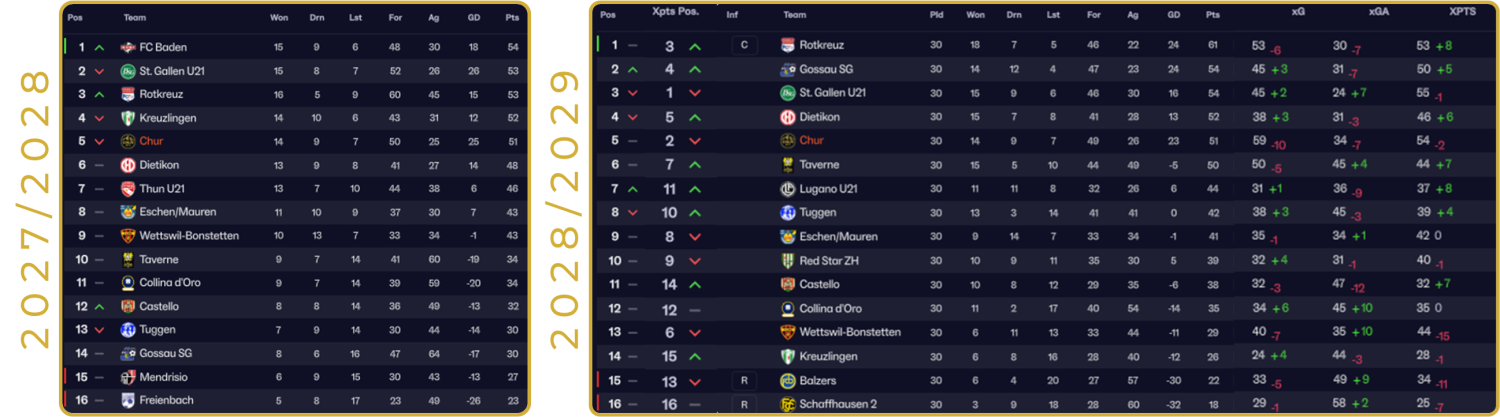
Chur’s second season in the 1. Liga Classic Gruppe 3 under Iñaki Arriola ended with a familiar line in the league table: 14 wins, 9 draws, 7 losses, 51 points, 5th place. The symmetry with the previous campaign is almost suspicious, as if the club had been placed on rails and pushed down the identical track for another year. Yet anyone drawn into that illusion of sameness would only need to dig a few centimetres beneath the surface to discover a season defined not by stasis but by contradiction, underperformance and tactical maturation. Chur scored one goal fewer than the year before and conceded one more, but that superficial statistical repetition obscures a far deeper story: a team that created more, controlled more, threatened more and – uniquely for a side coached by a Basque ideologue who demands precision from every action – finished less.
Arriola’s third year in senior management (his second at this level) should, by all the advanced metrics, have been the year Chur shook off its reputation as a rising but erratic project and imposed itself as a true candidate for promotion. The numbers were emphatic. Their expected points tally placed them second in the division; their expected goals for the season outstripped their actual return by ten; even their expected points figure exceeded last season’s by two. Chur performed like a contender, pressed and carried possession like a contender, constructed their 3-2-5 structures with the poise of a contender and created chances at the volume of a contender – and yet, when the mathematics hardened into league standings, they stood exactly where they had the season before.
The cruel shape of the campaign was made most visible during spring’s five-match winning run, a phase where Chur began to resemble precisely what Arriola has been building since the day he first stepped into Graubünden: a side that overwhelms with organisation and intensity, while attacking with height, width and conviction from its wide front five. The automatisms were sharp, the spacing consistent, the recoveries immediate. For the first time, Arriola’s 3-2-5 did not merely appear on a tactics board but actually breathed competition into the league hierarchy. They surged up the table, briefly touching the edge of what could realistically be called a title race even though the eventual champions already appeared out of reach. And then, with second and third place within reach, the rhythm faltered. One point from the final two matches took all momentum out of their closing stretch. Promotion had already slipped away, but the team’s late-season unease meant they didn’t even receive the consolation of landing where their performances suggested they belonged.
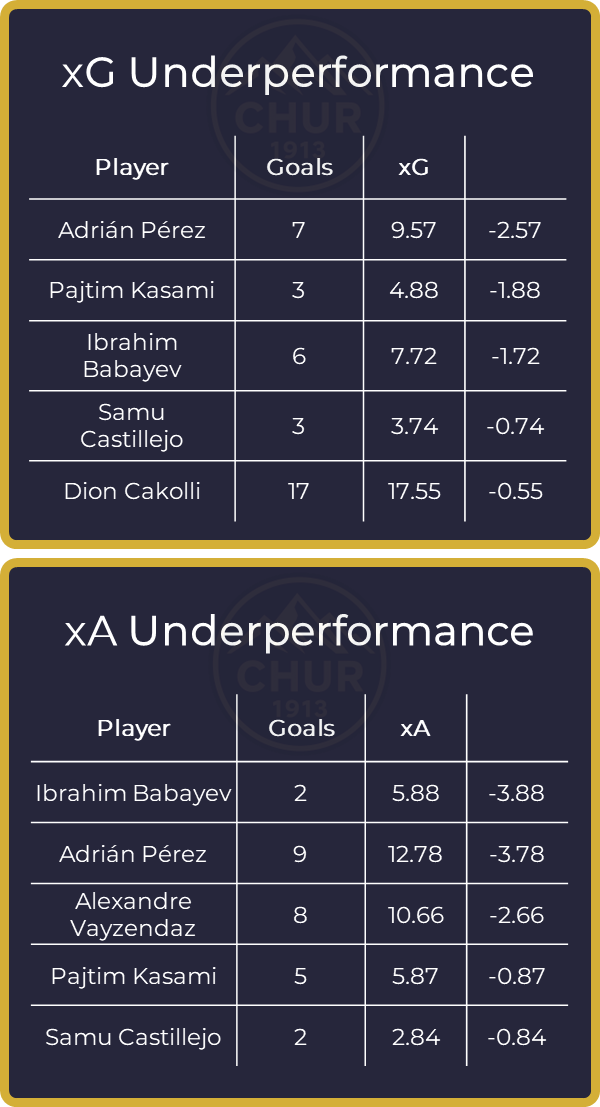
Much of this deflation can be located in the finishing, where a series of individual underperformances added up to something collectively corrosive. Adrian Perez, whose season will be remembered for its ingenuity and menace rather than its goals, came in 2.57 beneath his expected tally, finishing with seven but often looking capable of doubling that figure. Patjim Kasami, the veteran metronome and penalty taker, fell 1.88 short, though his role from the spot inevitably skewed the probabilities. Ibrahim Babayev scored six from 7.72 expected, an echo of the finishing deficit that haunted Chur across the year; Samu Castillejo’s shortfall of 0.74 would hardly be worth mentioning in isolation but adds weight to the narrative when viewed collectively. The most emblematic case was perhaps Dion Cakolli: once the club’s great overperformer (at one stage finishing nearly four goals above expectation), he ultimately fell back towards the mean, ending with 17 goals despite having been expected to score marginally more. Cakolli’s drought mid-season was not devastating, but it revealed a psychological fragility that the coaching staff had not previously needed to confront.
Chance creation followed a similar arc of frustration, even if the underlying mechanics were impressive. Babayev finished with only two assists despite nearly six expected; Perez registered nine but still fell short of his xA by 3.78; Alexandre Vayzendaz, who became a creative engine rather than merely a facilitator on the flank, was let down repeatedly by finishing, completing the year 2.66 assists below his own expected output. The patterns are clear: Chur created space, inserted the ball into dangerous zones and repeatedly found free men in the final third, but too often the final action betrayed them. Last year’s problem – strong creation, volatile finishing – remains stubbornly embedded.
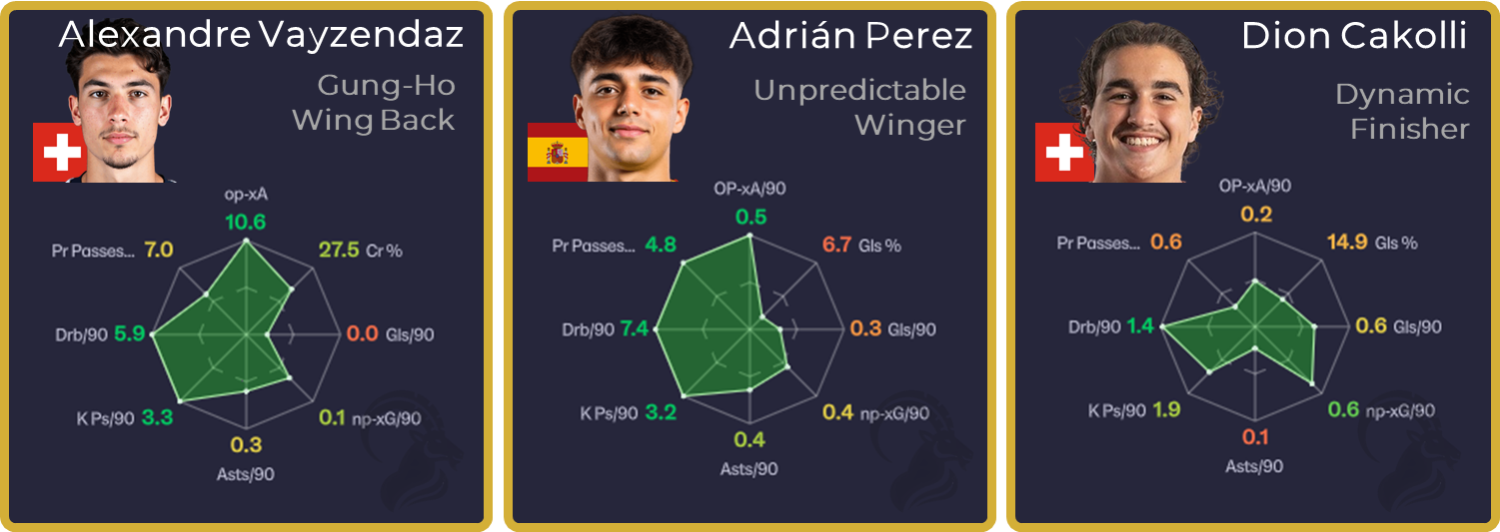
Yet it would be wrong to reduce the campaign to statistical misfortune, because the football itself evolved in meaningful ways and revealed a squad growing increasingly aligned with Arriola’s ideology. Vayzendaz, in particular, became the symbol of this growth. The gung-ho wing-back role that once belonged to Mateo Jungo has now been redefined by the Swiss-born wide runner, who posted a verticality threat index of 12.9, a remarkable rise from last season’s 9.1 baseline. His 3.3 key passes per 90 underline how consistently he arrived in zones of structural advantage, often forming the free man on the outer edge of the 3-2-5 and driving relentlessly into the half-spaces or along the touchline. Arriola values wide players who can stretch, break and destabilise, but also those capable of delivering the final ball with clarity; Vayzendaz ticked each of those boxes and then added his own chaotic flourish.
Perez, too, was transformative even in his moments of statistical frustration. Nineteen goal involvements stand as the headline, but the real impact came from the volume of progressive passes, most of which ended inside the box, and his dribbling actions that repeatedly bent opposition lines out of shape. He became the player opponents planned for rather than reacted to, and though he finishes the year with a transfer to Marbella worth €200,000 – a fee that will reshape Chur’s summer – there is a clear sense of both gratitude and regret around his departure. Arriola will need to replace not just a threat but a reference point.
Cakolli’s season, meanwhile, illustrated the subtle maturation of Chur’s attacking line. His conversion rate dipped, and his streakiness re-emerged, yet he became a far more complete centre-forward in the collective sense: physically strong, increasingly agile, and more intelligent in his movement when linking into the five-lane attack. Arriola demands a striker who can exist within structure without becoming constrained by it; Cakolli is beginning to understand the balance, even if his precision still fluctuates.
There is also the human reality that this summer brings departures not just of one key attacker but of two of the squad’s elder statesmen. Inigo Ruiz de Galarreta and Patjim Kasami will both retire, leaving behind leadership voids that extend beyond their statistical output. Arriola has built a dressing room on shared responsibility and role clarity; losing two figures who exemplify that instruction-heavy culture will require deliberate, targeted recruitment. Depth remains an issue, but so too does tactical alignment. Chur no longer needs raw talent; it needs players who can inhabit the system without weeks of apprenticeship.
So the club faces the cold truth of modern football’s middle tier: progress is nonlinear, and improvement does not always announce itself in league tables. Chur were better this year – decisively so in most phases of play – but the table reflects only what was finished, not what was built. Arriola’s third season has shown a side ready for promotion football in shape and intention, but not yet in execution. Their structures remain convincing, their automatisms increasingly intuitive, their identity sharper than at any point since his arrival. What they now require is clinical edge, depth to survive strain and a summer that replaces experience without diluting character.
In a league where the margins are thin and the evidence of progress is often hidden in between the results, Chur’s season stands as a testament to how far a team can rise while appearing, from a distance, not to move at all



 The Gaffers Lounge
Leave a comment