

When Paul Howarth took charge of Atherstone Town, he inherited a mid-table side in need of direction. What he’s implemented is a tactically sophisticated system that belies his inexperience—a fluid 4-3-3 that morphs into a compact 4-5-1 defensive block, exploiting FM26’s revolutionary in-possession and out-of-possession mechanics to create overloads, control space, and press intelligently.
This isn’t route-one football. This is structured chaos with purpose.
The Shape-Shifting Philosophy
Howarth’s system operates on two distinct shapes that work in tandem. In possession, Atherstone deploy a 4-3-3 with genuine width and midfield runners. Out of possession, they compress into a compact 4-5-1 mid-block designed to force errors and spring counters.
In Possession (4-3-3):
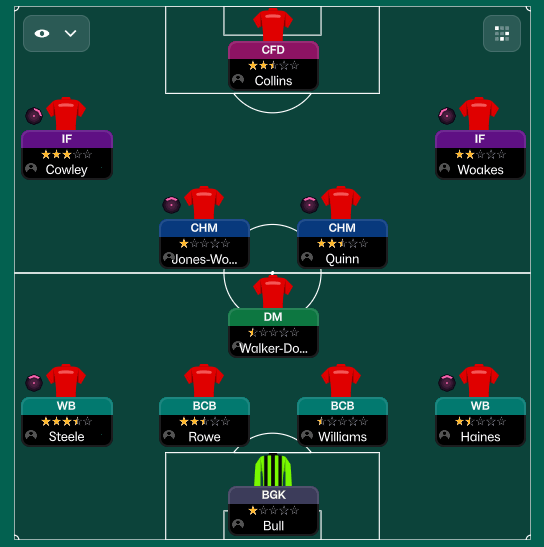
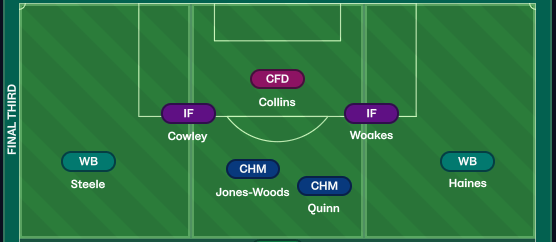
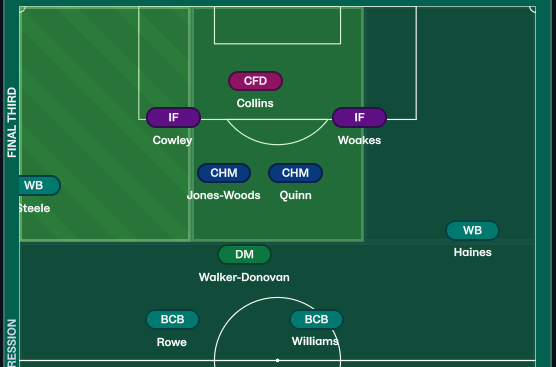
- Back four: Steele (WB), Rowe (BCB), Williams (BCB), Haines (WB)
- Midfield three: Jones-Woods (CHM), Walker-Donovan (DM), Quinn (CHM)
- Front three: Cowley (IF), Collins (CFD), Woakes (IF)
The Channel Midfielders sit either side of Walker-Donovan, creating a genuine midfield triangle. They’re not a double pivot—they’re positioned wider, in the half-spaces, ready to make diagonal runs and link with the wide forwards.
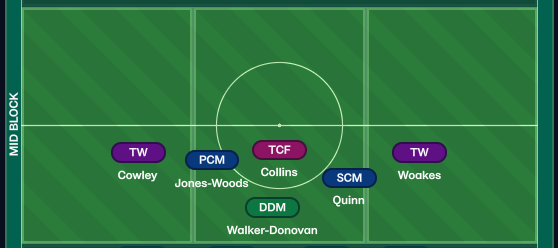
Out of Possession (4-5-1):
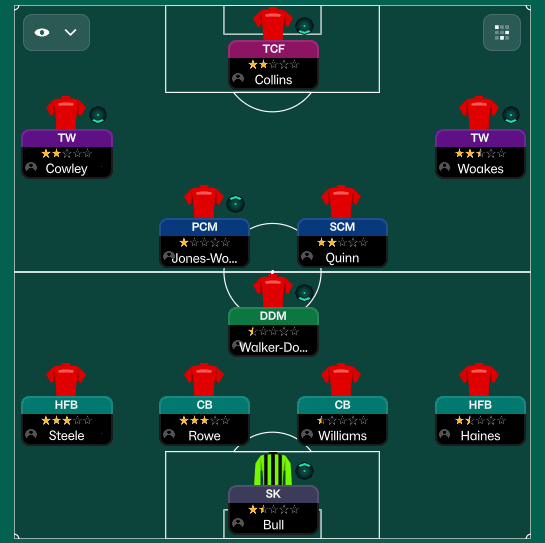
- Back four unchanged
- Midfield five: Cowley (TW), Jones-Woods (PCM), Walker-Donovan (DDM), Quinn (SCM), Woakes (TW)
- Lone striker: Collins (TCF)
The transformation is remarkable. The front three becomes a midfield five, with Cowley and Woakes dropping deep to form wide defensive positions. Collins is isolated up top as a target outlet. The two Channel Midfielders morph into contrasting roles—one screening, one looking to progress play on the counter.
The beauty lies in the transitions. Players aren’t simply occupying different positions—they’re adopting entirely different responsibilities based on ball possession.
Defensive Structure: The Low Block with Bite
Out of possession, Atherstone adopt a low defensive block with a higher defensive line—a seemingly contradictory instruction that actually makes tactical sense. The low engagement line (sitting around the halfway line) invites opponents forward, whilst the higher defensive line compresses the space between defence and midfield, making it difficult for opponents to play through central areas.
Key Defensive Instructions:
- Line of Engagement: Low Block (forces opponents to build from deep)
- Defensive Line: Higher (compresses vertical space, enables offside trap)
- Trigger Press: Much More Often (opportunistic pressing when opponents make mistakes)
- Defensive Transition: Counter-Press (immediate pressure after losing possession)
- Tackling: Standard (disciplined, avoiding unnecessary cards)
- Cross Engagement: Stop Crosses (aggressive wide defending)

The trigger press instruction is particularly clever. Rather than committing to a high press that could leave gaps against pacey opponents, Atherstone wait for triggers—a poor touch, a backwards pass, a player receiving under pressure—before engaging aggressively.
The transformation from Inside Forwards to Traditional Wingers is crucial. Cowley and Woakes essentially become auxiliary full-backs when defending, creating a genuine five-man midfield line that’s difficult to penetrate. This width in defence contrasts sharply with their narrow positioning when attacking, creating unpredictability that opponents struggle to read.
The 4-5-1 shape is built to absorb pressure and spring counters. Collins holds his position up top, offering an outlet for long balls or quick transitions. Jones-Woods and Quinn adopt asymmetric roles—the Screening CM (Quinn) sits deeper to track runners and intercept, whilst the Passing CM (Jones-Woods) positions himself slightly higher, ready to receive and distribute quickly when possession is won.

Offensive Philosophy: The Midfield Triangle Creates Chaos
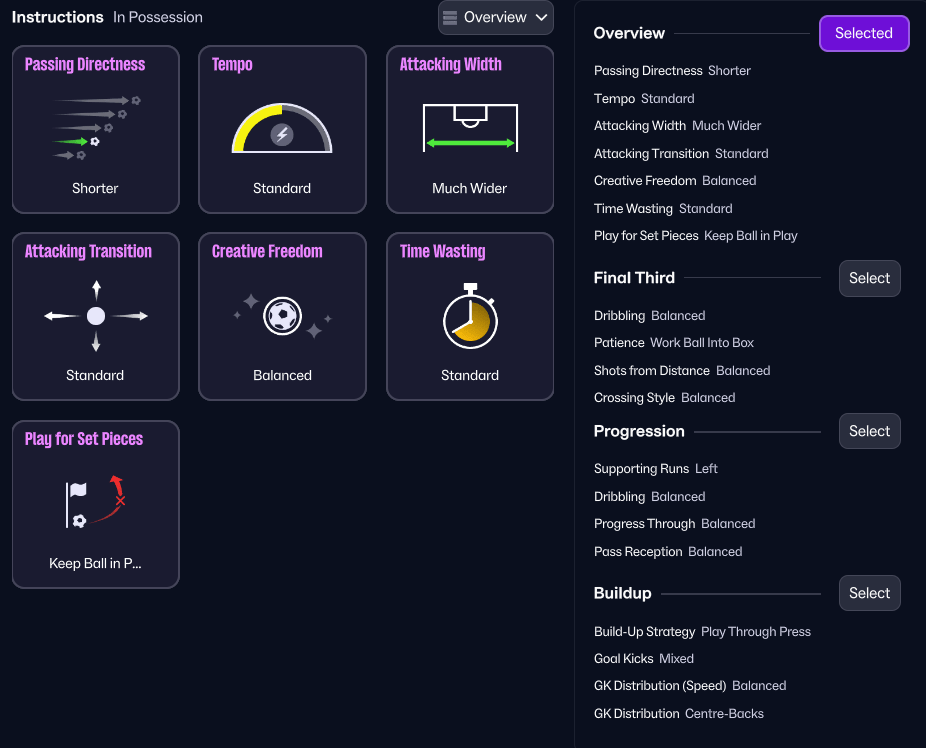
In possession, the 4-3-3 comes alive. The midfield triangle of Jones-Woods, Walker-Donovan, and Quinn provides the structural base, whilst the front three create chaos through movement and positional rotations.
Attacking Principles:
- Passing Directness: Shorter (patient build-up, drawing opponents out)
- Tempo: Standard (allows players to find optimal passing lanes)
- Attacking Width: Much Wider (stretches defensive lines)
- Attacking Transition: Standard (balanced, not reckless)
- Creative Freedom: Balanced (structure with flexibility)
- Time Wasting: Standard (pragmatic game management)
- Play for Set Pieces: Keep Ball in Play (maintain possession rather than force dead balls)
The “much wider” instruction is deceptive. Yes, Cowley and Woakes start wide, but their Inside Forward roles mean they’re constantly cutting inside, creating overloads in the half-spaces—those lucrative areas between the opponent’s full-back and centre-back.
Here’s where the Channel Midfielders become devastating. As Cowley cuts inside from the left, Jones-Woods makes a diagonal run from his wide-left midfield position into the channel Cowley’s just vacated. Suddenly the opposition full-back has a dilemma: track Cowley inside and leave Jones-Woods free in the channel, or hold position and allow Cowley space to shoot or pass centrally.
The same pattern occurs on the right with Woakes and Quinn. It’s systematic creation of two-versus-one situations in wide areas, with the added threat of Collins pulling defenders around centrally.
Lewis Collins’ Complete Forward role is the linchpin. He drops deep to link play, drags centre-backs out of position, and makes runs in behind. When Cowley and Woakes cut inside, Collins has the spatial awareness to drift wide or attack the channels, creating constant rotational movement that disrupts defensive organisation. His movement creates space for others as much as it creates chances for himself.
Walker-Donovan’s defensive midfielder role is critical. He’s the base of the triangle, the player who allows everyone else to take risks. His positioning between the lines means that if possession is lost, Atherstone have immediate counter-pressing capability without committing too many bodies forward. When the Channel Midfielders push high and wide, Walker-Donovan covers the central spaces they’ve vacated.
The Midfield Triangle: Width from Central Areas
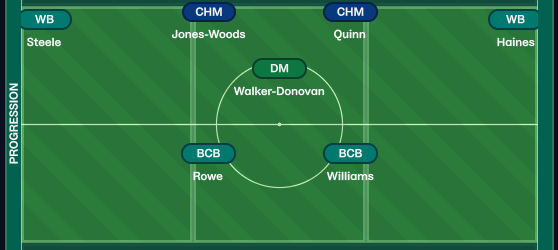
The genius of Howarth’s midfield setup is how it creates width without relying solely on full-backs or wingers. The Channel Midfielder role is perfectly suited to this.
In Possession:
- Jones-Woods and Quinn position themselves in the half-spaces between central and wide corridors
- They make intelligent supporting runs to link with wide attackers, often arriving late into the box or underlapping the Inside Forwards
- Their positioning creates passing triangles with the full-backs and wide forwards
- Walker-Donovan holds, recycles possession, and switches play
Out of Possession:
- Quinn becomes a Screening CM, dropping deeper to form a compact midfield unit
- Jones-Woods becomes a Passing CM, positioned slightly higher to spring counters
- The asymmetry prevents both being caught upfield simultaneously
This is tactically sophisticated stuff. In a traditional 4-3-3 with more conventional central midfielders, you’d expect both to sit relatively deep or both to push forward together. Howarth’s use of Channel Midfielders gives him width and penetration from midfield, whilst the out-of-possession transformation into Screening and Passing CMs provides defensive solidity and transition threat.
For sixteen-year-old Andrew Jones-Woods, this is demanding but clever management. In possession, he’s asked to make runs and link play—showcasing his talent and energy. It’s age-appropriate tactical management.
The Final Third: Progressive Passing and Supporting Runs
Howarth’s attacking instructions reveal a manager who values control over chaos:
Final Third Approach:
- Supporting runs biased to the left (creating asymmetry)
- Balanced dribbling (not excessive, but encouraged in the right moments)
- Work ball into box mentality (no speculative crossing or shooting)
- Balanced crossing style (variety keeps defenders guessing)
The “work ball into box” instruction is fascinating. It means players won’t whip hopeful crosses or shoot from distance unless they’re genuinely in a good position. Everything’s about creating high-quality chances. The xG of 3.47 against Leicester Nirvana wasn’t luck—it was systematic chance creation.
That left-sided bias in supporting runs creates predictable overloads that opponents struggle with. Cowley cuts inside from the left, Jones-Woods provides underlapping runs through the channel, and Steele overlaps when space opens up. Three players attacking the same zone from different angles, at different times, with different skill sets. Defending that consistently is nearly impossible at step five.
The right side operates differently. Woakes cuts inside, but with Quinn’s Channel Midfielder runs coming from deeper, the timing is staggered. Haines at right-back appears less adventurous than Steele (probably tactical instruction, player trait), creating natural asymmetry. The left side is about numbers and chaos. The right side is about isolated one-on-ones with Woakes receiving the ball and running at defenders.
Full-Back Involvement: Overlaps and Underlaps
The wing-backs (Steele and Haines designated as WB in possession) provide crucial width when the Inside Forwards cut inside and the Channel Midfielders make infield runs. This creates a fascinating pattern of movement:
- Inside Forward receives wide
- Full-back makes overlapping run
- Inside Forward cuts inside OR passes to overlapping full-back
- Channel Midfielder times run into space created by Inside Forward’s movement
- Opposition full-back is isolated against multiple threats
Against Leicester Nirvana, Atherstone completed 361 of 425 passes (84%) with 70 final third passes. That’s not a team lumping it long—that’s structured possession football with purpose. The Channel Midfielders’ positioning enables this by providing constant passing options in the half-spaces.
Set Piece Philosophy: Possession Over Danger
The “keep ball in play” instruction for set pieces is quietly astute. At step five, where technical quality varies and physical battles often dominate dead-ball situations, Howarth’s decision to prioritise possession retention over forcing dangerous set pieces shows tactical maturity.
Why launch the ball into a crowded box when you can keep it, draw opponents out, and create better chances in open play? That said, Atherstone’s goal from a corner against Leicester Nirvana (Rowe header) suggests they’re not exactly toothless from dead balls. The instruction simply prevents them forcing situations that aren’t there.
The Counter-Press: Immediate Reaction
The counter-press instruction is perhaps the most modern element of Howarth’s system. When Atherstone lose possession, they immediately pressure the ball carrier, forcing hurried decisions and winning it back quickly.
This works because of the compact shape out of possession. Players aren’t spread across the pitch, so when the ball’s lost, there are always two or three Atherstone players within pressing distance. The Channel Midfielders’ positioning is crucial here—they’ve made attacking runs into wide areas, so when possession turns over, they’re already high up the pitch and can immediately press the opposition full-back or wide midfielder who receives.
The transformation into a 4-5-1 means Atherstone have numbers across the pitch. If the counter-press fails, they’re not exposed—the five-man midfield line can recover and the higher defensive line compresses space. It’s high-risk in theory, but the structural setup minimises the danger.
Weaknesses and Vulnerabilities
No system is perfect, and Howarth’s has potential weaknesses:
1. Defensive Depth With Connor Gudger injured, Atherstone are desperately thin at the back. One more injury and they’re genuinely in trouble. The higher defensive line becomes far riskier when you’re playing converted full-backs or inexperienced youth players centrally.
2. Youthful Midfield Jones-Woods is sixteen. Asking him to operate as a Channel Midfielder making runs into the box requires serious tactical maturity. Out of possession he’s protected by the Screening CM role, but in possession he needs to time runs, link play, and make decisions under pressure. That’s a lot for a teenager.
3. Wide Defensive Exposure When the Channel Midfielders push high and wide, Atherstone can be vulnerable to direct switches of play. If Quinn’s made an underlapping run on the right and the ball’s turned over, there’s suddenly a massive channel for opponents to exploit. The counter-press needs to work, otherwise Atherstone are exposed.
4. Set Piece Vulnerability Leicester won eleven corners to Atherstone’s four. The “stop crosses” instruction helps, but conceding that many set pieces suggests opponents found joy in wide areas. Atherstone won only 53% of aerial duels (17 from 32), which isn’t terrible but isn’t dominant either. Against more physical sides, this could be problematic.
5. Reliance on Collins The entire attacking structure depends on Collins’ movement as a Complete Forward. If he’s injured, unavailable, or having an off day, suddenly the system loses its focal point. Harkin coming off the bench provides quality, but he’s a different type of player—more of a penalty box striker than a link-up man. The tactics might need tweaking if Collins isn’t available.
6. Assistant Manager Playing Right-Back Nathan Haines is doing a job at right-back whilst also being assistant manager. That’s a lot to juggle, and whilst he’s clearly competent (played the full ninety against Leicester), it’s not a sustainable long-term solution. If he picks up an injury, Atherstone lose both a player and half their coaching setup.
The Verdict: Tactical Maturity Beyond Experience
What’s remarkable about Howarth’s system isn’t complexity for complexity’s sake—it’s the intelligent use of what’s available to create a system that’s both structured and fluid. The 4-3-3 to 4-5-1 transformation isn’t gimmicky; it’s purposeful. The role selections aren’t random; they’re carefully calibrated.
Channel Midfielders exploiting half-spaces, Inside Forwards cutting inside to create central overloads, a Complete Forward providing the link, and full-backs offering width when the midfielders push into channels. It’s modern football distilled into a step-five budget.
The stats back it up. Against Leicester Nirvana, Atherstone recorded 24 shots, 3.47 xG, and 53% possession. They created four clear-cut chances and won 81% of their tackles. That’s not luck. That’s systematic domination.
For a manager in his first competitive match, Howarth has delivered a tactical framework that looks several years ahead of where it should be. Whether it holds up over a full season remains to be seen—Leicester were drifting in mid-table for a reason—but the foundations are undeniably solid.
If Atherstone can stay healthy, add a bit of defensive depth, and continue developing young talents like Jones-Woods and Seliearts within this system, there’s no reason they can’t push up the table. The tactics are there. The structure is sound. Now it’s just about execution, week in, week out.
And that, ultimately, is what makes football so beautifully unpredictable.




 The Gaffers Lounge
Leave a comment