

The January Revolution: Transforming Atherstone Town
The honeymoon period in football management is supposed to last a few weeks at most. A bounce, a bit of optimism, maybe a couple of wins before reality sets in and everyone remembers why the previous manager left. Paul Howarth’s first two months at Atherstone Town have comprehensively demolished that theory.
But before the results came the recruitment. Before the wins came the gambles. And before Paul could prove himself as a manager, he had to prove himself as a talent spotter operating on a shoestring budget in the January transfer market.
The Ambitious Rebuild
When Paul sat down with chair Maria Beale and the board in late December to discuss the plans in regards to adding depth, the brief was simple: strengthen the squad without spending money we don’t have. At this level, budgets are tight, wages are modest, and transfer fees are basically non-existent. You’re fishing in the free agent pool, hoping to find players who’ve slipped through the cracks or former pros willing to drop down a level or two for the love of the game.
What followed was one of the most remarkable recruitment drives in Atherstone Town’s recent history. Seven signings in four weeks, all on free transfers, all bringing something different to the squad. It was ambitious. It was risky. And it could easily have backfired spectacularly.
Ryan Harkin: The Prolific Striker Returns
The first domino fell on Christmas Day, 2025. While most people were pulling crackers and arguing about who’d burnt the roast potatoes, Paul was finalising the paperwork to bring Ryan Harkin back to Atherstone from league leaders Coventry United. The deal had been in the works for weeks—those Twitter DMs, the phone calls, the conversations about ambition and belief—but getting it over the line on Christmas Day felt somehow appropriate. A gift to the supporters, if you will.
What Paul didn’t say publicly was how much the signing meant personally. Convincing a player of Harkin’s quality to drop down represented validation—proof that maybe, just maybe, he wasn’t completely out of his depth.
Callum Carsley: Coming Home
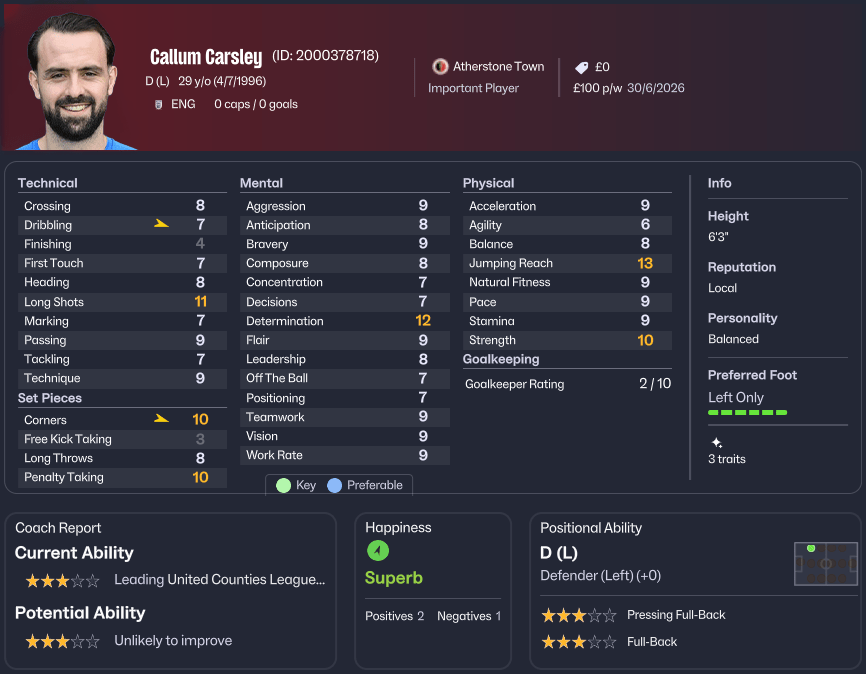
Five days later, on 30th December, Paul pulled off another coup: Callum Carsley, a 29-year-old left-back from second-placed Nuneaton Town. Like Harkin, Carsley who is the sone of England U21 Manager Lee Carsley was a former Adder returning home, and like Harkin, he was stepping down from a promotion-chasing side to join Paul’s project.
“Callum’s footballing education speaks for itself,” Paul said when the signing was confirmed. “He’s played at a good level, been part of successful teams, and he brings qualities we need. The fact he’s chosen to come here when he had other options shows the direction we’re heading.”
He wasn’t coming in as a project player who needed developing—he was ready to contribute immediately. The left-back position had been a bit of a revolving door, with different players filling in as needed. Now Paul had genuine quality there, someone who could defend, attack, and understand the tactical demands of the 4-3-3 system.
The Free Agent Frenzy
Between 4th and 22nd January, Paul signed five more players, all free agents, all bringing different qualities to the squad:
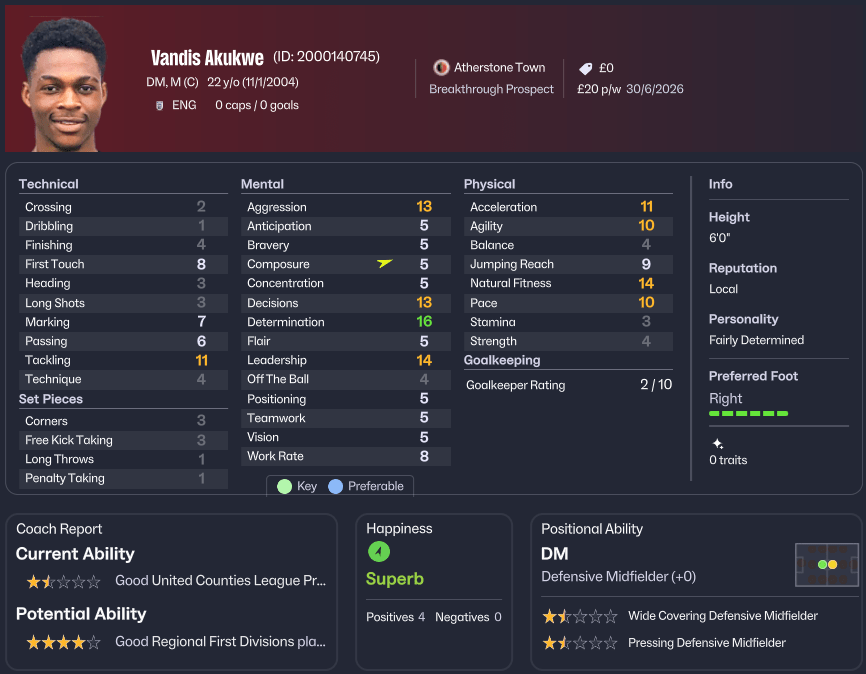
Vandis Akukwe (4th January) – A 22-year-old defensive midfielder who’d been without a club. Young, hungry, athletic. Akukwe had the physical tools—11 acceleration, 10 agility, 14 natural fitness—but needed guidance. His mental attributes were raw (5 composure, 5 positioning) but his determination (16) suggested someone willing to learn and improve. A project player with potential to become something special.
The coach’s report was encouraging: “Good United Counties League Premier Division South player with the potential to develop into a good Regional First Divisions player.” High praise at this level, and exactly the kind of signing that could pay dividends if nurtured properly.
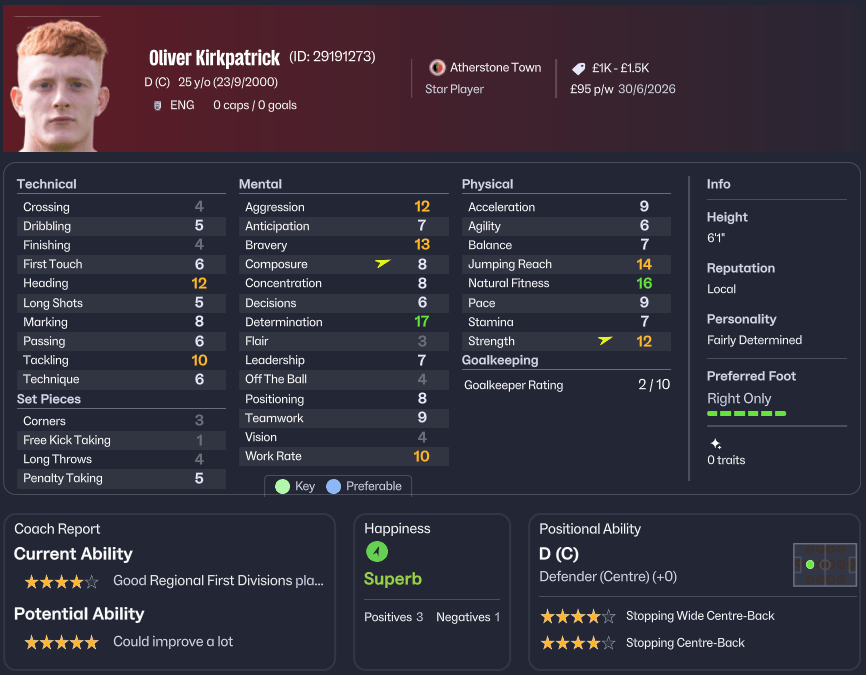
Oliver Kirkpatrick (8th January) – A 25-year-old centre-back, also a free agent. Kirkpatrick was more polished than Akukwe, with better all-round attributes. Standing 6’1″ with 12 strength and 14 jumping reach, he was exactly the kind of physical presence Atherstone needed at the back. His determination (17) and work rate (10) suggested a player who’d give everything, and his potential rating indicated he could improve significantly.
Billy Bishop (14th January) – A 29-year-old goalkeeper on a free. At 6’2″ with solid reflexes (11) and decent handling (8), Bishop provided competition for Jake Bull and cover in case of injury. Goalkeepers are notoriously difficult to sign mid-season—most are contracted and clubs won’t let them leave—so finding one with Bishop’s experience available was a minor miracle.
His leadership (12) and determination (10) meant he wouldn’t sulk if he wasn’t first choice. He’d train hard, push Bull to stay sharp, and be ready when called upon. Exactly what you need in a backup keeper.

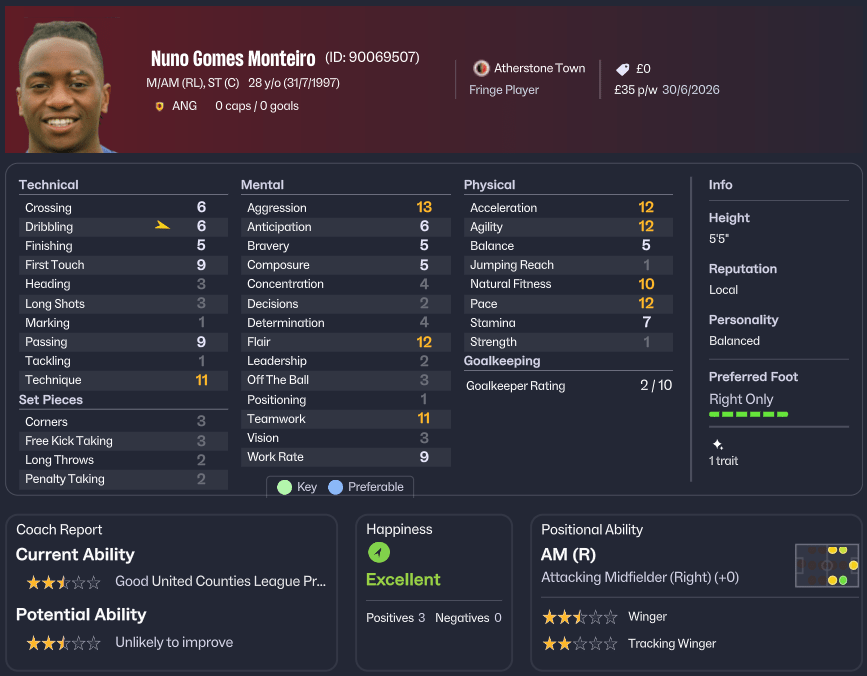
Nuno Gomes Monteiro (14th January) – A 28-year-old attacking midfielder/striker signed from Leicester Nirvana. This one was particularly satisfying. Not only was Paul strengthening Atherstone, he was simultaneously weakening a relegation rival. Monteiro had played against Atherstone in Paul’s first match—the 4-1 win—and clearly made an impression.
Standing 5’5″ and quick (12 acceleration, 12 agility), Monteiro offered something different: pace in wide areas, the ability to run at defenders, and genuine flair (12). His technique (11) and dribbling (6) needed work, but his determination (4) was… concerning. Paul would need to manage him carefully, find ways to motivate him, and hope the change of scenery reinvigorated his career.
The coach’s report was mixed: “Good United Counties League Premier Division South player, unlikely to improve.” Not exactly a ringing endorsement, but as squad depth and someone who could change games off the bench? Worth a punt at zero cost.
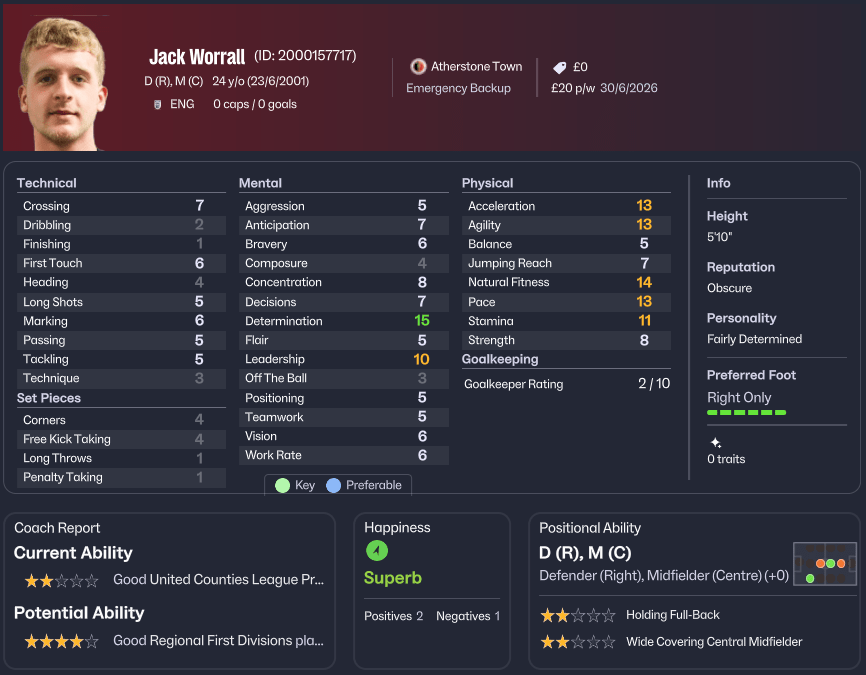
Jack Worrall (22nd January) – A 24-year-old defender/midfielder signed as emergency backup. Worrall was versatile—he could play right-back, centre-midfield, or even centre-back in a pinch. Standing 5’10” with 13 acceleration and 13 agility, he had decent athletic attributes, and his determination (15) suggested he’d work hard to establish himself.
His leadership (10) and teamwork (5) indicated a player who’d fit into the dressing room without causing issues. Sometimes you need players who aren’t superstars but will do a job when required. Worrall fit that description perfectly.
Seven signings in four weeks. Seven new personalities to integrate, seven different motivations to manage, seven tactical brains to align with Paul’s system. It was a lot. Perhaps too much. But Paul had identified gaps in the squad—lack of goals, defensive depth, competition for places—and moved decisively to address them.
The board backed him, trusting his judgement despite his lack of experience. The existing players welcomed the new arrivals, understanding that competition improves everyone. And the supporters, cautiously optimistic after Paul’s appointment, began to believe this might actually work.
Now came the hard part: making it work on the pitch.
The Results: Ambition Meeting Reality
From early January through to late February 2026, the Adders played eight matches: six wins, two defeats. Eighteen points from a possible twenty-four. A leap from twelfth place—mid-table obscurity—to seventh, with genuine playoff ambitions suddenly looking realistic rather than delusional.
It wasn’t just that they were winning. It was how they were winning, and more importantly, how they responded to setbacks.
Match 1: Lutterworth Town (A) – Lost 2-1
Paul’s second match in charge brought him crashing back down to earth. Away at Lutterworth Town on 3rd January, Atherstone were beaten 2-1 despite Mitchell Woakes giving them hope on 52 minutes with what ultimately was a consolation goal. Matt Langham opened the scoring for Lutterworth on 38 minutes, and Jarrad Acton’s 49th minute strike earned them the 3 points..
It was a harsh lesson in the margins at this level, but what mattered was the response.
Match 2: Daventry Town (A) – Won 2-0
A week later, Atherstone travelled to Browns Road to face Daventry Town, and delivered exactly the performance Paul needed. Ryan Harkin, making only his second appearance since returning from Coventry United, opened the scoring after just 7 minutes. Ryan Quinn doubled the advantage on 28 minutes, and Atherstone controlled the match from start to finish, winning 2-0.
It was professional, efficient, and exactly what was required after the Lutterworth disappointment. No drama, no late scares, just a solid away performance that collected three points and restored confidence. Harkin’s early goal settled any nerves, and from there Atherstone looked comfortable.
Match 3: Eynesbury Rovers (H) – Won 3-0
The 17th January brought Eynesbury Rovers to Sheepy Road, and Atherstone absolutely dismantled them. Oliver Kirkpatrick—the new signing from just nine days earlier—opened the scoring after just 9 minutes, nodding home from a corner on his debut. Chris Cowley added a second ten minutes later, and Ryan Quinn wrapped it up on 61 minutes.
Three-nil. Comfortable. Dominant. The kind of home performance that makes supporters believe something special might be happening.
Match 4: Bugbrooke St. Michaels (A) – Won 3-0
The trip to Bugbrooke St. Michaels on 24th January was significant for one reason above all others: Connor Gudger was back. The full-back, out since early December with a fractured cheekbone, returned to the starting eleven and immediately made his presence felt.
Atherstone won 3-0, and Gudger scored the third goal on 76 minutes, capping a performance that showcased everything Paul had been missing. Having him back meant the defence could play higher, press more aggressively, and trust that if someone did get in behind, there was recovery ability to deal with it.
Lewis Collins opened the scoring after just 8 minutes—his first goal in a while after a surprising drought—before Ryan Quinn added a second on 45 minutes, right before half-time. Collins’ goal was particularly welcome. He’d been working hard, linking play brilliantly, but strikers need goals to stay confident. Getting off the mark against Bugbrooke hopefully ended any doubts creeping into his mind.
The away support—about forty or fifty who’d made the trip—sang throughout. “There’s only one Connor Gudger!” echoed around the ground after his goal, and the big defender milked every second of it. Football at this level thrived on these moments, the connection between players and supporters that made it all worthwhile.
Match 5: Aylestone Park (H) – Won 2-1
The 31st January fixture against Aylestone Park at Sheepy Road was far tighter than Paul would have liked. Mitchell Woakes gave Atherstone the lead on 23 minutes, and for the next hour they clung to it, defending resolutely against an Aylestone side who’d travelled with nothing to lose and everything to gain.
Matt Dawson’s thirty-sixth-minute red card for Aylestone should have made things easier, but instead it seemed to galvanise them. They defended deep, made life difficult, and threatened on the counter. Jake Bull made several important saves, the defence blocked shots, and the clock ticked agonisingly slowly.
Then, in the 90th minute, Chris Cowley struck. The ball broke to him in the area, he adjusted his feet, and slotted home to make it 2-1. The relief was palpable. Three points secured rather than two dropped.
Paul learned something that afternoon: winning ugly mattered just as much as winning well. Style could wait. Points couldn’t.
Also notable: Leke Shodunke was sent off for Aylestone in stoppage time (90+4), reducing them to nine men. By then the game was already won, but it summed up their frustration.
Match 6: GNG Oadby Town (A) – Won 2-1
Away at GNG Oadby Town on 7th February, Atherstone again found themselves in a scrap, then Lewis Collins happened.
Two goals in two minutes. 85 minutes: lead. 87 minutes: winner, surely? It wasn’t quite so cut and dry, when Sam Clarke pulled one back for the hosts on 89 minutes, but the Adders saw the game out. From heading home sharing the spoils to leaving with all three points in the blink of an eye. Collins wheeled away in celebration both times, the frustration of recent weeks pouring out in those moments. This was what he did. This was why Paul had kept faith in him even when the goals dried up.
Ryan Harkin had also scored earlier, on twenty-eight minutes, giving Atherstone a lead they’d held until Clarke’s late intervention. But Collins’ double salvo was what everyone remembered. The matchwinner. The hero. The striker doing what strikers do best.
Paul’s post-match team talk was brief: “That’s character. That’s belief. That’s why we’re going places.” The players believed him, and more importantly, they believed themselves.
Match 7: Histon (A) – Lost 2-0
Every good run has a reality check, and Atherstone’s came on Valentine’s Day at Histon. They travelled to the FWD-IP Community Stadium—14th February, ironically the day when Paul should have been focusing on romance rather than football—and got absolutely nothing from the match.
Histon scored twice through Tom Binder, once on 28 minutes and again on 73, and Atherstone couldn’t respond. It was one of those afternoons where nothing quite worked. Passes went astray, chances didn’t fall, and the opposition keeper had the game of his life.
Paul took it in stride. Every team loses matches, and two defeats in eight was hardly catastrophic. What mattered was the response, and Atherstone duly delivered, bouncing back with victory in their next match.
Match 8: Northampton ON Chenecks (H) – Won 3-1
The response came on 21st February at Sheepy Road. Northampton ON Chenecks visited, and Atherstone delivered a performance that erased the memory of Histon and reinforced their credentials as genuine playoff contenders.
Mitchell Woakes opened the scoring on 41 minutes, giving Atherstone a half-time lead. Jamie Wolfe equalised for Northampton on 46 minutes—barely a minute into the second half—but rather than panic, Atherstone responded brilliantly.
Ryan Quinn restored the lead on 52 minutes, and Chris Cowley sealed it deep into stoppage time (90+5), completing a 3-1 victory that had the home supporters dreaming of what might be possible.
Cowley’s contribution during this period couldn’t be overstated. Four goals across the eight matches, often at crucial moments, and his work rate never dropped. The supporters loved him for it—the kind of player who’d run through walls for the shirt.
The Table Tells The Story
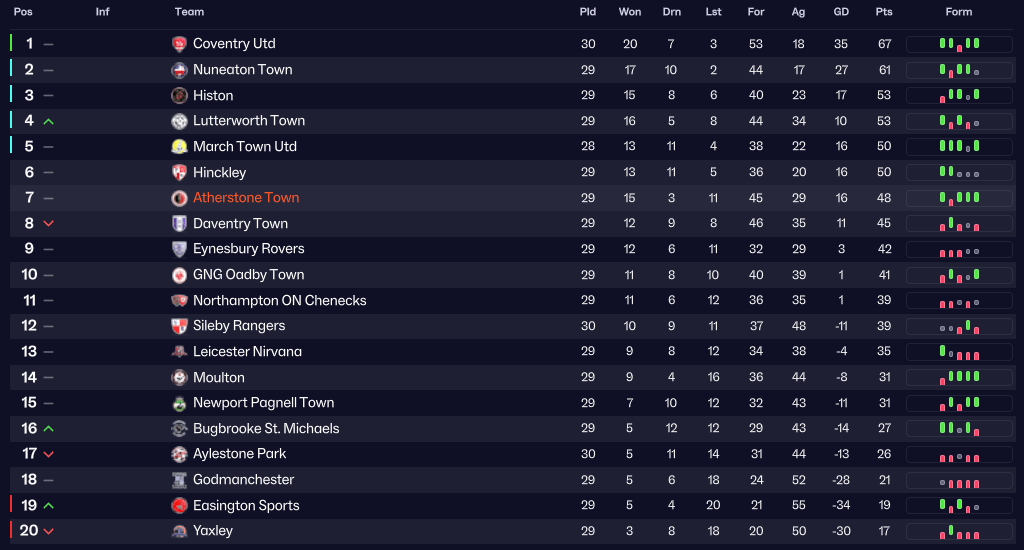
When Paul took over in late December, Atherstone sat twelfth with thirty-nine points from seventeen matches. Respectable, but hardly thrilling. By late February, after this extraordinary run of results and recruitment, they’d climbed to seventh with forty-eight points from twenty-nine matches.
The top two—Coventry United (67 points) and Nuneaton Town (61 points)—were effectively beyond reach. But the playoff race? That was wide open. Third-placed Histon had fifty-three points from twenty-nine matches, just five points ahead of Atherstone. Fourth-placed Lutterworth Town had fifty-three points from the same number of games. The gap was closeable.
More importantly, Atherstone had momentum. Six wins in eight matches, seventeen goals scored, genuine quality added to the squad, and a system that was starting to click. The Channel Midfielders were exploiting half-spaces, the Inside Forwards were cutting inside to create overloads, and the defensive structure was solid.
If they could maintain this form, keep the squad healthy, and navigate the run-in with the same determination they’d shown so far, playoff football wasn’t just possible—it was probable.




 The Gaffers Lounge
Leave a comment