

The Quiet Revolution
The morning mist clung to the foothills beyond the training camp as the staff set out cones, mannequins and GPS vests with a level of precision that felt new. Much sharper, more intentional, almost more professional in its neatness and method.
Even before the players arrived, you could sense it: something had shifted at Arezzo.
Not in the squad – that part had been evolution, not interruption – but in the people orchestrating what happened next.
The Manager stood at the edge of the main pitch, hands in his pockets, watching the scene form. The familiar faces of last season’s promotion heroes would soon jog out, still buzzing with the confidence of success yet carrying their own questions into the new division.
Could Matteo Guccione, now 33 and returning from a three-month injury that had dulled his legs and rhythm, still anchor midfield with the creativity and authority he once did?
Could Pietro Cianci, who lost his starting place to Ravasio last season, rediscover the dominance that had brought him 14 goals in 33 games?
Serie B was a higher, harsher landscape. Belief alone wouldn’t be enough – BUT belief was why most of this squad was still here.
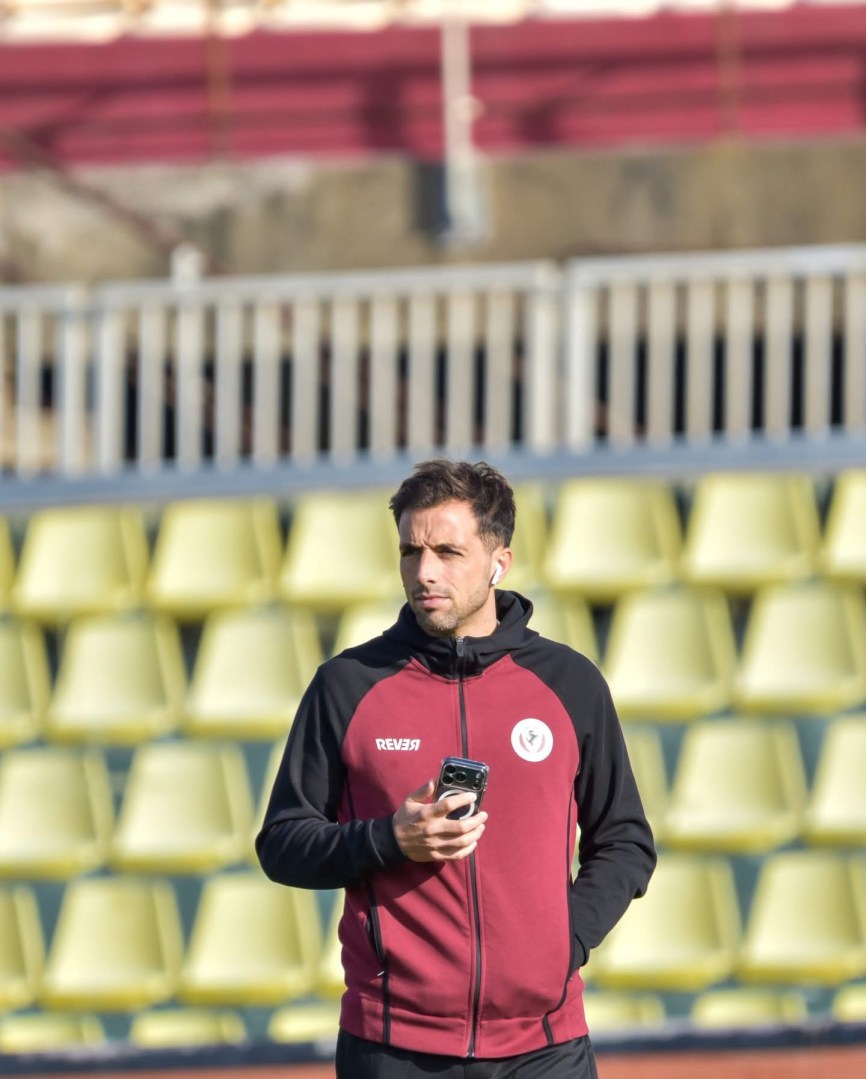
Guccione at training camp
Continuity builds loyalty. Continuity builds culture.
The Manager had decided that culture was worth protecting.
He had made only minimal changes to the playing group, choosing trust over turnover, identity over panic. But while the footballers remained largely the same, everything surrounding them – everything shaping their habits, sharpening their standards, elevating their understanding of the game – had undergone a transformation.
This season, the true signings weren’t wearing boots.
They were wearing whistles.
It all starts with the Assistant
Daniele Cavalletto arrived quietly, but the effect was seismic.
Fresh from the Ajax bench – and OGC Nice in Ligue 1 before that – he represented something S.S. Arezzo had never had: a coach trained in the detail, discipline and developmental precision of Europe’s most respected academies.
He didn’t shout. He didn’t grandstand. He just elevated everything.
Possession structures. Fluid rotations. Intelligent build-up.
All woven seamlessly into Arezzo’s 4-3-3 framework. Discipline and control.
Cavalletto wasn’t simply replacing Flavio Giampieretti; he was redefining the role.
A cultural upgrade.
A second voice who had lived the standards Arezzo were now trying to reach.
A coach who could look a player in the eye and say, “This is how it’s done at the top.”
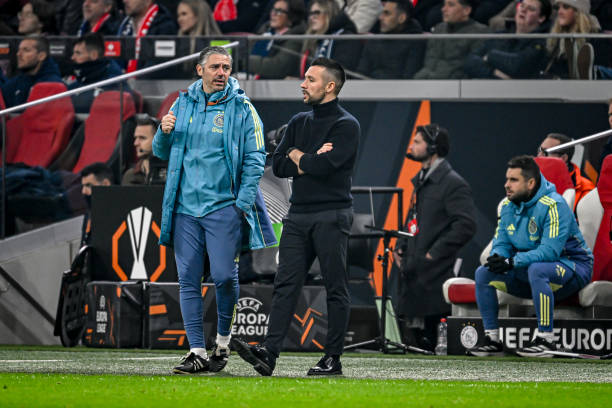
Cavalletto alongside Farioli, in Europa League action with Ajax.
Fine Margins and Power Plays
On the second pitch, Paolo Favaretto bent over a magnetic board, sliding red and yellow pieces into tight, choreographed movements. The new set-piece coach — another addition born from necessity — had arrived from Sampdoria with the briefest of briefs:
Help us survive.
Help us steal points.
Help us find goals in the margins.
Nobody expects FC Midtjylland’s magic overnight, but even incremental improvement could be the difference between comfort and chaos in Serie B.
A few metres away, Massimo Lo Monaco, the new defensive coach from Monza, stood with the authority of a man used to higher divisions – a stern presence who barked instructions with the weight of experience. Opposite him, Gianluca Falsini, former AS Roma U18 manager, adjusted positioning grids with meticulous care, guiding younger players into their starting shapes.
Then came Corrado Grabbi – once a striker and coach at Juventus, now the attacking voice in the room. He spoke with an assurance that only comes from having scored goals in the places these players dreamed of reaching. His sessions were fast, unforgiving, and filled with angled passes that forced attackers to become sharper versions of themselves.
All of them, in their own way, carried the habits and expectations of bigger clubs, higher divisions, and better infrastructures.
And now they carried Arezzo.
The Fitness Revolution
But perhaps the most immediate impact was felt in the work of Sean Rush, a fellow Englishman joining the staff as a second fitness coach. His CV spanned Leeds United, Middlesbrough, Birmingham City, and a recent stint in Italy with Triestina.
Alongside Iuri Bartoli, Rush had been tasked with the most visible fix:
Make Arezzo fitter.
Make them last 90 minutes.
Make the drop-off of last season a memory, not a trend.
Their sprint lanes were harsher, their thresholds higher, their demands clearer. GPS metrics ruled everything. No hiding, no shortcuts.
A few groans drifted across the pitch as players faced the new reality.
Serie B required lungs to match ambitions.
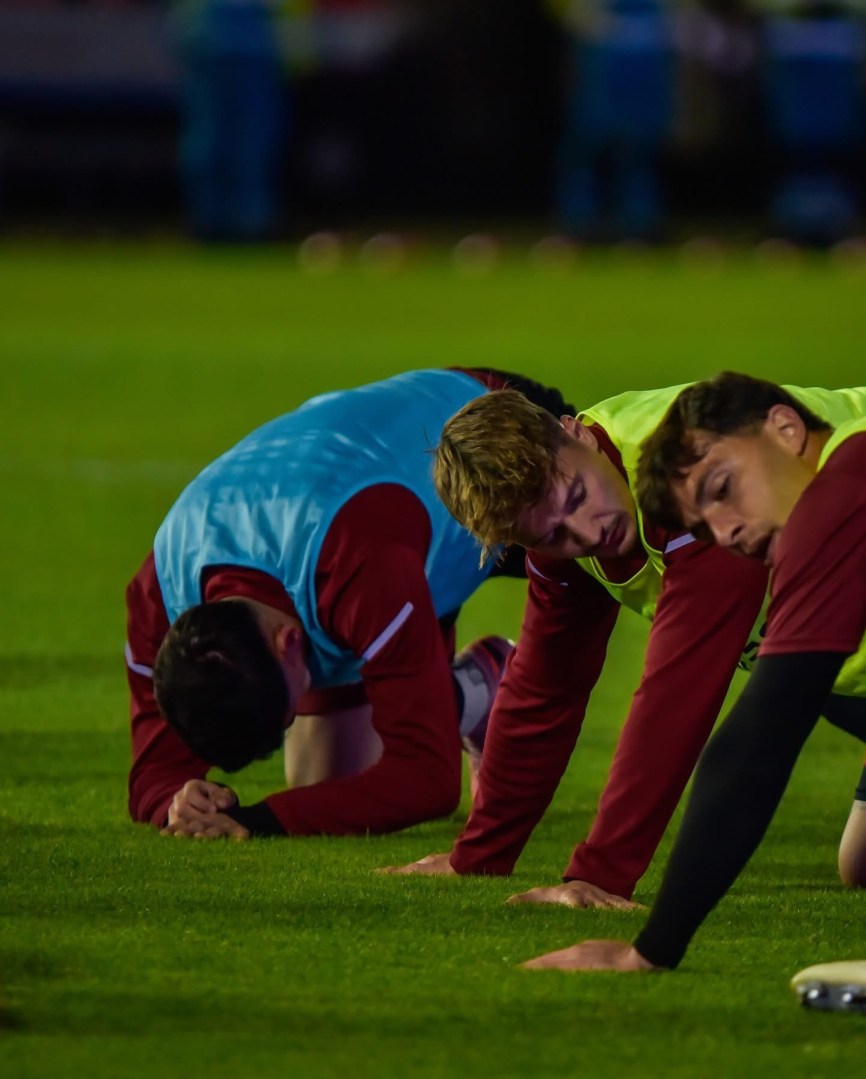
Pre-season at S.S. Arezzo – a new standard is set.
The Eyes in the Data Hub
Even the analysis department had evolved.
Hubert Malowiejski – formerly the Head Performance Analyst of the Poland national team — now sat alongside Michele Passalacqua, splitting screens, coding sequences, mapping every movement with international-level scrutiny.
For the first time, Arezzo weren’t just training harder.
They were training smarter.
The Squad of Last Season, The Staff of the Next
As the players finally gathered for the first warm-up, The Manager took a moment to absorb the picture in front of him.
Same squad.
New standards.
Guccione, stretching cautiously but determined to prove he wasn’t finished.
Cianci, already joking with teammates but with something steely in his eyes.
Younger players watching the new coaches with a mixture of curiosity and awe.
And behind them: Cavalletto, Favaretto, Lo Monaco, Falsini, Grabbi, Rush, Malowiejski — the clearest sign yet that S.S. Arezzo were no longer simply trying to survive the next step.
They were building a structure that could belong there.
In the end, the players would still decide everything.
But this staff?
They might be the most valuable signings the club made.
The whistle blew.
The revolution – quiet, deliberate, but unmistakable – began.
In part 2, we’ll look at the new, and returning players – who’ll be fighting and clawing for every inch to ensure S.S. Arezzo survive the Serie B season.




 The Gaffers Lounge
Leave a comment