

ALONE IN THE ALPS: THE ISOLATION OF CHUR AND THE FUTURE OF ITS FOOTBALL
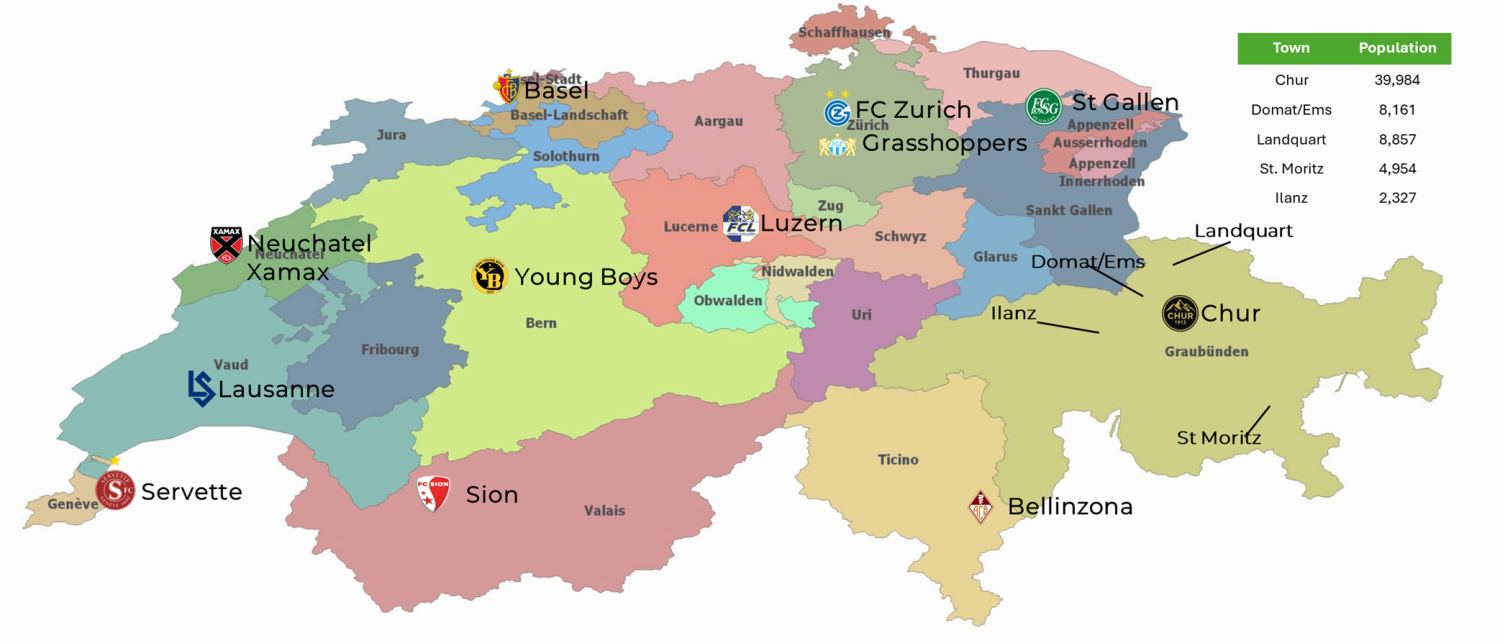

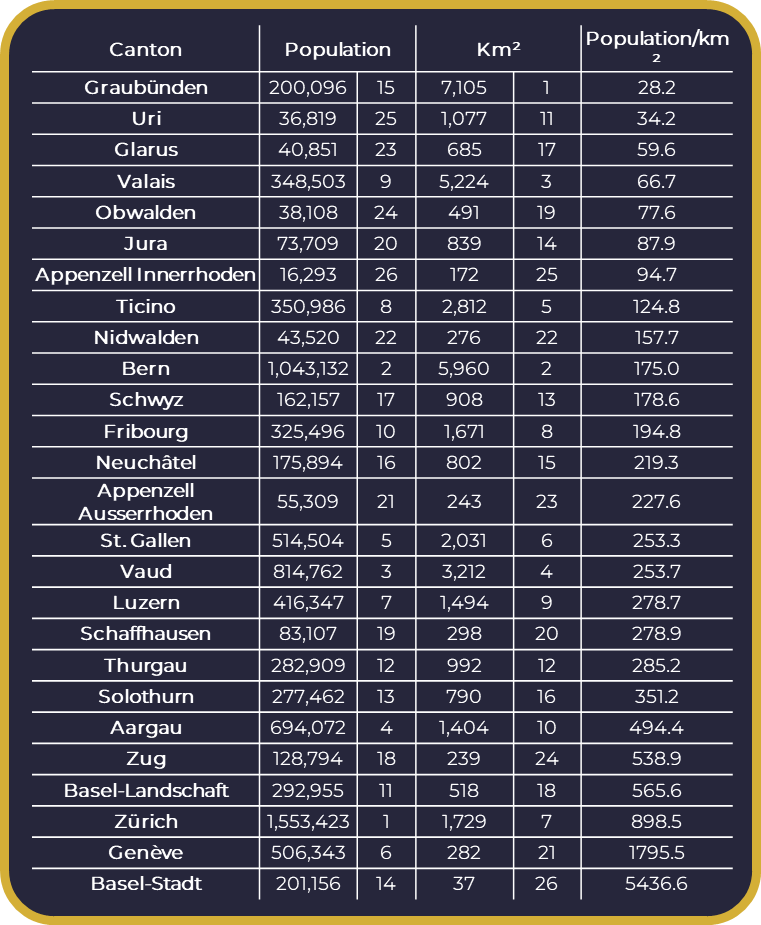
In Switzerland, geography is destiny. And no place feels that more sharply than Chur. Set deep inside Graubünden-the country’s largest canton by landmass yet the emptiest by population – Chur exists in a curious paradox: a city surrounded by vastness but deprived of company, a regional capital defined as much by space as by the silence within it. While Zürich packs nearly nine hundred people into each square kilometre and Basel-Stadt bursts beyond five thousand, Graubünden sits at the very bottom of the density rankings, with barely twenty-eight souls per square kilometre, mostly made up of a spattering of small alpine villages with even smaller populations. It is a region that stretches out over 7,105 square kilometres of valleys, forests, and jagged passes, yet it feels almost hollowed out by the distances between its communities.
This is not simply a place far from the action – it is a place far from everything. Chur’s nearest major cities sit not on a commuter line but on the far side of mountain walls and winding roads. Zürich lies nearly two hours away; St. Gallen further still. Bern, Basel, and Lausanne feel closer to foreign capitals than to this eastern outpost. In the context of Swiss football, where proximity is often the lifeblood of competition, scouting, and development, Chur does not merely occupy the periphery-it isthe periphery.
Now in early 2029, Chur have re-established themselves in the fourth tier, a level where survival depends heavily on access: to talent, to infrastructure, to larger networks of clubs. But Chur has none of the advantages enjoyed by their counterparts in more crowded cantons. The talent pool is diluted by geography; potential signings may admire the mountains but rarely wish to relocate into them; and even a routine away game becomes a test of endurance. The club survives on an island of rock and quiet, in a canton where languages change valley by valley and entire communities disappear behind ridgelines. It is the only canton in Switzerland where German, Romansh, and Italian coexist-a triumph of culture and identity but an additional layer of complexity for anyone trying to build a cohesive football environment.
Into this landscape walks Iñaki Arriola, the Basque manager whose philosophy was shaped by the cliffs of Zarautz, the industrious spirit of the Basque Country, and the tactical rigor of Spain’s lower leagues. Isolation is not foreign to him; nor is the idea that a team can be forged as much by environment as by instruction. Yet even he recognises that Chur represents something different. It is not Bilbao with its conveyor belt of young players, nor Zürich with its vast reservoir of talent, nor even St. Gallen with its mix of tradition and infrastructure. Chur offers none of these conveniences. A player must actively choose this life, must accept the distance, must embrace the horizon.
Arriola quietly refers to his new home as “football in the sky”- a place far removed from the bustle and scrutiny of larger markets. What might be a disadvantage to others becomes, for him, a strange kind of freedom. Here, the noise of external expectation is replaced by the hum of the valley winds. The absence of constant media attention grants space to experiment, to build slowly, to insist on cohesion over glamour and systems over stars. In Chur, there is no pressure to mirror metropolitan methods; instead, there is room to craft something more elemental.
And perhaps that is the beauty of the isolation. Chur’s loneliness is real, but loneliness can be a clarifying force. Graubünden’s emptiness strips the game back to its fundamentals: a team, a plan, a community that knows exactly who it is because there is no one else to imitate. The Alps around Chur tower like guardians, monumental and immovable, framing a football project that is equally ambitious in its modesty.
Chur stands alone in the largest, quietest expanse of Switzerland. Yet in this solitude lies the chance for reinvention. Arriola’s task is daunting, but it is also pure. To build a team here is to build against the grain, against the geography, and perhaps even against the odds. But sometimes distance from everything is precisely what a club needs to discover what it can become.


 The Gaffers Lounge
Leave a comment