So I finished my 1st season with Real Sociedad and have a few takeaway points to share with you. Firstly, on a positive note we ended the season in 3rd place behind the usual suspects of Real Madrid (1st) and Barca. The Defence- First 4-2-3-1/4-4-2 hybrid tactic did well to take us there. Nevertheless, there are aspects of it that I think could be better and my main objective for season 2 is to make systematic improvements to the tactic to make it even more reliable in defence. I noticed that predictably the tactic was more leaky against top sides like Real Madrid. And now with Champions League football available for us again (after 2 year hiatus), we have to become harder to break down defensively when facing elite European clubs. Our ability to control the ball in the short time and small space (such as under intense pressing) also has to improve. Especially because Real Sociedad cannot rely on having superior possession against European football giants, we must make sure that we make the best of the opportunities that we do get. Quality over quantity. Surgical precision over brute force. It is time for the surgically fine-tuned Swiss Army Knife approach to Basque Football!
Basque Football 3.0
The objective for season 2 is not to drastically change the nature of my Basque Football tactic. We must continue to rely on the usual strengths of Basque region, its strong strikers and quick wingers. Furthermore, the foundation for success is already there in the 4-2-3-1 IP/4-4-2 OOP hybrid formation. I definitely want to keep the positive aspects of the 4-2-3-1 attacking shape to help us do at least as well in the 2nd season. Finishing 3rd (for a team predicted to only finish in the Top Half) in La Liga is no small feat and we actually managed to score plenty of goals against some tough sides. I believe that the Basque Football style’s typical advantage in the winger department played a definite role in our success. Last season, 3 out of 4 of our top scorers were wide attacking players. Our False 9 Oyarzabal managed to hit the mark 14 times but the other three top goalscorers all attacked from out wide.
- Ander Barrenetxea – with 14 goals and 4 assists in 34 games
- Takefusa Kubo – 14 goals and 6 assists in 36 games
- Luka Sučić – 5 goals and 3 assists in 19 games (mostly as a sub)
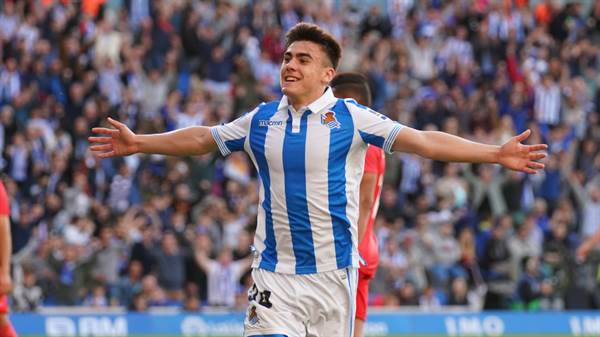
Our primary choice striker for the whole season was Mikel Oyarzabal (with DLF Jon Karrikaburu filling in on a few occasions). I was actually rather surprised how well Mikel performed in his support-focused role.
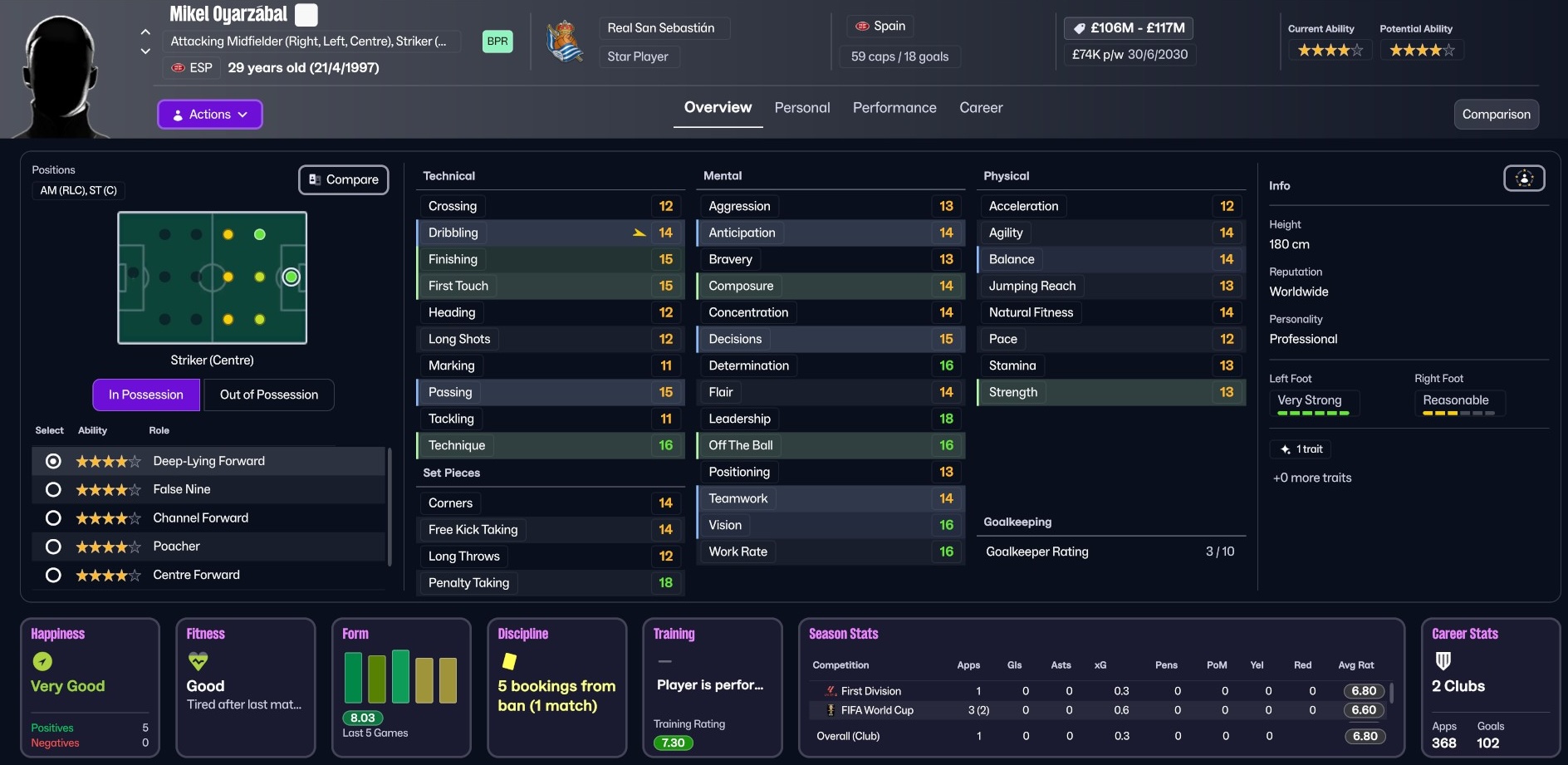
My hope for season 2 is to get Mikel even more involved in attack while maintaining his essential “link-up” function. Also, as you can see from his profile, Mikel is no push-over physically and is rather well suited to Deeplying Forward Role. I think as he ages, it might be an advantage to utilize his Balance, Jumping Reach and Strength rather than relying on his declining Dribbling and Acceleration. The DLF role should serve similar link-up function as the False 9 but do it in a much more physically imposing manner with less need to high mobility. In accordance with my preferred Basque Style, I would like Real Sociedad to inject even more physicality into our tactics in order to help us succeed in those ever-important battles against superior possession-hungry sides.
So a few tweaks to my Basque Football tactic are needed to make it, hopefully, even better this season. It’s about time for Basque Football 3.0!
Preliminary Tactic Requirements
In short, the updated “Swiss Army Knife” 4-2-3-1 tactic I am going to discuss today, is best suited to clubs that:
- Have an above average level of technical attributes spread throughout the squad – especially in passing, and dribbling (among the forwards).
- Possess above average physical attributes among its attacking core of players – you will need pacy wingers/wide forwards and physically imposing, strong lone striker.
- Field typical fullbacks rather than wingbacks. This is rather contrary to most modern-style 4-2-3-1 tactics where the wingbacks often act as the widest players while the wide attackers cut inside. My tactical vision does not require fullback players to aggressively overlap and be the widest roles in attack. It is preferable that they stay solid in the back while underlapping and offering backline security during transition. It is our wingers/wide forwards who should provide majority of team’s width and attacking threat. Consequently, my fullbacks need a combination of good defensive attributes like Positioning, Concentratio, Marking, and Tackling. Above average Teamwork and Jumping are recommended.
If your club does not check off these basic requirements, then it might not be well suited to this tactic. These requirements are irrespective of the status of the club. For example, you could be the top club in your league and not really have the players needed for my tactic. I have noticed that surprising amount of clubs in the lower leagues meet the requirements more easily for this type of “Pragmatic” football than elite “super clubs”. Maybe it is because those clubs are less obsessed with pure possession, or possession for the sake of possession, and tend to be more direct in their attacking approach. On a side note, it’s a challenge to recruit good wingback-type players for clubs with less means and reputation. From my past FM experience, good wingbacks become rarer as the seasons pass in-game and the game values them more and more. So it is always a bonus to make an effective tactic that does not need world-class wingbacks. In true Basque fashion, let’s make do with what we have!
Swiss Army Knife System Introduction
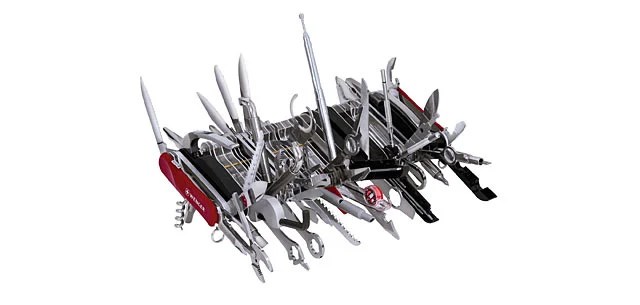
When I think of a Swiss army knife then immediately words like “versatility” and “surgical precision” come to mind. Those are also the key tenets of Pragmatic-style football that I have loved in Football Manager for a while now. It is no secret that I’ve been a long-time fan of Jose Mourinho’s tactics. Consequently, I often tried to install the values of Mourinhoe-style football into my tactics in previous FM versions.
Below is an example of such FM experiment which I chronicled on SI tactical forum quite few years ago:
Pragmatic style of football is often associated with managers like Jose Mourinho and typically more concerened with keeping clean sheets and winning “clinically” than maintaining superior possession or engaging in “flashy”, entertaining attacks. My kind of football! As you can see in the link above, I already wrote about it in 2021 when I created my first Swiss Army Knife Tactic with FM21 (also tested with Real Sociedad then). I will be taking some inspiration from that older tactic and trying to make the new and improved Swiss Army Knife Tactic (aka Basque Football 3.0) work in Football Manager 26.
Versatility and Adaptability in Attack
Versatility and adaptability are essential in football tactics. It makes perfect sense to me.
Good tactic needs to work consistently well against a variety of opponents. This is part of the tactic’s Versatility. Equally important is its Adaptability. A good tactic needs to be EASILY adaptable against different opposition. You cannot play exactly the same type of football against an underdog as you do against a superior elite opponent and expect similar results. The superior opposition might require your players to use a lower defensive line and/or line of engagement in order to defend more effectively and not leak too many goals against their elite forwards. While if you try the same approach against an underdog then you will probably sit in your half for most of the 90 minutes and end up with a rather boring scoreline of 0-0. You see my point, hopefully.
At the same time, you could go overboard in tactical tinkering and attempt to adjust your team instructions and formation to fit each opposition, making small or big adjustments before each match. This is not something I enjoy doing, nor endorse even though I emphasize things like tactical flexibility and versatility in my blogs. In my opinion such tactical micromanagement introduces too much minute fiddling into the game. This could get to the point where you lose the fun aspect of the game as it becomes a chore to set everything up before each match.
Instead I prefer to leave most of my tactical instructions unchanged between matches irrespective of the opposition. The changes that I do make before each match must be systematic and predictable. Not reactive and random. This reflects my primary tactical DNA – disciplined Basque Football distilled to its absolute essence.
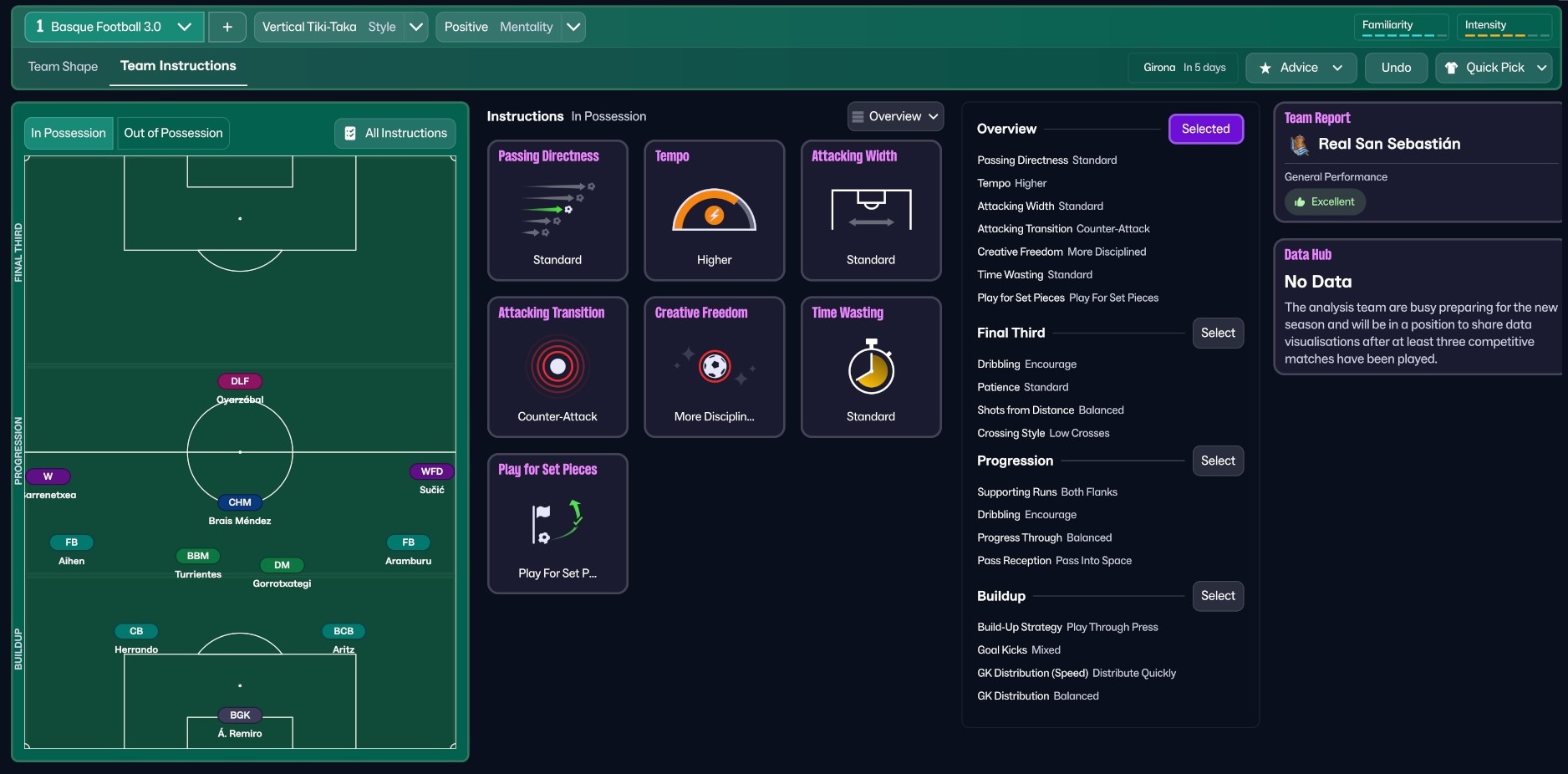
No matter, the opponent or the conditions of the match, I always want my team to play a very disciplined style of football that is wide, quick, energetic and decisive in attack just as it is solid, compact and tough-as-nails to break down in defence. The advantage of our technique, pace and flair on the wings needs to be balanced by the strength and energy offered by our strikers and midfielders. This is the Basque Way and the main objective of this FM Story series remains to emphasize and promote it.
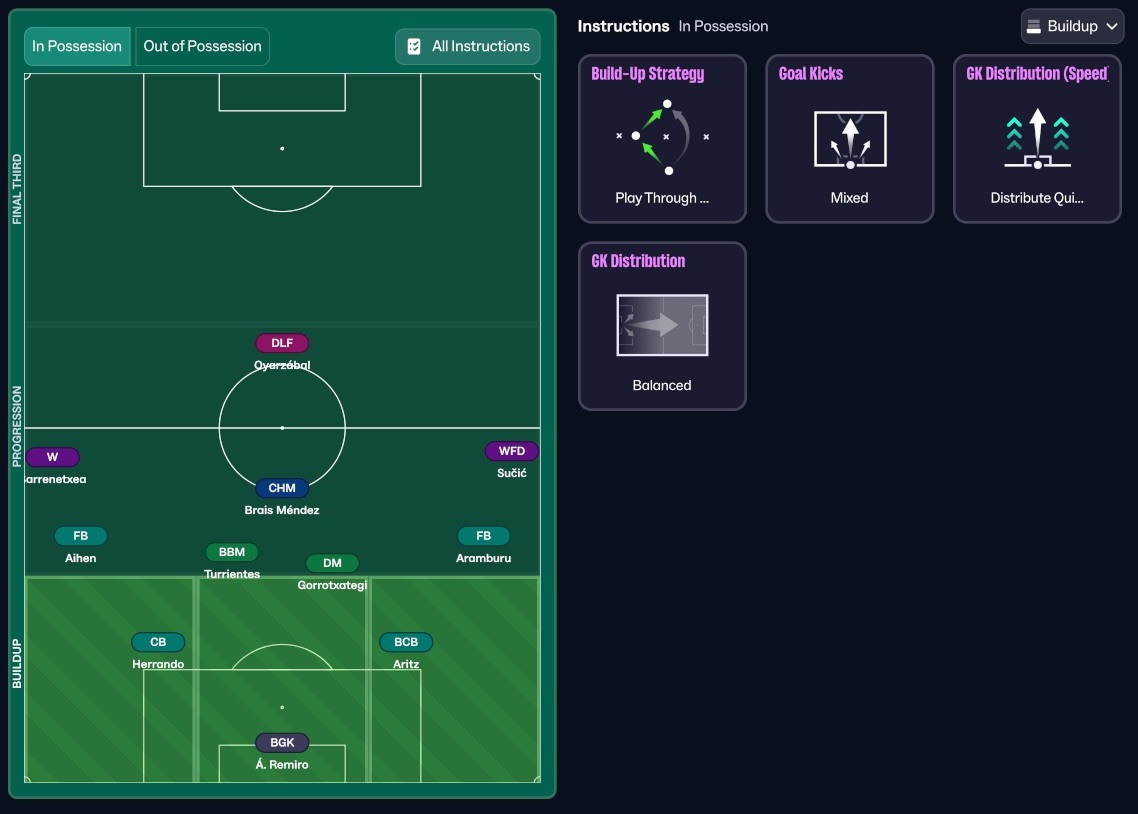
During our in-possession build up phase, I try to encourage this decisiveness and vertical ball movement by leaving my Keeper’s instructions pretty open-ended and give our GK free reign to choose the best passing options. At the same time I want him to distribute the ball quickly and spring more counter-attacks that way. We are definitely not playing direct, long-ball football here though. The team is technical enough and mentally strong enough to be able to play through the press and try to bring the ball forward. This is where we aim to use our winger advantage.
As we progress the ball up the pitch, there are THREE defining aspects to the tactic that emerge.
Firstly, note the absence of any traditional playmakers. I decided to make that change from the older versions of the tactic for one reason.
- To create quicker, vertical ball movement.
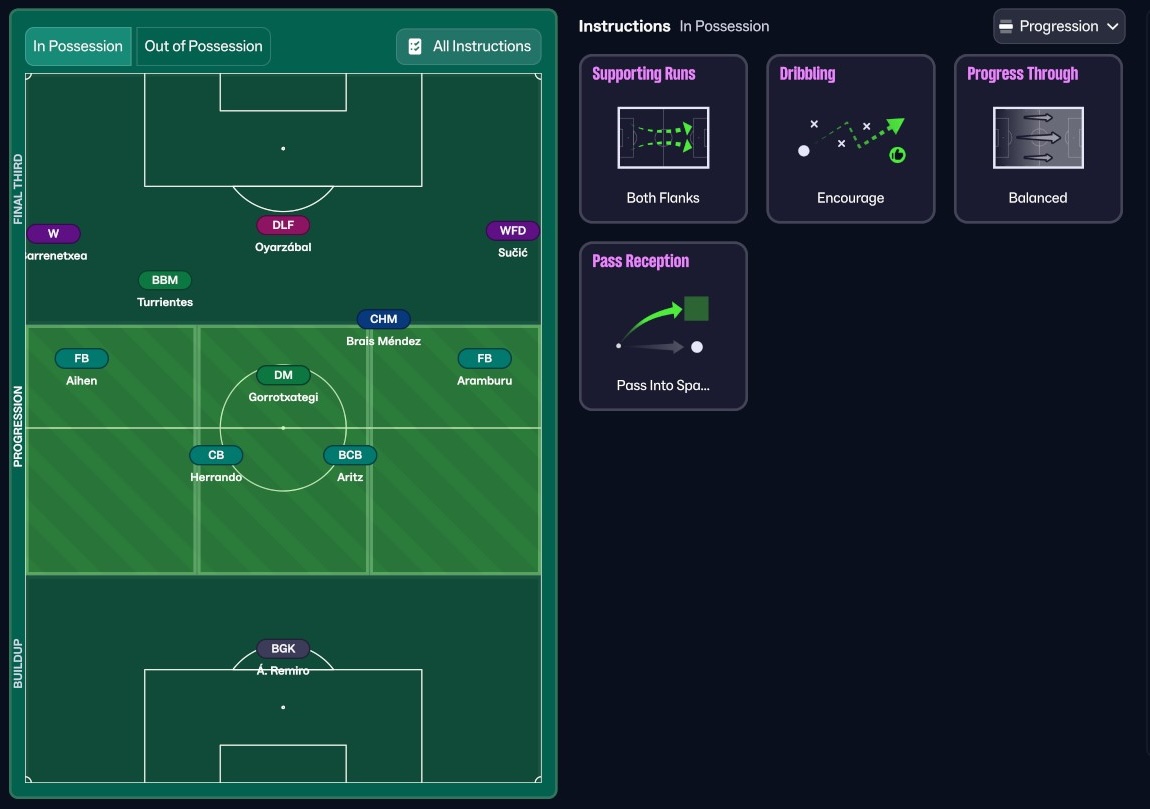
Without any playmaking magnets to draw the ball, and naturally slow down the play, the ball is instead drawn vertically via channels and specific roles up to our attackers. I want the ball to get up to our wide attackers and striker as quickly as possible BUT not via long-ball Route One method. Having a creative Channel Midfielder (our unofficial playmaker) positioned in the proximity of our Wide Forward ensures a good balance of supporting and attacking runner roles on the right. On the left flank, BBM runner is encouraged to use the open space left by the left Winger who in this case acts as support to the late arriving goal threat that is your Box-to-Box Midfielder.
- Secondly, the two instructions of “Pass into Space” and “Encourage Dribbling” are both there to draw advantage from our superior wingers.
Players like Luka Sučić with his good Dribbling, Anticipation, Off The Ball and Mobility (Acceleration and Pace) can thrive in the right type of tactic with those two instructions selected. High Mobility, Off the Ball and Anticipation are all needed for “Pass into Space” to work well while Dribbling is pretty self-explanatory.
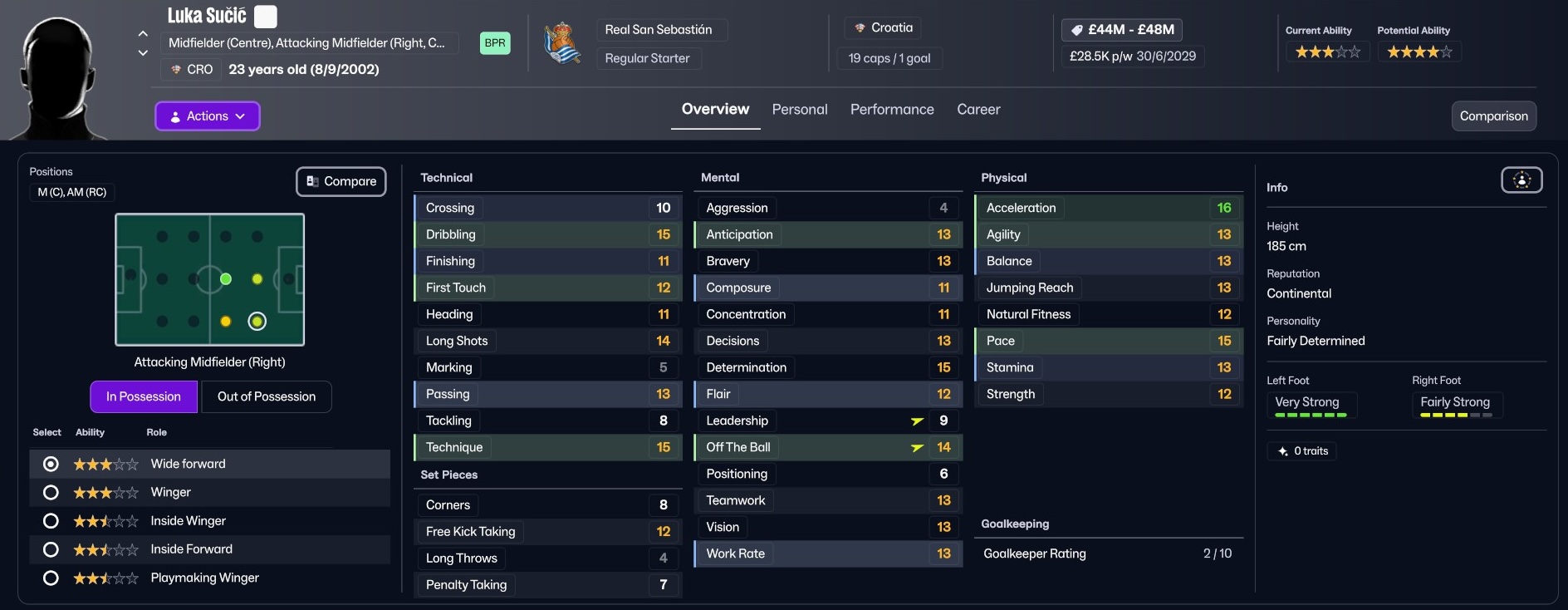
- Thirdly, underlapping Fullbacks are an important element of this tactic. They should provide a solid defensive foundation from which our front five attacking players can operate.
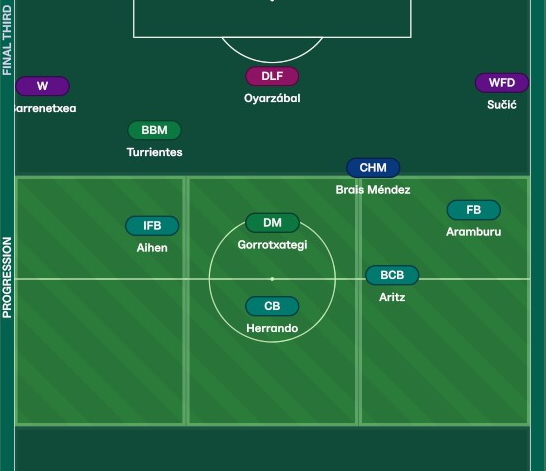
I have experimented with both Inverted and traditional Fullbacks. As you can see in the image above, regular Fullbacks will generally operate wider and provide more support on the flanks. However, when used on both flanks, the IFBs don’t position themselves as narrow as you might expect (like on the left in the image above).
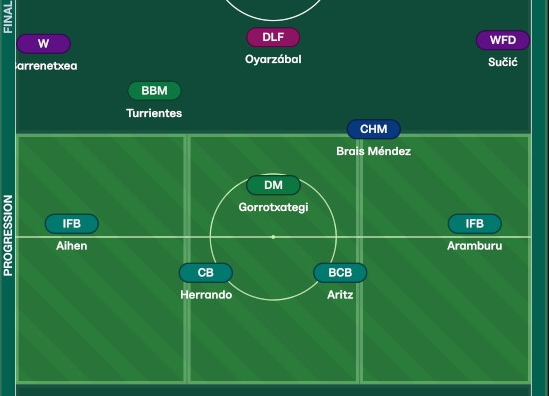
Here the two Inverted Fullbacks actually form a nice back four with the centrebacks while still providing a wide presence. A best of both worlds perhaps? Let’s see how things progress into the Final Third in the image below.
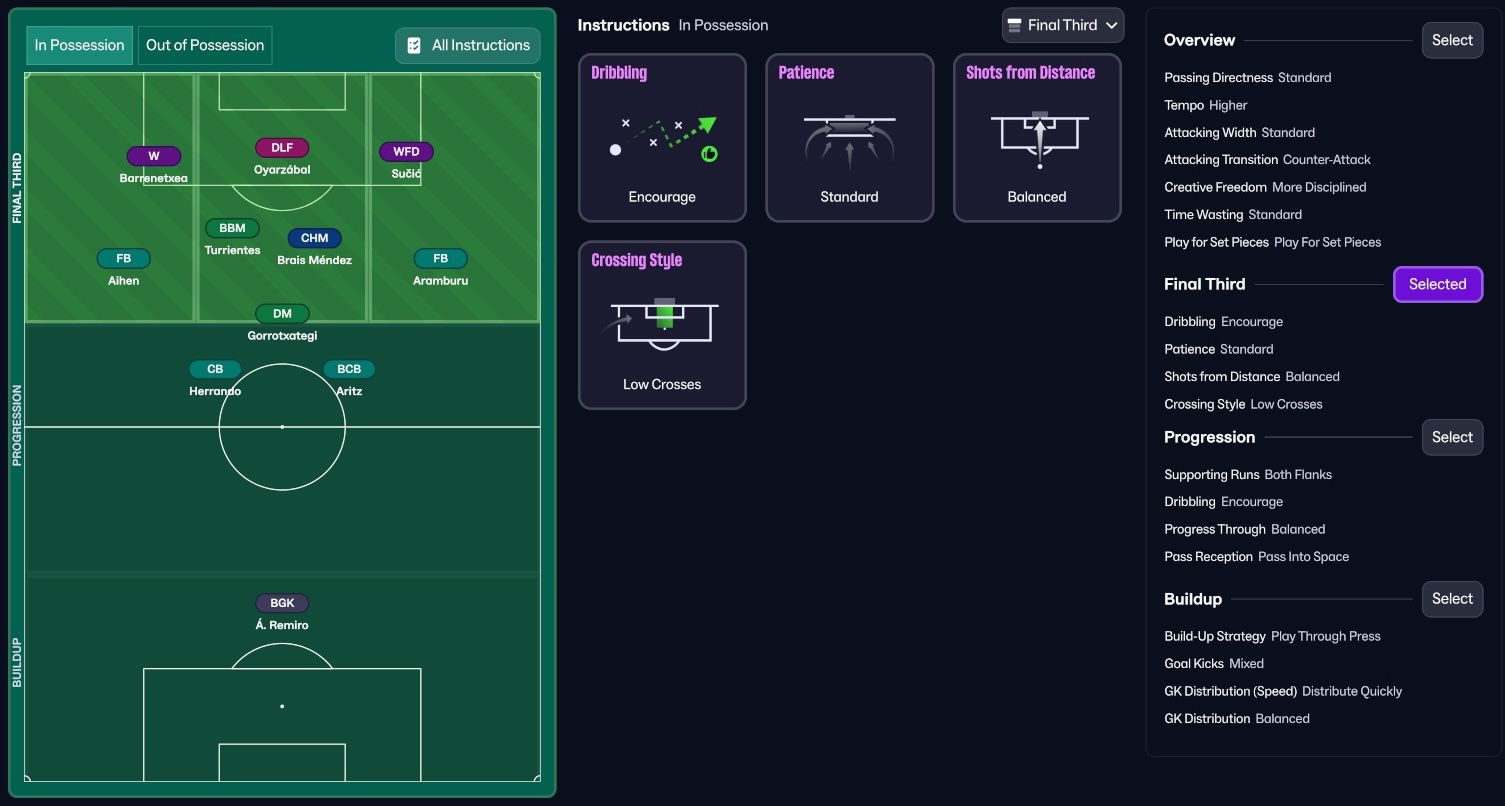
I think the deciding factor, on whether to stick with regular Fullbacks or to change them to “fancy” IFBs, came to me when observing the player movement in the Final Third. Regular Fullbacks, when instructed to underlap on both flanks, will actually advance and provide support from a relatively safe position from which they can still move back into their deeper defensive positioning, if the ball is lost. I really like the two attacking lines of four and three that we form with these selected roles. I neat 2-1-4-3 attacking shape!
Unfortunately, the IFBs on both flanks did not give us this shape, as they tended to stay much deeper in line with the two centrebacks. So I think I will keep the Inverted Fullback role in mind for the tough few matches where we are a clear underdog and expected to lose but otherwise stick with the regular FBs. Inverted Fullback is still a great role for the times when you require better defensive cover at the expanse of greater support during attack.
Versatility and Adaptability in Defence
I think that 4-2-3-1 remains the best formation to achieve the style of football that I am after. Due to the formation’s top heavy layout (which also works well for when you want to press high) it is ideal for progressing the ball vertically and quickly from defence. A great formation for Vertical Tiki Taka.
Another key aspect of the 4-2-3-1 is that it provides solid central protection ahead of the back four. Should the opposition play two central forwards, the deep midfield double pivot in a 4-2-3-1 can screen, block and back-press to cut out any attempted passes by the opponents. As I illustrated already in my Defence-First blog, the 4-2-3-1 can quickly morph during Out of Possession phase into a very defensively solid 4-4-2 or 4-4-1-1 with its 2 banks of 4. So essentially you have the best of both attacking and defending worlds when you employ a 4-2-3-1 IP/4-4-2 OOP hybrid tactic.
Naturally, Basque Football is all about versatility. Depending on the kind of opposition I face, there are few OOP instructions that I will tweak to better match my tactic to the opponent. To avoid the endless tinkering nightmare, I only systematically adjust the same few parameters to make my tactic more suited to the specific opposition. This way, as with any good experiment, I know which adjustments yield good results and which don’t. These quick changes result in about 3 to 4 versions of my tactic, depending on the opposition we are facing and whether it’s Home or Away game. I learned early in my FM career to always be less gung-ho in Away matches.
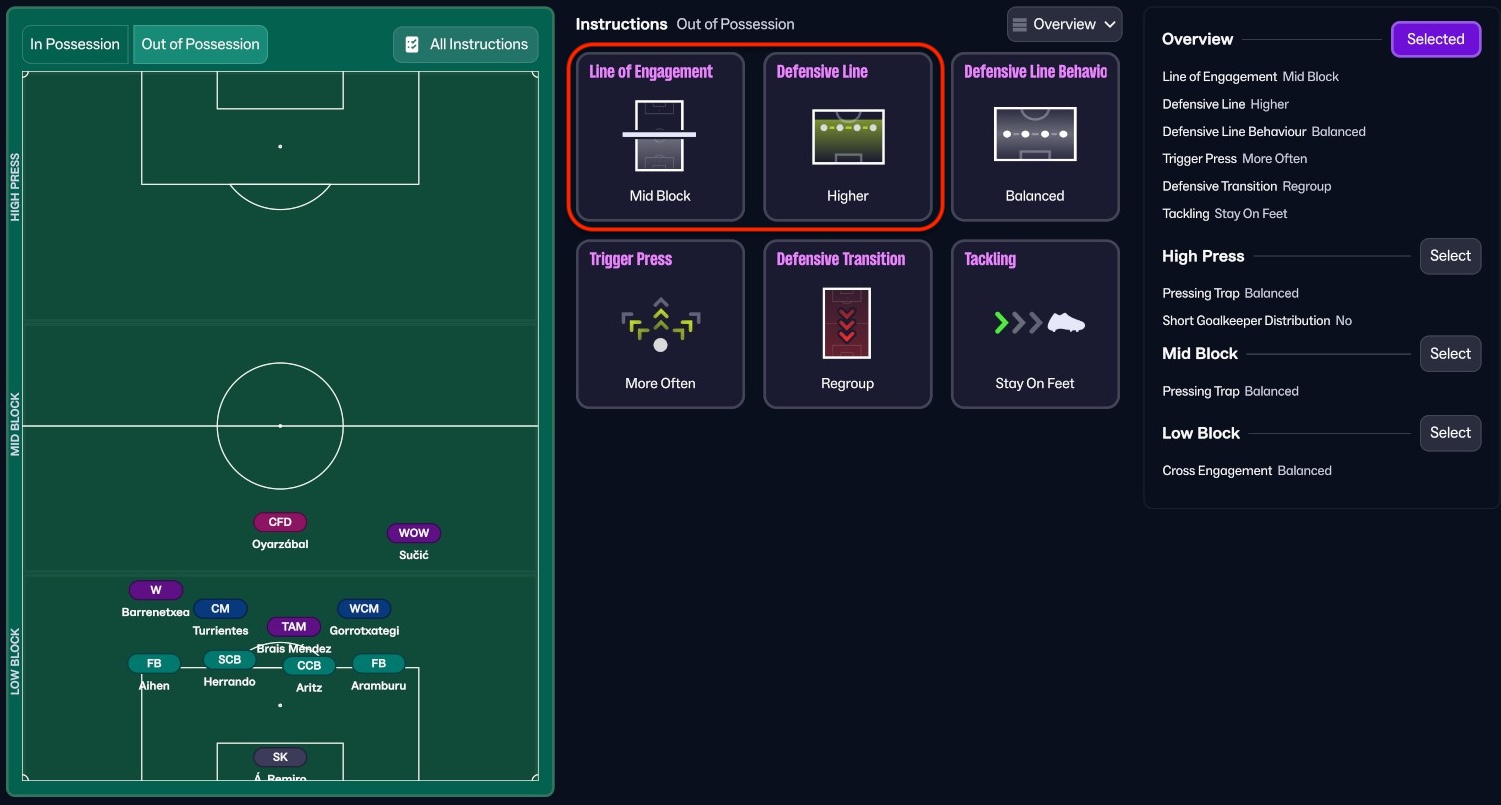
In the current tactic, the only OOP instructions which I ever really adjust are my “Line of Engagement” and “Defensive Line” ones. That and some midfield role changes. Sometimes I will ask my Winger to play as Wide Midfielder when we need more protection in our Mid Block or Low Block. I will also adjust tactic’s overall mentality sometimes depending on the flow of the game and how desperate we are for a goal (or to protect the lead). I tuned my tactic to the point where none of these tactical changes ever increases my overall tactical intensity. Even when playing on Attacking mentality with the highest LOE and DL, out overral tactical intensity remains 5/7.
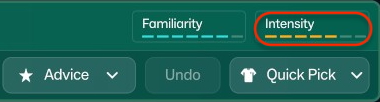
If you are looking for more drastic changes, then there is the final resort of changing the overall mentality of the tactic. Such as upping it from Positive to Attacking in the final 20 minutes of a losing match. Since my club is more or less expected to finish in top 5-6 of the table, we can pretty much play the majority of our matches on Positive Mentality. The only exceptions being matches against very defensive relegation-favoured underdogs or the two “topdogs” of Barcelona and Real Madrid. And even then matches against heavily favoured elite clubs don’t always mean a drop in mentality since considerations like Home advantage play a big role too.
My Ode Against Gegenpress
I really don’t like Gegenpress in FM26. But not for the reasons you might expect.
I don’t like it because I tried Gegenpress-style tactics and found that they injure a lot of my players while the results are not all that much better than when playing with a less intense style. And when my players are not injured then they are fatigued most of the time. This is very important since I found that my current level of tactical intensity (two pips from full) is near perfect in how it doesn’t tire my players too much between matches (even on weeks with 2 or more games) and keeps our overall injuries low.
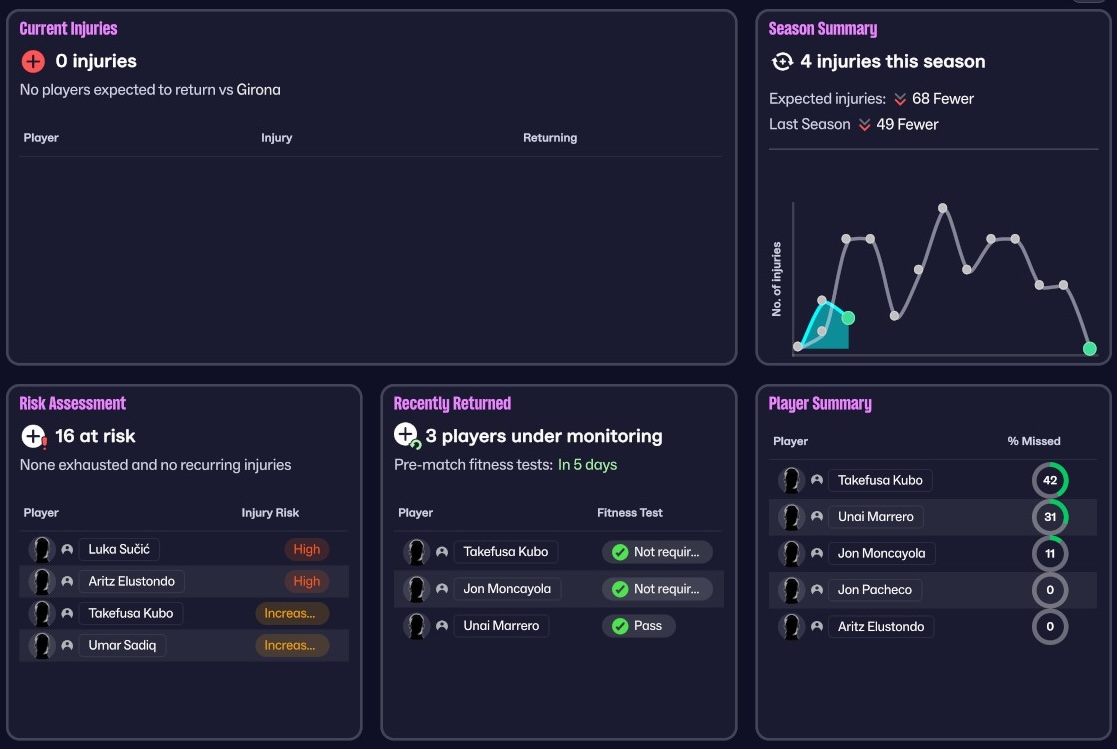
I know that Gegenpress tactics always seem to be the popular META in FM games but in FM26 one really needs to take into account the tactic’s intensity. Since running your tactic at full 100% intensity (red 7/7) can greatly increase your players’ injury susceptibility. There has already been a lot of talk of increased and “unfair”, “bugged” injuries on the game’s forum and other social media platforms. But it honestly makes me smile when I see that. I can bet 100% that a lot of these “unfair” injuries could be averted if only the player paid more attention to how their chosen tactic affects the overall intensity level and how it fatigues your players. There is a definite trickledown, accumulative effect that can come back to bite you in the arse come midseason. If you take time and pay attention to what actually causes injuries in your squad and make appropriate changes (rest your tired stars and use realistic team rotation) then I believe many (if not most) injuries can be avoided.
Anyhow, that was just a little aside. My main point is that sometimes it is not the best idea to use intense Gegepress-like tactics, all the time. It might work for some elite teams and might help you win most games with such teams. But if you think about it, such clubs already have quality technical players to be able to win even without intense Gegenpress tactics. Others might have their preferences but to me clinical precision and minimalist (relatively speaking) effort is what defines a good fine-tuned tactic. Success feels much more satisfying with such tactics then when you brute force your opponent into submission with your superiorly fit squad. I do not mean that counter-attacking and low-block defending should be your one for all strategy. The truth is farthest from that. As sometimes playing low-block defensive football can be more intense and draining on footballers then even the most aggressive gegenpress. No, this is where the tactical versatility and adaptability come into play. You want to create a tactic that at its core is very versatile and suited to a wide variety of opponents AND can also be easily adapted (via minimal tweaks) to different match situations. Such tactics should be intuitive and easy to use. Most importantly, they should not make your pre-match preparation overly onerous and lengthy. So let me explain this via a few examples from my own tactic.
Swiss Army Knife Tactic – FM26 version
After long experimentation I fine-tuned my Basque Football 4-2-3-1 tactic just the way I like. It’s never going to be perfect and the job of tactical tinkering is never finished (as many FM grognards will perhaps agree) but at least I managed to update my tactic to be much more versatile and adaptable against variety of opposition. And the adaptations can be done quickly and easily via a few easy-to-remember rules.
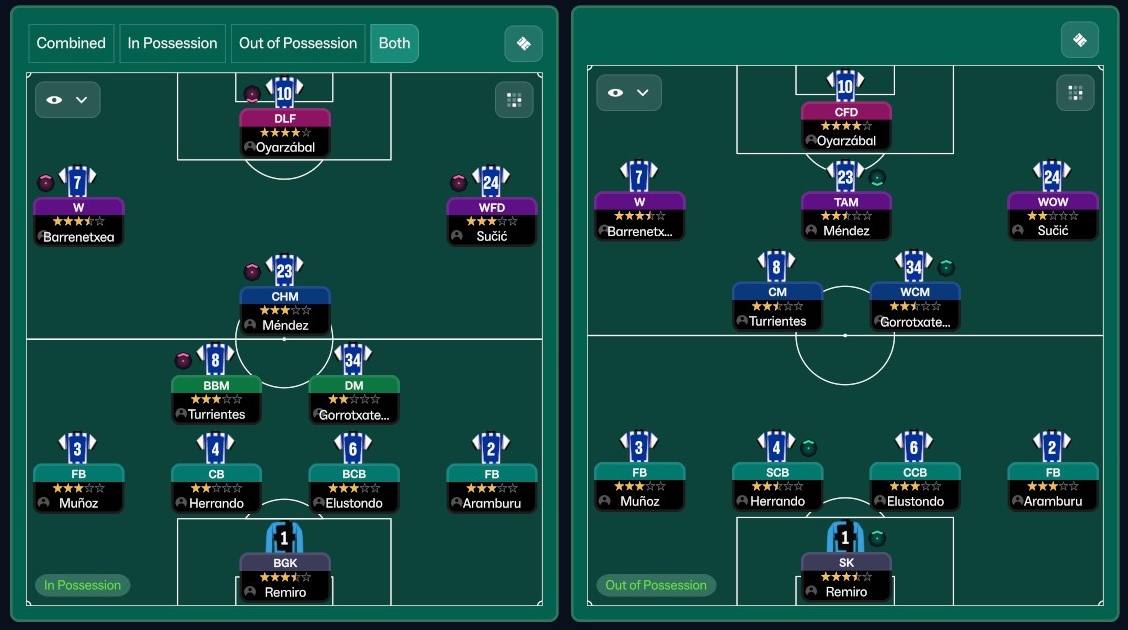
What I like about this new 3.0 version of my Basque Football tactic is that now it’s set up to be used with many mentalities from “Defensive” (if you wish) to “Attacking”. And despite mentality change the overall tactical intensity remains at the same 5/7 level. I would not recommend using “Very Attacking” as it offsets the balance and increases the intensity, meaning that if played for extended period, player fatigue will increase accordingly and risk of injuries will go up. So while I would not hesitate to use Attacking mentality for the whole match against an underdog sitting back in their own half, the extreme “Very Attacking” mentality might only be appropriate for the last minutes of a match where you are loosing by one or more goals and have nothing to lose. And a victory might mean something more than just another 3 points in the table.
In the screenshot above, my OOP shape might not look very defensive and some might argue that it looks even more attacking than the IP shape. But in fact, our OOP formation is that way for a reason as it is way more adaptable to varied tactical situations.
Firstly, it’s starting top heavy shape is great for when I want my team to High Press. I use this aggressive method of defending in matches where I am an absolute favourite and expect my opponent to sit back and park the bus for the majority of the match. In this case, I switch my Line of Engagement to “High Block” and set my Defensive Line to “Much Higher”. The formation shape I keep the same for the most part. The only role change I would make is using a generic Attacking Midfielder in the AMC position. I don’t need my AMC to track back as much in High Block.
Generally in a High Block situation I favour using AML/AMC/AMR roles to press high and give some breathing room to my backline. The advanced winger/fb combo works really well for this. Whenever I require my team to be more defensive I switch to the Tracking AM role and change the Winger role to Wide Midfielder. The only instruction which I adjust is the Line Of Engagement one since it is my “where do we defend” toggle. Is the opponent sitting back in their own half? Then we need to defend there because it is unlikely that they will wander into our own half very often. Our defence needs to be more proactive as we try to win the ball back high and give the opposition less time to waste with it.
However, for most of my matches I will use the Midblock set-up with Higher DL and the role distribution as seen in the image above. Note the nice asymmetric 4-4-2 shape when out of possession.
Sometimes I will switch my winger roles into their midfield strata equivalents and transform the formation into an even more compact 4-5-1. For increased defensive cover I could also use wide midfielder role on the left. But even without changing the winger roles, the tactic morphs into a nice compact shape of 2 banks of 4 in the Midblock. That is exactly what I want to see!
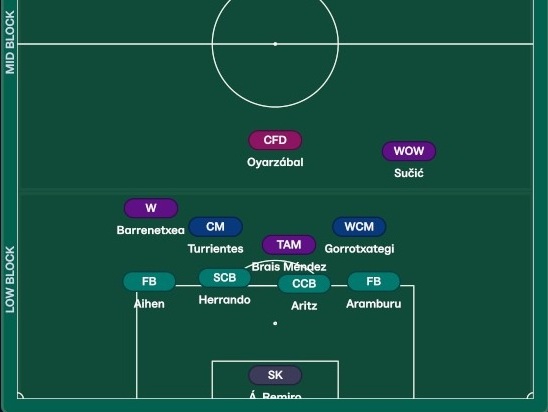
The Low Block is generally my least used defensive set-up. I will use for the few times when we are the underdog (or during Away match against an equally strong opponent). Yet as with the High and Mid Blocks I follow my golden rule of ideal compactness by pairing Low Block LOE with Standard DL. As a little side note, I want to explain this “golden rule”.
- Going as far back as the introduction LOE and DL into Football Manager, I have always used Defensive Line that is one notch higher then expected. So Higher DL (instead of Standard) for Mid-block, Standard (instead of Low) for Low Block and Highest for High Block. This way there is always less space between my midfield and centreback lines which is ideal for creating compact defence, especially in 4-4-2 formation.
The thing with FM26, is that we should be less hesitant to use Low Block defending shape together with a very attacking in-possession formation. In previous FMs, Low Block acquired a reputation for putting the human player at a disadvantage against the AI opponents. Well not anymore. Judging from my recent experimentation with an attacking 4-2-3-1 that defends in a low block. For some matches I was able to keep the opposition xg very low, even for some very good sides like Real Madrid. Understandably you will run into issues when trying to defend in such a manner against underdogs or other more equally-matched opponents. But that is where my Swiss Army Knife Tactic’s adaptability comes into play. I assure you, that if you take a little bit of time to adjust your Line of Engagement and Defensive Line (and make a few role changes perhaps) you will always have an easier time in FM26, no matter who is your opponent. Happy management and happy holidays!
To be continued….
Postscriptum
PS: Those who have followed this blog series since it’s start in October should probably note that there might a bit more time between now and my next blog entry. I have run into a little (but at the same time quite significant for me) snag with my save. I found out recently that there is a bug in FM26 that is preventing me from hiring more B Team coaches.
So even though the game tells me that I have room for more (and I do not have any except for the Manager and Assistant Manager), I cannot hire more. Trust me, I tried. I signed multiple B Team coaches between June and August and while they appear to accept my contract, they never show up in my coach list. And weirdly, their career page shows that they have been hired by our club. Not really sure whether its purely UI bug where the game simply does not show information properly while the coaches are still there and doing their job under the hood? Currently, I have quite a few very good prospects in my B Team affiliate. As you probably remember from my previous blog, having a fully functional B Team is very important in my Youth Development method. I generally like to promote my best u19 players to the B Team so they can take advantage of our superior coaching and facilities while playing in a competitive league (Segunda Division). Loaning is usually my last resort as it gives me virtually no control over young player’s training and game time. So yes, until this issue is fixed, I dare not continue with my Real Sociedad save lest my prospect players’ development suffers. Loaning them all out and/or putting them into my First Team does not really seem like an ideal solution.
Because of this, further testing of my Swiss Army Knife system might require that I start another save with a team that has no B team affiliate. Only a short holiday from San Sebastian hopefully.

 The Gaffers Lounge
Leave a comment