
CHUR’S NEW INTELLIGENCE: HOW A PART-TIME SIDE IS REDEFINING PERFORMANCE METRICS IN PART-TIME SWISS FOOTBALL

When you work in the shadows of Switzerland’s footballing centres, innovation becomes a survival tool. In Chur’s case, it has become an identity. During a mid-season visit to the club, we gained rare access to the three bespoke analytical metrics developed by the coaching staff:
- Defensive Intelligence Index (Interceptions ÷ Tackles)
- Vertical Threat Index (Dribbles + Progressive Passes)
- Intensity Load Index (Distance ÷ Sprints)
The numbers offer a window into how Chur play, who they rely on, and why – despite part-time status – the club operates with a clarity of tactical vision usually found much higher up the pyramid.
DEFENSIVE INTELLIGENCE INDEX — “WHO THINKS FIRST?”
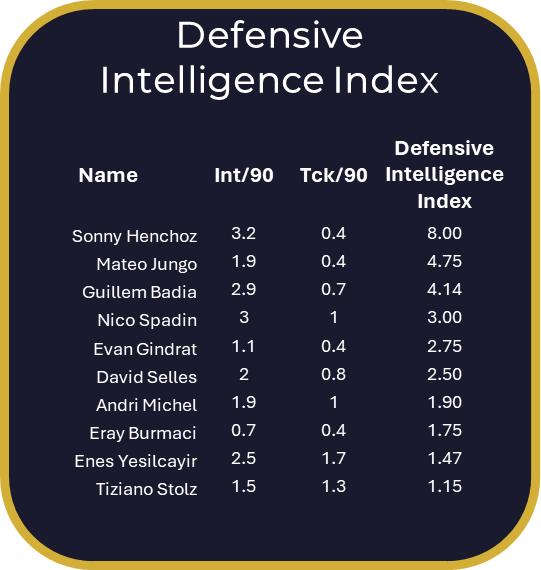
In a league often defined by chaos, Chur defend with surprising cerebral calmness. The Defensive Intelligence Index (DII) measures anticipation rather than aggression – interceptions divided by tackles – and the table is revealing. Sonny Henchoz sits at a remarkable 8.00, an almost unheard-of figure and unmatched within the squad. His 3.2 interceptions per 90 compared to just 0.4 tackles paints the profile of a chess-player defender — someone who solves the situation before physical contact is required. Mateo Jungo (4.75) and Guillem Badia (4.14) round out a top three that shows how the team’s spine reads danger early.
Chur’s block is built not on last-ditch duels, but on pre-emption. They squeeze forward, demand early decisions, and rely on intelligent defenders to collect loose balls rather than chase them. The team-wide average – 2.56 – reinforces that this is no accident but a stylistic imprint: Chur defend with their brains.
VERTICAL THREAT INDEX — “WHO BREAKS LINES?”
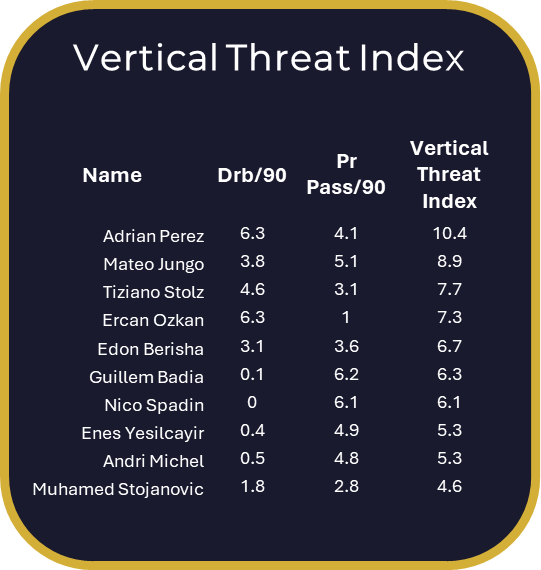
If the Defensive Index reveals how Chur survive, the Vertical Threat Index (VTI) explains how they attack. Adrian Perez tops the list at 10.4, driven by 6.3 dribbles and 4.1 progressive passes per 90. He is the system’s accelerant – the player who changes tempo instantly. Mateo Jungo (8.9) again emerges as a high-impact, multi-phase contributor. Tiziano Stolz (7.7) and Ercan Ozkan (7.3) provide a balanced mix of dribble-led and pass-led progression. The club’s verticality is distributed widely across roles: wide forwards carry, central players pass, and defenders step in when opportunities appear. The average of 5.48 shows a team that does not value sterile ball circulation; they look up field, instantly.
Chur’s attacking style is rooted in forward ambition. They attack fast, use runners between lines, and emphasise players who turn possession into penetration, not pauses.
INTENSITY LOAD INDEX — “HOW DO THEY RUN?”
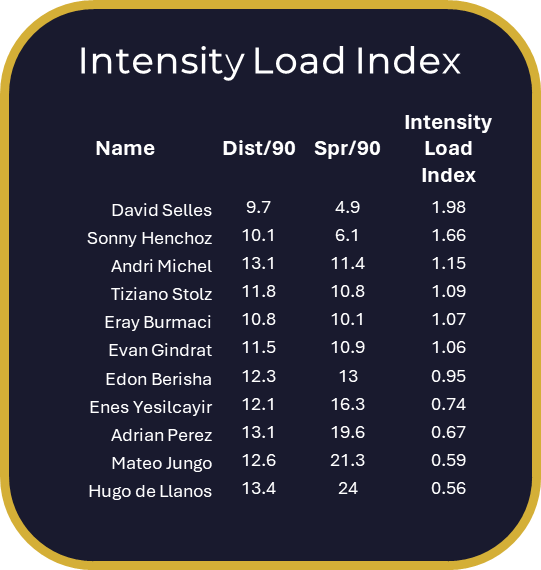
The most revealing of the three metrics may be the Intensity Load Index (ILI): distance covered divided by sprints. Rather than measuring how much players run, it reveals how they run. The ILI highlights a team that works steadily rather than explosively. David Selles (1.98) and Sonny Henchoz (1.66) top the list as constant-movement players: steady shifters, always adjusting, rarely sprinting wastefully. Andri Michel – the holding midfielder – (1.15) and Tiziano Stolz – the wide man tasked with getting up and down, keeping chalk on his boots – (1.09) provide similar long-duration work rates. The team average of 1.03 suggests that Chur lean into endurance and structure, not transition chaos. There are, however, players below 0.80 – including Adrian Perez (0.67) and Mateo Jungo (0.59) – who represent the opposite movement profile: explosive, high-burst contributors relied on for pressing and counter-transition.
Chur blend two movement types: a stable base (high ILI): defenders and controlling midfielders who keep the structure intact and explosive disruptors (low ILI): attacking players who break lines and press aggressively. The balance allows Chur to maintain shape without sacrificing vertical aggression.
WHAT THE THREE METRICS REVEAL ABOUT CHUR AS A TEAM
Across all three datasets, Chur show a coherent identity:
1. They defend with anticipation, not reaction: High DIIs across multiple positions indicate a team drilled in reading patterns, not chasing them.
2. They attack with purpose: The Vertical Threat Index shows that progression is a shared responsibility – a collective philosophy rather than the burden of a single creator.
3. They run intelligently: The ILI splits the squad into stabilisers and accelerators, giving the system rhythm without sacrificing intensity.
This blend is rare for a part-time side. The data suggests not just a tactical plan, but a cultural one – a team that values intelligence, verticality, and purposeful work over raw athleticism or pure grind. In an era where analytics trickle down slowly into the lower leagues, Chur have chosen not to wait. They have built their own language of football – metrics that match their game model, not someone else’s. The three indices tell a story of a club that knows what it is, what it wants to be, and how to measure the behaviours that matter.
For a side fighting above its weight, that clarity might be the real competitive advantage.




 The Gaffers Lounge
Leave a comment