

How Chur Have Quietly Become a 1. Liga Force

There is something quietly remarkable about the way Chur have announced themselves to the 1. Liga Classic. No fireworks, no noise, no sweeping statements – just a slowly accumulating sense that this team, newly promoted and still operating on a modest wage structure, has more about it than most expected. Sixth place after fifteen games is not glamorous, but for a club taking its first steps in a higher division, it feels like milestone after milestone has been ticked off in silence.
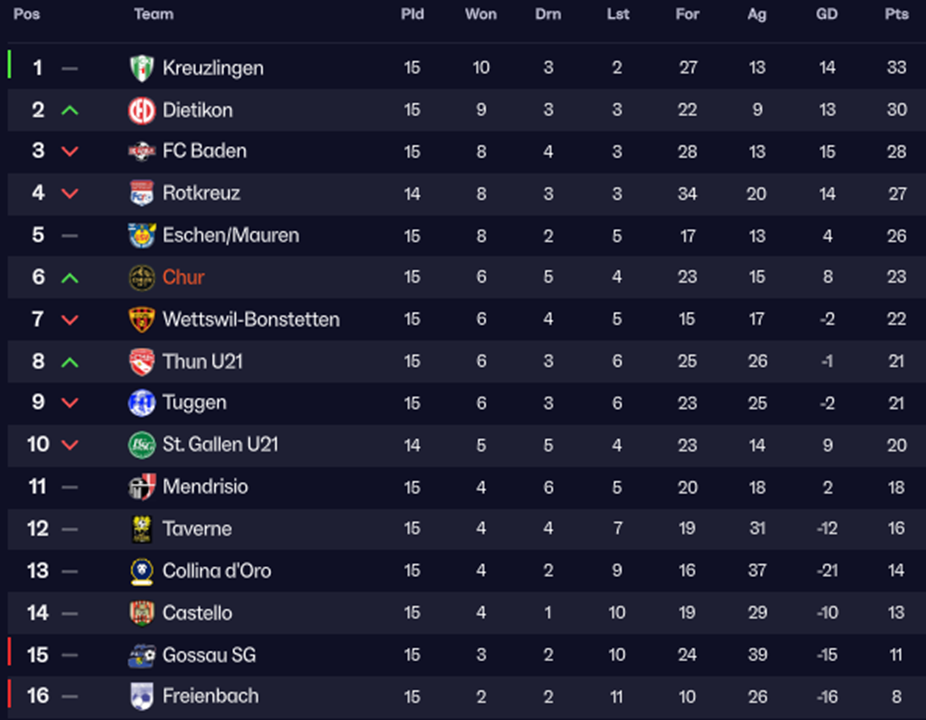
What makes their position more striking is how complete they look statistically. Their defensive radar shows a side outperforming the league average in almost every area that matters: high possession wins per game, controlled xGA, and a capacity to keep opposition shots manageable despite recording just five clean sheets. This is not an accident. It’s a by-product of defending early, not late; preventing emergencies rather than surviving them. Chur’s defenders are not last-ditch heroes – they don’t need to be. They read danger early, they intercept, they block, they shepherd rather than slide. The numbers back it up: they sit in the division’s upper bracket in defensive actions that favour anticipation over chaos. It’s not glamorous, but in this league, it is gold.
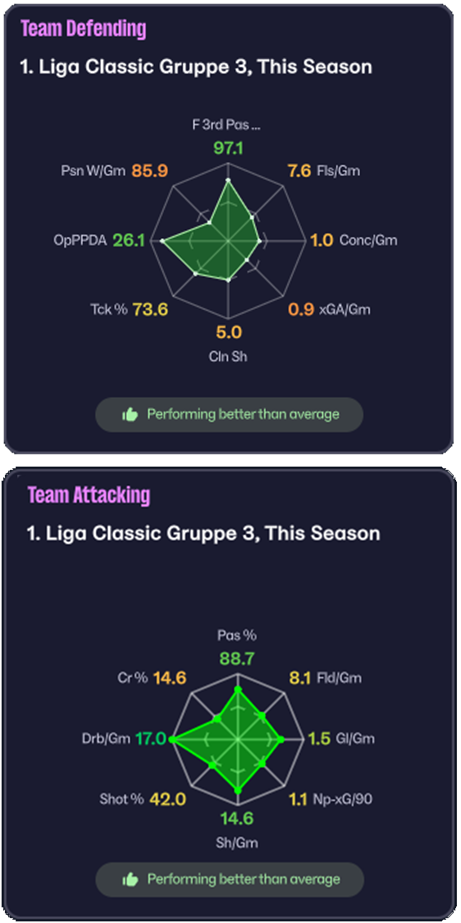
The attacking radar, meanwhile, reveals a team surprisingly progressive for their resources. With strong pass accuracy and high dribble volume, they’ve carved out a style that feels expressive without being reckless. And central to that expression is Tiziano Stolz, whose 10 league goals are the axis around which the season has turned. Stolz is not a dominant target man and not a pure poacher – he plays like a forward who understands the rhythm of this team, arriving, drifting, timing runs that exploit the structured spaces created by Chur’s layered buildup. When the game tilts, it is Stolz who turns the pressure valve by appearing exactly where a defender doesn’t expect him.
But goals don’t arrive in isolation, and Chur’s creativity has developed two very distinct channels: Enes Yesilcayir and Mateo Jungo, the runners who stretch defensive blocks to breaking point: not volume passers but they make it count. Between them, they’ve provided 11 assists – six for Yesilcayir, five for Jungo – but they supply danger in completely different ways.
Yesilcayir is the chaos agent. He presses high, arrives in the box like an extra forward, andshoots often enough that the coaching staff probably breathe through their teeth whenever he winds up from 18 metres. The problem is his accuracy – he gets into great positions, he hits the ball with conviction, but rarely with the precision that turns half-chances into goals. Still, the underlying threat is there, and the numbers don’t lie: few players in Chur colours force back lines into more uncomfortable reshuffles.
Jungo, by contrast, does his damage through movement rather than individual incision. He’s the runner who doesn’t just break lines – he exposes them. His pass volume is lower, but that’s because his passes are high-risk by design. He tries to hurt teams, not recycle possession, and while that means the ball is sometimes lost in dangerous zones, it also means Chur carry immediate forward threat in transition moments. He is one of the main reasons their attacking radar shows such strong final-third presence.
Then there is the midfield engine room, where the contrast in styles is even more dramatic. Adrian Perez plays football like someone who has swallowed caffeine tablets before warm-up – all action, all acceleration, all volume. His game is loud, energetic, and relentless. In a team that relies on running power to bridge the gap between defensive stability and attacking fluidity, Perez is the bridge itself. Set beside him are Berisha or even the young Favaro, two players who see the pitch as a puzzle board. Both specialise in threading passes into pockets or retaining the ball higher up the pitch. They don’t run as aggressively as Jungo nor crash the box like Yesilcayir, but they give Chur the ability to slow the game, to create thoughtful moments that stand in contrast to the otherwise high-octane approach. Their contributions show up subtly in the attacking numbers – elevated pass accuracy, strong chance creation – and in the fact that Chur rarely look panicked in possession.
The broader picture, though, is of a team that has adapted shockingly well to the step up in competition. Their position in sixth feels like a fair reflection of their performances: good enough to trouble anyone, structured enough to avoid crisis, but still missing the ruthlessness that could convert promising metrics into a sustained climb up the table.
And perhaps that’s the story of their first half of the season: a newly promoted side that looks like it belongs here. A side whose numbers match their ambition, whose players look comfortable at a higher level, and whose standout performers – Stolz, Yesilcayir, Jungo, Perez, Berisha – are shaping an identity that feels more and more defined with each passing week.
If the second half mirrors the first, Chur will not just survive this level. They will begin to reshape expectations entirely.




 The Gaffers Lounge
Leave a comment