
As the dust settles on what has been an electrifying first season in Porto, the final whistle always brings a mix of emotions. This post serves as our comprehensive end-of-season summary, a deep dive into the campaign that promised so much yet ultimately left us wanting more. We’ll be dissecting our underlying numbers, the key moments where things arguably went wrong, and our performance in the UEFA Europa League. Finally, we will measure the team’s overall performance against the saves short-term goals, providing an honest and complete picture of where the Dragões stand as we head into the next chapter.
Season Summary: The Numbers That Deceived

The raw statistics paint a picture of total dominance—a side that was fundamentally superior to every other team in the Primeira Liga, including the champions. Yet, this is where the Moments of Glory meet the reality of the Unfinished Business.
- Attacking Firepower: Our forward line was sensational, evidenced by the most goals scored (+21) and the league’s highest Non-Penalty Expected Goals (npxG) at +1.86 above the nearest competitor. This suggests our offensive output was not only high but also consistently high-quality.
- Defensive Steel: The backline was equally impressive, recording the lowest Expected Goals Against (xGA), 4.07 goals fewer than any other side. We were stingy in allowing chances, a hallmark of Porto’s style.
- Goal Difference: The combined brilliance resulted in a league-leading +20 goal difference, a metric that often correlates directly with championship success.
- The Expected Points Paradox: Perhaps the most painful stat is the Expected Points (xP) calculation. Based on the quality of chances created versus those conceded in every match, Porto were expected to finish at least five points better than our actual standing. The model suggests that, over the course of the season, we were simply unlucky—or, crucially, lacked the necessary ruthlessness to turn statistical advantage into cold, hard points.

The stark reality: Porto possessed the best underlying data in the league but finished six points behind an undefeated Sporting. The difference wasn’t the quality of play over 34 matches, but the failure to convert statistical supremacy into the ultimate prize.
Section II: The Cold Reality – Where the Dragon’s Fire Went Out
The Crucible of the Big Games: Why the Blueprint Failed Early
I think you’ll agree that we have had an amazing first season – the numbers which the current squad have been able to consistently achieve are nothing short of exhilarating. However, when the real tests arrived—when we faced our direct rivals—the tactical rigor turned to chaos.
*Below is our Head to Head results from all competitions.
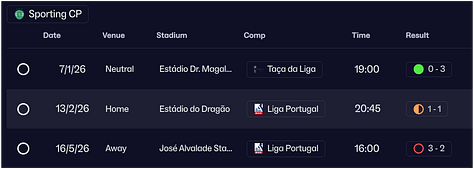
The numbers don’t lie. In the league, against our direct rivals—Sporting, Benfica, and Braga—our performance has been unacceptable. We entered the season needing to assert dominance, but instead, we saw fundamental failures in executing the Game Model we preached.
The Crisis Point: Failure to Execute Tactical Rigor
Across six crucial matches against our main rivals, our record is abysmal: 5 points from 18.
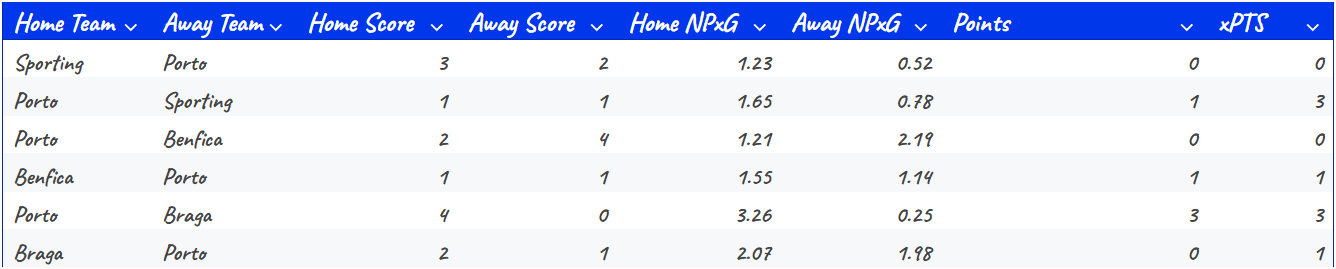
The NPxG data is damning. In three of these six matches, our expected goals conceded was significantly negative, proving the absolute breakdown of the high defensive line and coordinated pressing. We are conceding high-quality chances too easily—a direct failure of the Farioli mandate.
The Bogey Team Problem: Gil Vicente’s Humiliation
But the crisis runs deeper than the Clássicos. The true measure of a champion is consistency, and against teams we must dominate, we have been humiliated by what appears to be our bogey side: Gil Vicente.

Against Gil Vicente, we dropped four points from a possible six. The problem here isn’t a lack of talent; it’s a failure of professionalism and focus. We were tactically superior away, yet settled for a draw. At home, we displayed an anemic attack, unable to generate the necessary high-quality chances against a side that parked the bus.
Section III: European Redemption – The Night of the Triumph
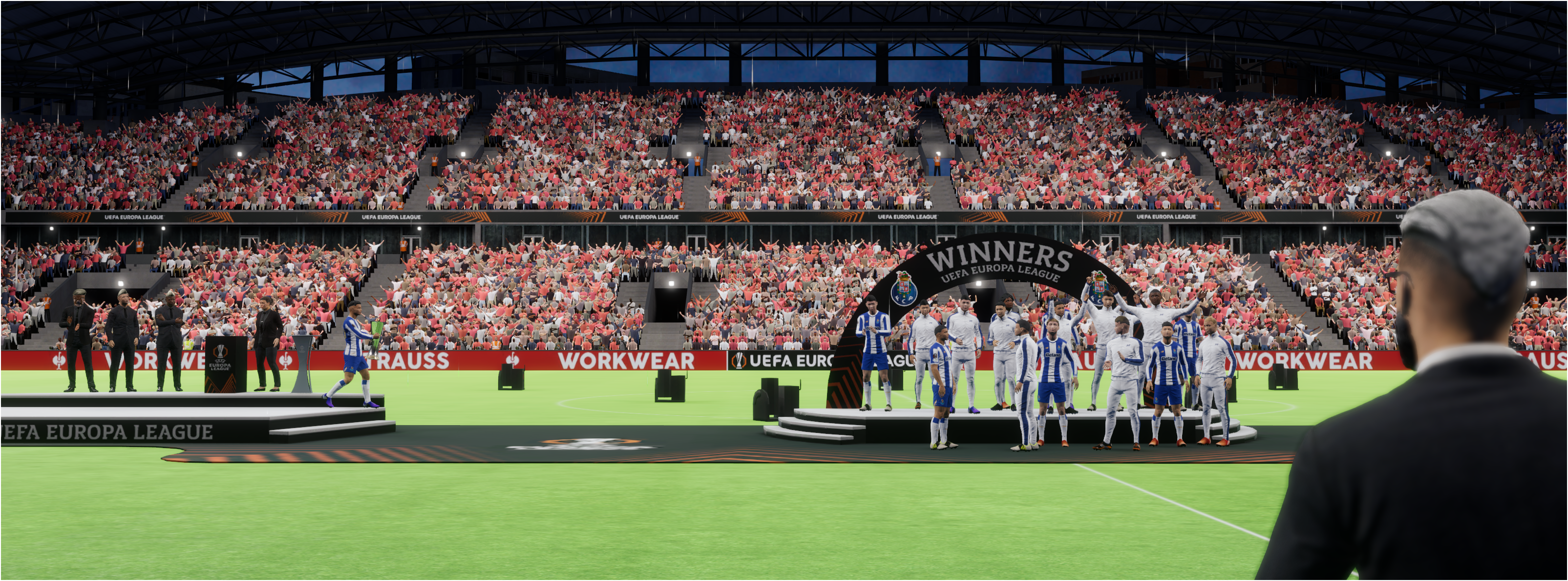
My inaugural season in charge of FC Porto culminated in immediate, spectacular success: lifting the UEFA Europa League trophy. This victory not only marks a crowning achievement for the club but also continues a personal, almost uncanny, trend of European conquest, following previous seasonal triumphs with OGC Nice and Ajax.

This hard-won European title, Porto’s first since the Europa League success in 2010/2011 (when they defeated fellow Portuguese side Braga 1-0 in the final thanks to a goal from Radamel Falcao), has resoundingly restored the club’s status on the international stage. Yet, the work has only just begun. This is merely the foundation upon which we will build our ultimate ambition: to solidify our standing as the continent’s preeminent team by securing the UEFA Champions League title.

The Structural Triumph: Four Defensive Pillars in the Team of the Season!
This is not just an achievement; it is a triumphant validation of the tactical foundation and structural genius brought to this club! To see five of our players named in the UEFA Europa League Team of the Season—including an astonishing three key defensive structural players—proves the success of Farioli’s system is rooted in defensive mastery.
This recognition validates the complex principles of Vítor Frade’s Tactical Periodisation: the success of the attack is built on the stability of the defense. The world is recognising that the high demands we place on positional discipline and the Rest-Defence are utterly devastating to the opposition.
The world is celebrating our defensive spine and tactical specialisation:
- Kiwior and Bednarek are recognised for their composure and technical excellence as Ball Playing Defenders, proving that the high-risk Lure Build-Up is sustainable only through their precise execution.
- Francisco Moura and Alberto Costa are acknowledged as the supreme executioners of the Fullback role, managing the complex duality of providing central overloads in attack while locking down the flanks defensively. Their selection proves the structural effectiveness of our system.
- And up top, Samu Aghehowa is rightfully named for his phenomenal output, demonstrating that the foundation laid by the defense ultimately gives our Pressing Forward the freedom and positioning to be a lethal, high-energy closer.
We stand immensely proud that our players have showcased the absolute cutting edge of tactical football on the continental stage. This is a testament to the collective intelligence of the squad and a powerful promise of the success yet to come! The system works, and the Dragon is ascending!
Section IV: The Star Players
As detailed within the SI Forum – I have implemented a Structured Squad Rotation across the campaign – following in the footsteps of the likes of
. It is only fair that I provide you with a summary of how the six star players performed across the first campaign.
Alberto Costa

Costa’s role was that of the dynamic Fullback, a role which demands high tactical discipline and technical proficiency to manage the duality of the position (fundamental for build-up and progression): he must constantly tuck inside to augment the midfield numbers in possession, securing the central area, yet also possess the stamina and speed to provide the defensive width needed when the team is transitioning to the Low Block. His positioning dictates the space the wingers (Pepê/Gomes) can exploit.
While the other flank, managed by Francisco Moura, often carries the creative burden, Alberto Costa’s primary value lies in his defensive solidity and superior physical outputs. He is a reliable anchor in the wide defensive third, which is essential for Farioli’s system as it allows the midfielders to commit forward. Comparing Costa’s performance to Moura, who operates on the more creative flank, it is in the defensive outputs which the 22-year-old excelled: Costa won a remarkable 74% of his headers across the season, demonstrating a significant aerial advantage of 22% over Moura. Furthermore, Costa’s tactical awareness was higher, evidenced by his average of 1.3 interceptions per 90 minutes. This reliable defensive base is what allows the entire team to maintain structure when shifting into the Low Block and provides security for the central overloads.
Jakub Kiwior
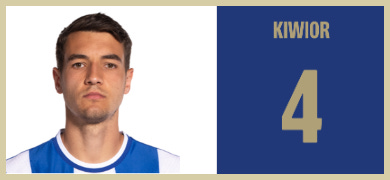
As a Ball Playing Defender, Kiwior’s role is not just to defend but to be a structured passer who maintains discipline in the build-up phase. Utilising his technical quality and left-footedness, he is responsible for safely receiving the ball from Costa and initiating the slow, controlled circulation required to bait the press. He must hold his high line to compress space and execute the precise short or medium passes that feed the pivot or one of the tucking Inverted Fullbacks, maintaining the necessary defensive security (Rest-Defence) throughout the process.
Kiwior’s aerial dominance is notable, winning a solid 85% of his headers (9% more than Bednarek—a surprising aerial advantage for a BPD). Furthermore, he boasts a phenominal 100% tackles won rate in the league. While he lost possession 1.4 times more than Bednarek, this is expected given his mandate to play riskier/progressive passes that are essential for breaking the opponent’s lines after the lure.
Victor Froholdt
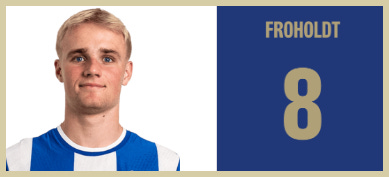
Froholdt is perfectly suited to the demanding Channel Midfielder role, tasked with providing both high intensity and positional flexibility. His athleticism and work rate are critical in both phases of play: he makes fluid runs into the half-spaces in possession to link with the wingers, and his immediate intensity makes him an asset in the Counter-Press to swiftly regain the ball.
Demonstrating maturity beyond his 20 years, Froholdt logged an impressive 3245 minutes across the season (second only to Bednarek among outfielders). Crucially, the young Dane contributed to 17 goals (five goals, 12 assists). His creative quality is underscored by outperforming his expected assists by 5.47 (likely capitalising on Samu’s finishing), although he statistically underperformed against his expected goals figure of 9.11.
Gabri Viega

Veiga is the creative engine and technical focal point of the midfield, perfectly suited to exploit the central space created by the system. He thrives by utilising his flair, technical mastery, and exceptional off-the-ball movement to constantly position himself behind the opponent’s first line of pressure. Veiga is responsible for executing the incisive passes—often participating in Third-Man Combinations—that transition the team from patient build-up into a dangerous attacking move, making him key to the Central Overload.
The 23-year-old was arguably one of the side’s best performers, achieving a spectacular 30 goal contributions across the season (19 goals and 11 assists). His efficiency is underscored by remarkably balanced underlying statistics (11.1 xG for 19 goals and 10.8 expected assists for 11 assists). Furthermore, his ability to consistently create saw him lead the open-play key pass stat across the team with 3.2 per 90, and, among players with over 2,000 minutes, his 17% conversion rate was the second highest in the Porto squad.
FM26 Tip – play your Advanced Playmaker in the Central Midfield Strata
Borja Sainz

Sainz operates as an isolation specialist, whose primary function is to maintain aggressive width and exploit the space created by the tactical decisions of his teammates. Because Farioli’s Fullbacks tuck inside to create the central overload, Sainz is frequently left in a crucial 1v1 duel against the opponent’s fullback. His speed, verticality, and expert dribbling are necessary to win these duels, allowing him to attack the box directly and stretch the defense to create openings for the late-running midfielders.
Statistically, Sainz was the league’s volume dribbler, attempting 7.45 per game. He translated this high activity into phenomenal output, achieving 27 goal contributions across the season. Crucially, his finishing was a significant outlier: he scored 19 goals from an expected 9.11 xG, demonstrating exceptional efficiency, taking 96 shots at an average of 0.09 xG per shot.
Samu Aghehowa

Aghehowa is the system’s high-energy link, tactical pivot, and absolute scoring leviathan who dictates the tone of the defense and links the attack. His role as a Pressing Forward demands relentless work rate, as he is the first line of defense, leading the Immediate Counter-Press with ferocious intent. Crucially, his intelligence allows him to drop deep and roam, transforming into the essential fulcrum that connects the midfield maestros to the wingers.
But his scoring is where he transcends: the young star delivered a mind-blowing 46 goal contributions across the season (36 goals and 10 assists)! This efficiency is phenomenal, highlighted by a jaw-dropping 35% conversion rate—he scored all 36 goals from a mere 23.3 xG, showcasing finishing ability that borders on the supernatural. With league-leading stats of 1.29 goals per 90 and an NPxG per 90 of 0.52, Aghehowa isn’t just a striker; he is a guaranteed goal machine ensuring Farioli’s complex patterns end with devastating simplicity. He is the undisputed closer!
Section V: Performance Against Short Term Milestones
Domestic Dominance Denied: The ‘Justice Table’ Debate
While the European campaign was an unqualified success, our first attempt to reclaim domestic supremacy fell agonisingly short. We finished in second place in the Primeira Liga, a result that secured Champions League qualification but leaves a bitter taste. Crucially, statistical analysis confirms our tactical dominance: the squad should have won the title based on Expected Points (xP), underscoring a season defined by brilliant performances undermined by poor finishing or moments of misfortune. This near-miss has only intensified our determination to make the Estádio do Dragão an impregnable fortress and sweep the domestic titles in the year ahead.
European Conquest: A Trend Established
Against our initial short-term goal of simply reaching the Quarter-Finals, we achieved immediate European glory by lifting the UEFA Europa League trophy. This hard-won title, Porto’s first since the 2010/2011 Europa League success (when they defeated fellow Portuguese side Braga 1-0 thanks to a goal from Radamel Falcao), has resoundingly restored the club’s status on the international stage.
The Path Ahead: From Underachievers to Champions
The foundation is now laid. We have proven we can compete and conquer in Europe, but the domestic gap—a gap the statistics suggest we earned the right to close—must be sealed. The ultimate ambition remains to solidify our standing as the continent’s preeminent team by securing the UEFA Champions League title, but first, we must turn our Expected Points into Actual Points and ensure the Primeira Liga trophy returns home.




 The Gaffers Lounge
Leave a comment