
As the dust settles on our promotion-winning campaign — capped off by lifting the Serie C Super Cup against Vicenza and Catania — our focus now begins to shift toward the challenges of Serie B.
But before looking ahead, it feels right to pause and reflect on the season that brought us here: how the team performed, which players drove us forward, and which members of the squad may not be part of the next chapter in Arezzo’s journey.
We may have finished as champions, but a deeper look at the numbers reveals far more than just a rose-tinted view of success.
Attacking Output
From the attacking output alone, it’s clear we carried a real threat going forward this season. We finished with 78 goals — just two short of the all-time Serie C/B record of 80 — and the underlying data backs up how consistently dangerous we were.

We averaged 15.6 shots per match, converting that pressure into 2.1 goals per game and a strong 1.6 non-penalty xG, showing that our chances weren’t just frequent, but high in quality. Our 44.3% shots-on-target rate kept us efficient in front of goal, ranking third in the division behind Ternana (47%) and Ascoli (45%). Naturally, that fed into a 13% shot conversion rate, again the third-best return in the league, trailing only Ascoli and Ravenna (14%).
Our wide players were central to this identity. With 17.8 dribbles per game and a 23.6% cross accuracy, they consistently stretched defences, forced overloads, and pushed opponents backwards.
In possession, we held 53% on average, the fourth-highest in the division. I stuck with a Standard tempo for most of the season, and it proved the right balance — controlled, purposeful, and well-suited to the strengths of this squad.
Defensive Output
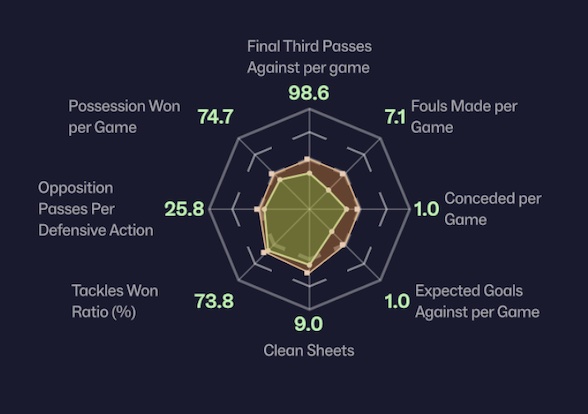
Defensively, our strength came from structure and discipline rather than desperation or last-ditch heroics. Conceding just 1.0 goal per game from 1.0 xGA tells the story of a back line that gave up exactly the chances you’d expect — and crucially, no more.
A 73.8% tackle success rate and 74.7 possession recoveries per match ensured the midfield shield stayed firmly in place, preventing opponents from turning pressure into meaningful attacks. Even when teams did reach the final third, they struggled to break us down, averaging just 98.6 final-third passes per game, the fifth-lowest figure in the division — a clear indication of how effectively we controlled space and shut off central routes.
Player Performance
Before diving into individual performances, it’s worth briefly revisiting the tactical framework that underpinned our success.
In possession, our aim was to control matches through short, purposeful passing, patiently waiting for the moment to unpick defensive lines. Out of possession, we stayed compact and disciplined in a mid-block, guiding opponents toward the flanks and using the touchline as an extra defender. This balance between calm control and structured discipline became the foundation for everything we achieved this season.
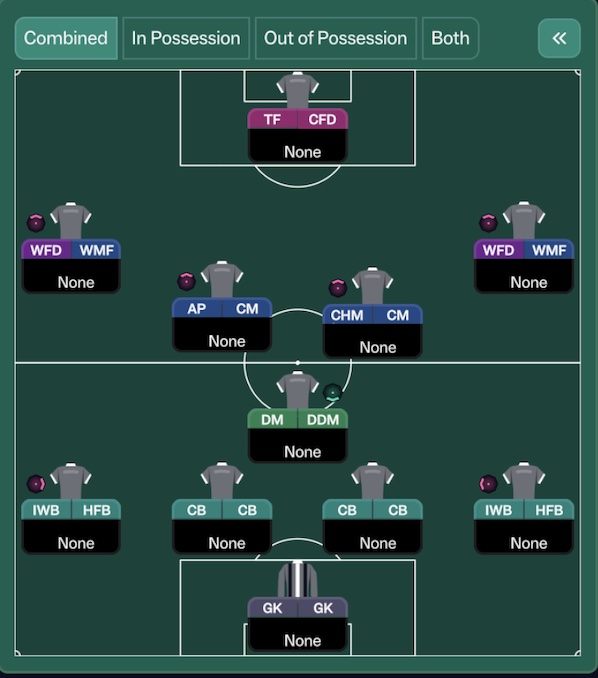
Note: Due to the current state of the Data Hub, I wasn’t always able to pull the same charts for each player (even though they play the same position!). So, I’ll show the data where I have it.
Goalkeepers:
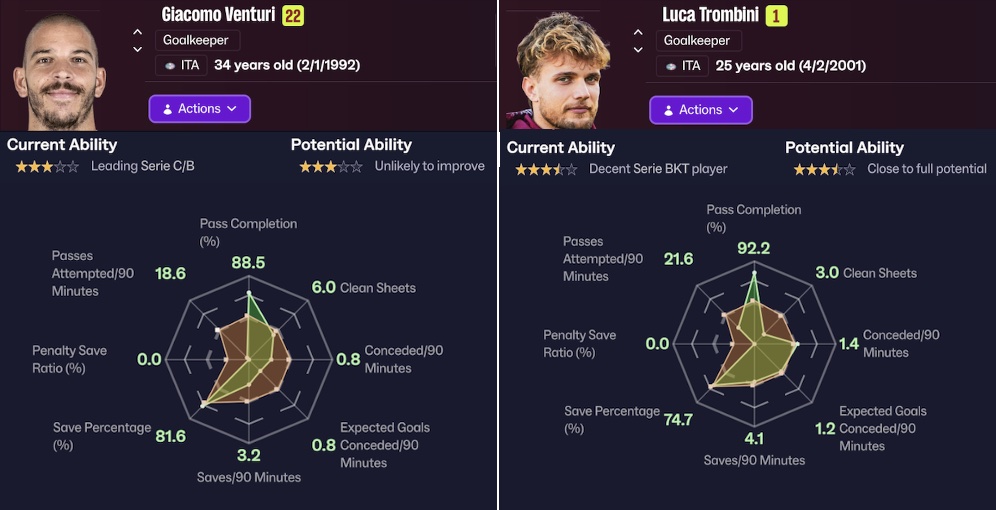
Unusually, both goalkeepers played significant minutes this season. Venturi began as the starter, making 24 appearances before a shaky run saw him replaced by 25-year-old Trombini, who featured 17 times.
Over the full campaign, Venturi delivered the steadier headline numbers — the stronger save percentage and the lower goals-against record. But Trombini stepped in during the most turbulent stretch of the season, when injuries tore out our spine and the defensive unit changed every week. He faced more shots, carried a heavier workload, and still helped maintain our structure. His distribution was sharper, and his composure during chaotic match states became one of the quiet reasons our promotion push held firm.
Verdict: Venturi’s contract will not be renewed. Trombini is expected to take the No.1 shirt heading into Serie B.
Left Fullbacks
In this system the fullbacks are asked to invert into the defensive midfield strata when possession is established and be there to retain possession, looking to pass to the central midfielders or the wingers.
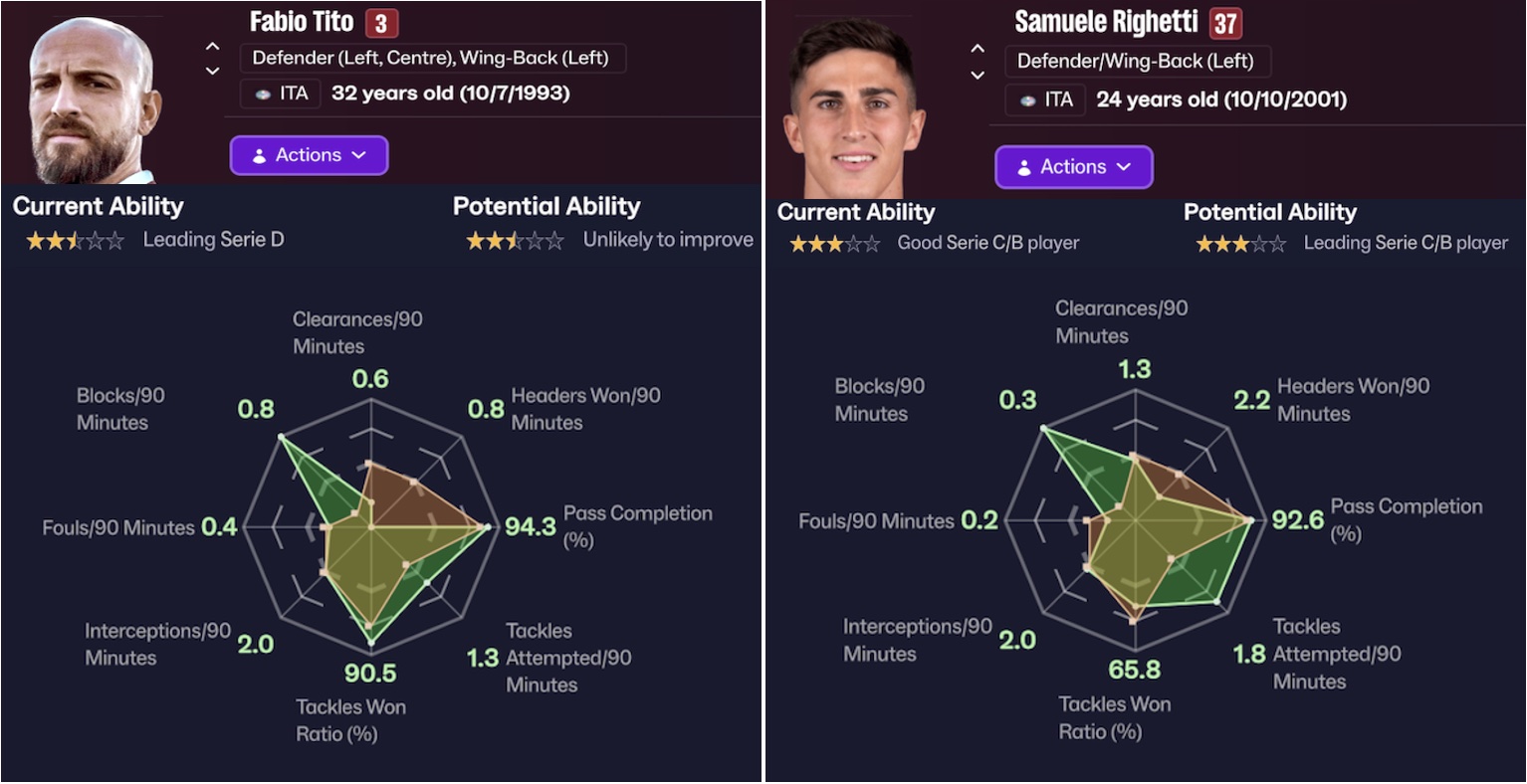
Both left-backs adapted well to the inverted role, but in very different ways. Tito, with 19 starts, was the calmer presence — 94.3% pass completion, smart positioning, and just 0.4 fouls per 90 made him the safer, more controlled option. His 2.0 interceptions per 90 showed how well he read the game.
Righetti, across 22 starts, brought a more athletic, disruptive style. He won more duels (2.2 headers, 1.8 tackles attempted per 90) and offered higher defensive volume, but his 65.8% tackle success and looser passing made him less reliable in our possession-first system.
Both ended with two assists, but the contrast is clear: Tito fit our build-up, Righetti thrived in more physical games.
Verdict: Tito, unfortunately, has regressed and may struggle in Serie B. Righetti isn’t the long-term answer but could provide depth due to his age. A new starting left-back is needed.
Right Fullbacks
On the right, both full-backs gave us exactly what the inverted role demands: composure, defensive reliability, and safe possession. De Col, with 22 games, offered the more traditional defender’s profile — strong in the air (66 headers won at 57%), steady in blocks, and a reliable 92% pass completion. His 67% tackle success made him the calmer option in matches where control was key.

Renzi, across 23 appearances, wasn’t as dominant aerially (40%), but his defensive efficiency stood out: a 73% tackle success rate, more interceptions (2.09 per 90), and higher clearance volume. His 93% pass completion also made him cleaner in tight build-up phases.
De Col brings steadiness and physicality; Renzi offers sharper anticipation and smoother recycling.
Verdict: Renzi is a long-term project — he has the attributes for the inverted role, and he’s not going to break in as a central midfielder. So, I’ll continue developing him here. De Col can remain as reliable depth, but will have to accept a backup role.
Central Defenders
The centre-backs delivered exactly what the system demands at this level: security on the ball, consistency in duels, and reliability in restoring possession without overplaying.
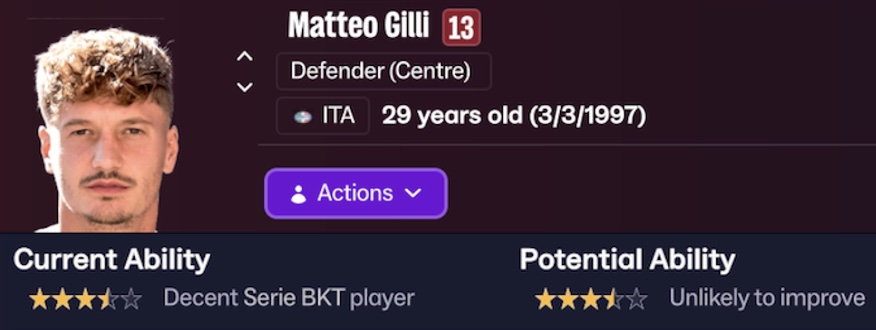
Matteo Gilli was the cornerstone, starting 38 games and pairing a strong 94% pass completion with the highest defensive volume — 1.76 interceptions per 90 and 9.1 possession wins per 90 — the profile of a defender who reads danger early and keeps you on the front foot.
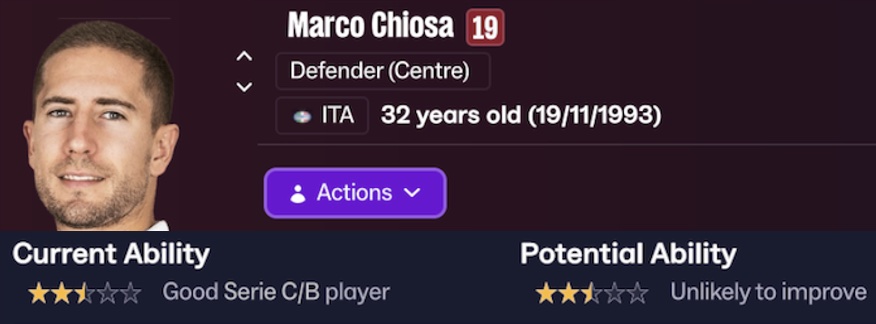
Marco Chiosa, in his 22 starts, offered similar composure with a team-leading 95% pass accuracy, though the club-captain was the least active of the three in terms of regains, reflecting a more reserved, position-first style.
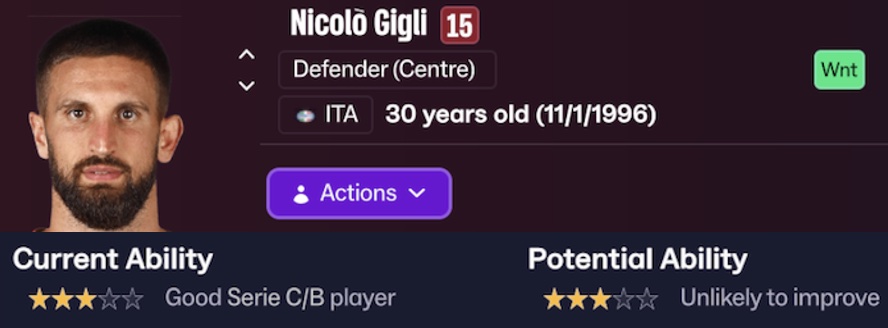
Nicolo Gigli brought the most disruptive presence: 2.32 interceptions per 90 (comfortably the highest), 100% tackle success, and a team-best 77% headers won, making him invaluable in matches where the defensive line came under aerial or transitional pressure. Even with more possession lost per 90, his overall 7.00 average rating shows how much his ball-winning mattered.
In short, Gilli provided the stability, Chiosa the calm, and Gigli the aggression.
Verdict: Whilst I’m happy to keep all three at the club, I feel that a move to Serie B may need another kind of defender. Someone with a ball-playing style will be bought in to complement the existing trio.
Defensive Midfielders
The ask of the Defensive Midfield role, as this Serie C level, is just to do the basics well. Win the ball, be a nuisance and maintain possession. Elku and Iaccarino did this, but in completely different profiles — one built on physical presence and defensive volume, the other on control, progression, and intelligence on the ball.

Eklu was the enforcer: strong in the air (2.2 headers won/90), dominant in duels (3.21 tackles won/game), and producing higher defensive volume with 2.55 interceptions and 1.11 clearances per 90. He protected the centre-backs, broke up play, and gave the technical players freedom. His 92% pass completion was tidy, but his role was about disruption, not orchestration.
Iaccarino played the role very differently — more deep playmaker than destroyer. His 94% pass completion and 0.94 key passes/90 show a midfielder who sees and breaks lines, which is rare at this level. He made fewer defensive actions than Eklu but remained efficient with an 80% tackle success rate. His value came from control and progression.
Verdict: Eklu fits the Disruptor role perfectly and will be important in Serie B. Iaccarino is only on loan, but I’ll push to bring him back — the two complement each other extremely well.
Central Midfielders
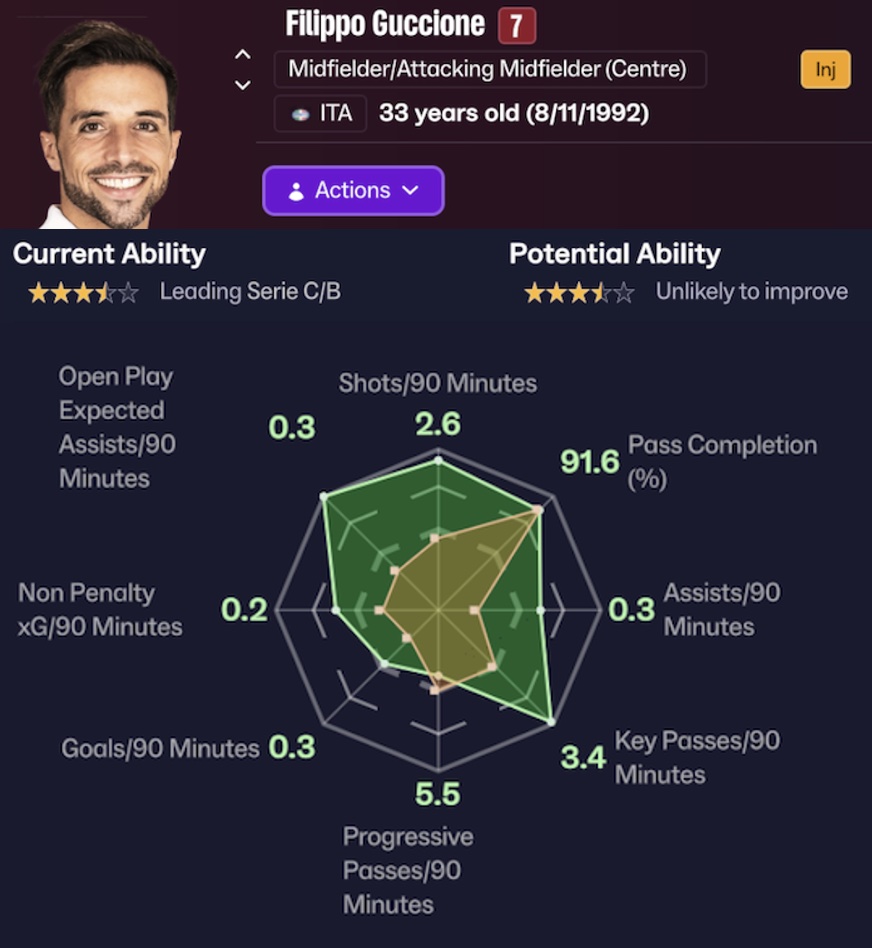
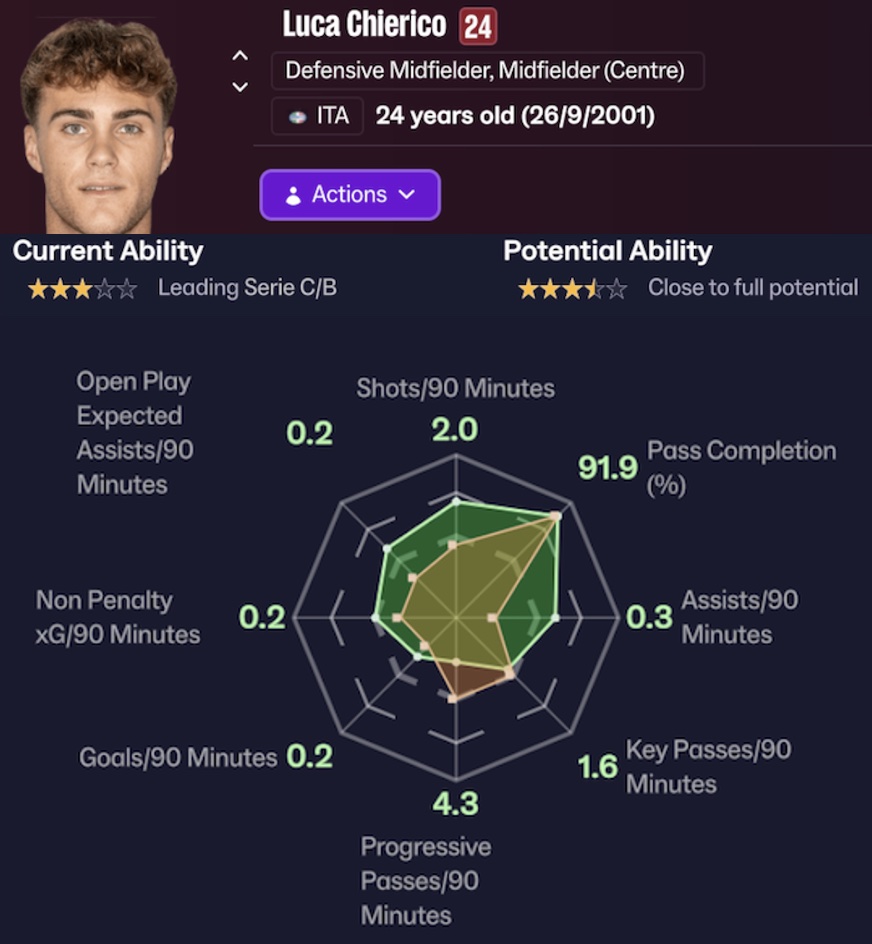
Guccione and Chierico gave the midfield its identity, each interpreting the No. 8 role in a way that made us unpredictable. Guccione was the creative heartbeat — 8 goals and 8 assists in 30 games — shaping matches until injury cut his season short. Chierico provided the balance and the engine, with 5 goals and 9 assists in 35 appearances, linking phases, driving vertically, and arriving in the right spaces at the right times. Together, they made the midfield the driving force behind our promotion push.
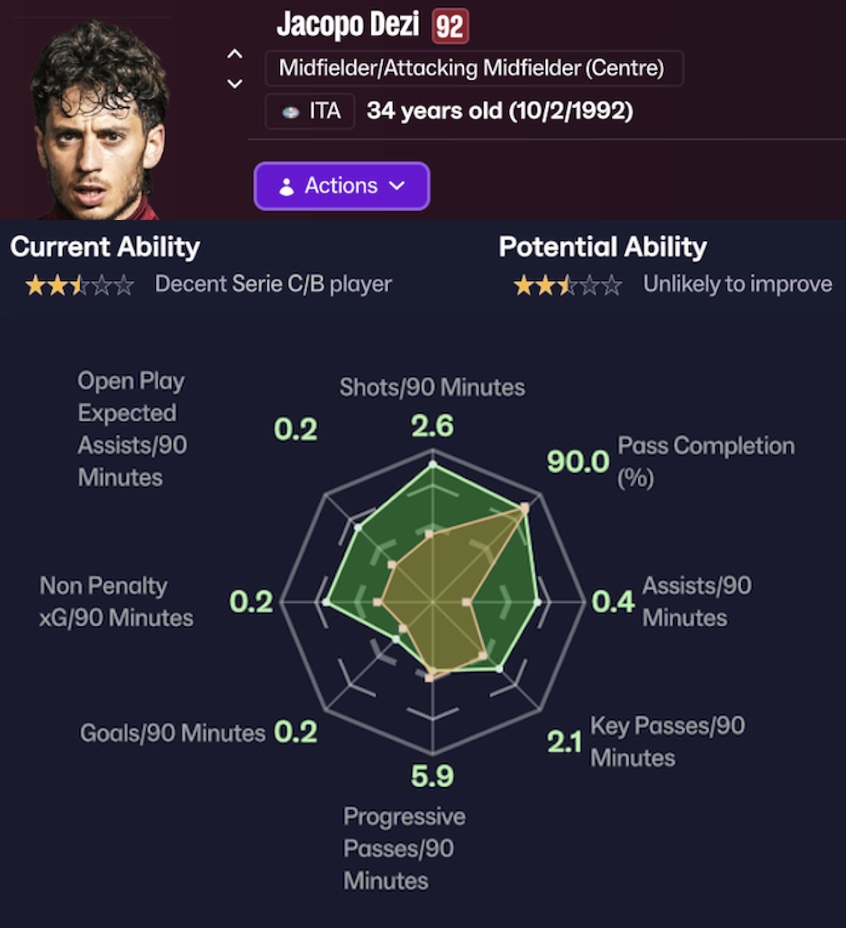
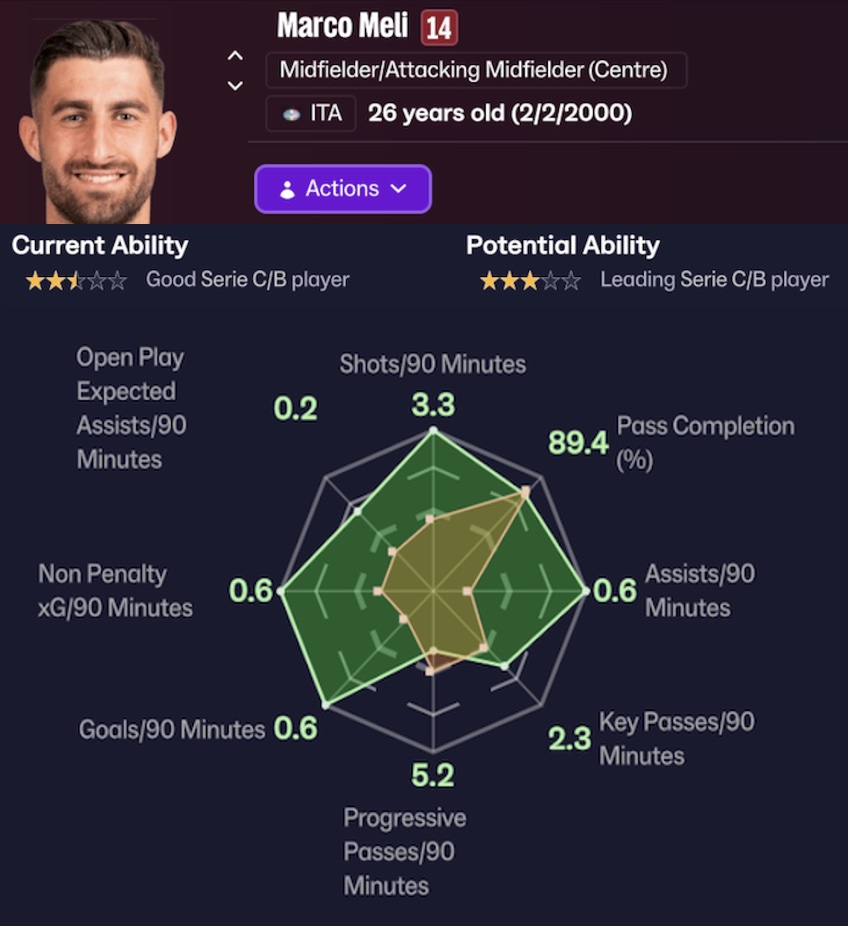
Behind them, Meli and Dezi kept the unit functioning. Meli, backing up Guccione, was the pure impact option — a final-third threat whose 4 goals and 3 assists (mostly off the bench) made him a genuine game-changer in limited minutes. Dezi offered the opposite: experience, structure, and calm two-way play. His 3 goals and 3 assists came through smart positioning and tidy progression, ensuring the midfield retained its identity whenever Chierico rested.
Verdict: The effects of Guccione’s three-month injury layoff will be something to monitor next season, but he and Chierico remain first-choice. Dezi, now 34, will not be renewed. Meli returns to Juve Stabia after a successful loan spell.
Wingers
Pattarello and Tavernelli defined our wide threat — two wingers producing almost identical output through completely different interpretations of the role. Pattarello, cutting in from the right, played with electric directness: sharp touches, bursts into space, and relentless one-v-one ambition. He delivered 8 goals and 5 assists in just 27 starts before injury disrupted his momentum, and his influence was obvious whenever he featured.

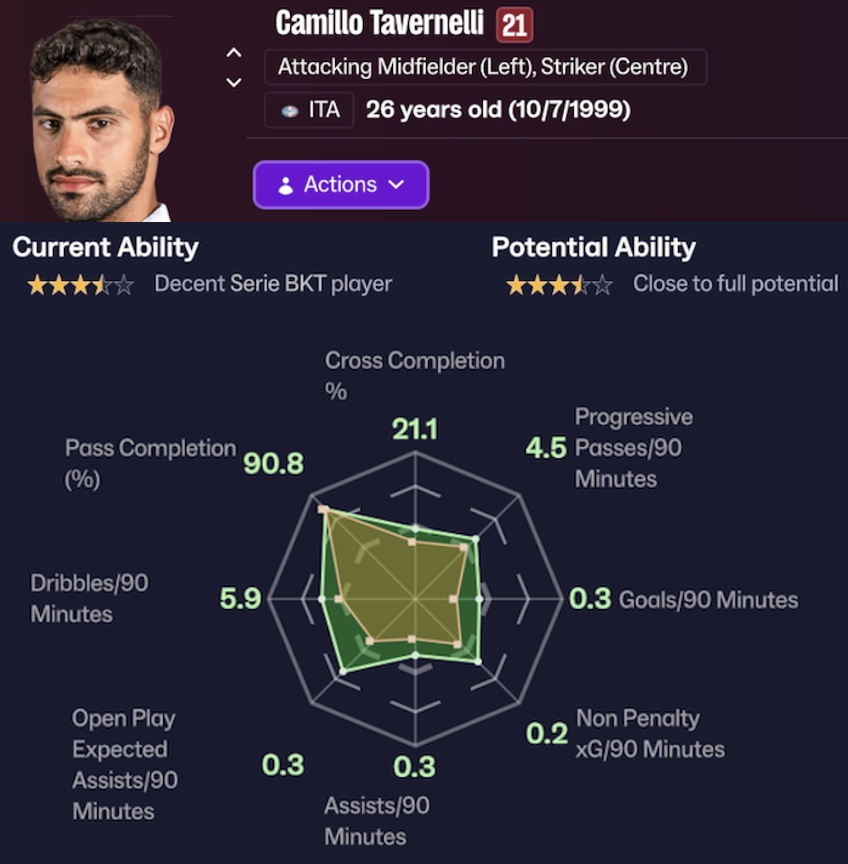

Tavernelli, on the left, offered the perfect counterbalance — less raw, more measured. His intelligent movement between lines, tidy combinations with midfield runners, and ability to stretch defences gave the side structure during its most turbulent periods. His return of 8 goals and 8 assists across 34 starts came through timing and craft rather than explosiveness.
Behind them, Djamanca provided the rotational punch every promotion campaign needs. Comfortable on either flank, he produced 5 goals and 6 assists from 12 starts and 25 cameos, driven by immediate aggression (7.4 dribbles per 90, the highest in the squad) and surprising composure on the ball (90.1% pass accuracy).
Verdict: The hope is to keep all three — each looks capable of contributing in Serie B — but a fourth wide option will be needed to complete the unit, with Dell’Aquila returning to Torino.
Sriker
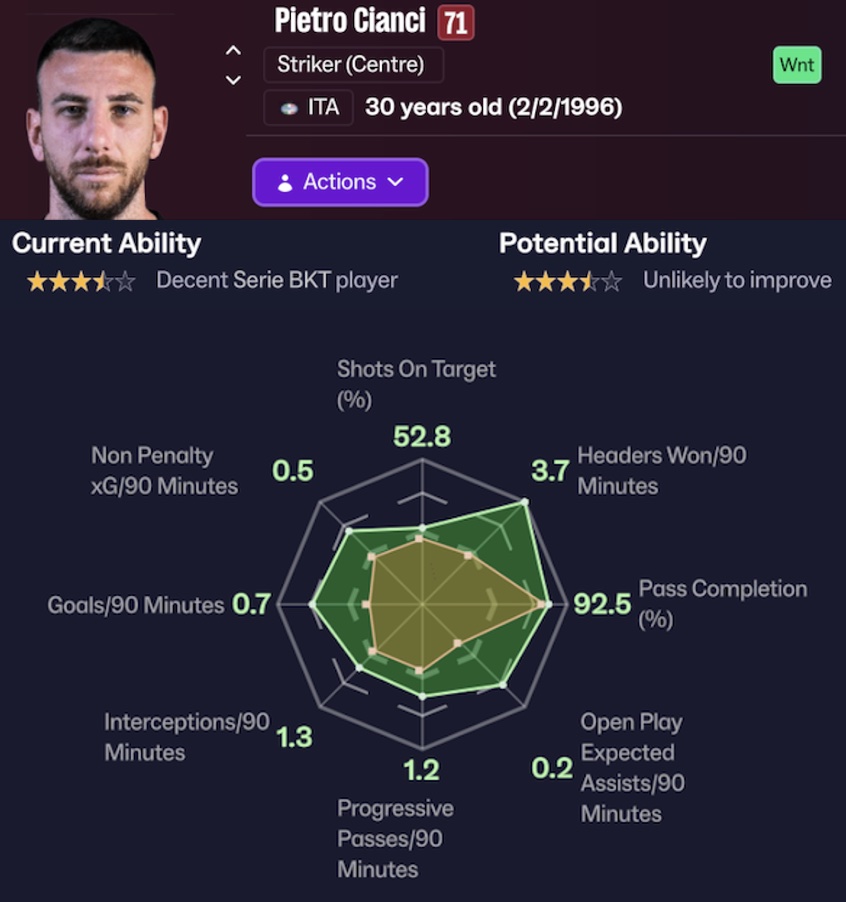
Cianci’s season was built on patience and resilience. Losing his starting role to Ravasio could have knocked him off course, but he stayed professional — and when the opportunity returned, he stepped straight back in. Across 33 appearances, he delivered 15 goals and 5 assists, showing a clear understanding of the system’s rhythm. His profile reinforces that: a tidy link man (92.5% pass completion), strong aerial presence (3.7 headers won/90), and a reliable finisher (0.7 goals/90, 52.8% shots on target). Never the flashiest striker, but exactly the focal point we needed once the season became turbulent.
Behind him, Fettal arrived on loan with a very different profile. Though used mainly as a late-game disruptor, he played his part — offering direct running, energy in transition, and the physicality to pin defenders. His single goal in 12 appearances doesn’t capture the value of his cameos: stretching the pitch, buying time, and helping us close out tight games.
Verdict: Cianci has earned the starting role heading into Serie B, but it won’t come easy. I’ll be looking to bring in a younger striker to support him and offer a different dimension.
Looking Ahead
As you can tell from my comments, I’m more than willing to give the players who won the division a chance to shine at the higher level.
There’s loan players leaving who’ll leave gaps, but also loan players returning from loan who could contribute to the squad.
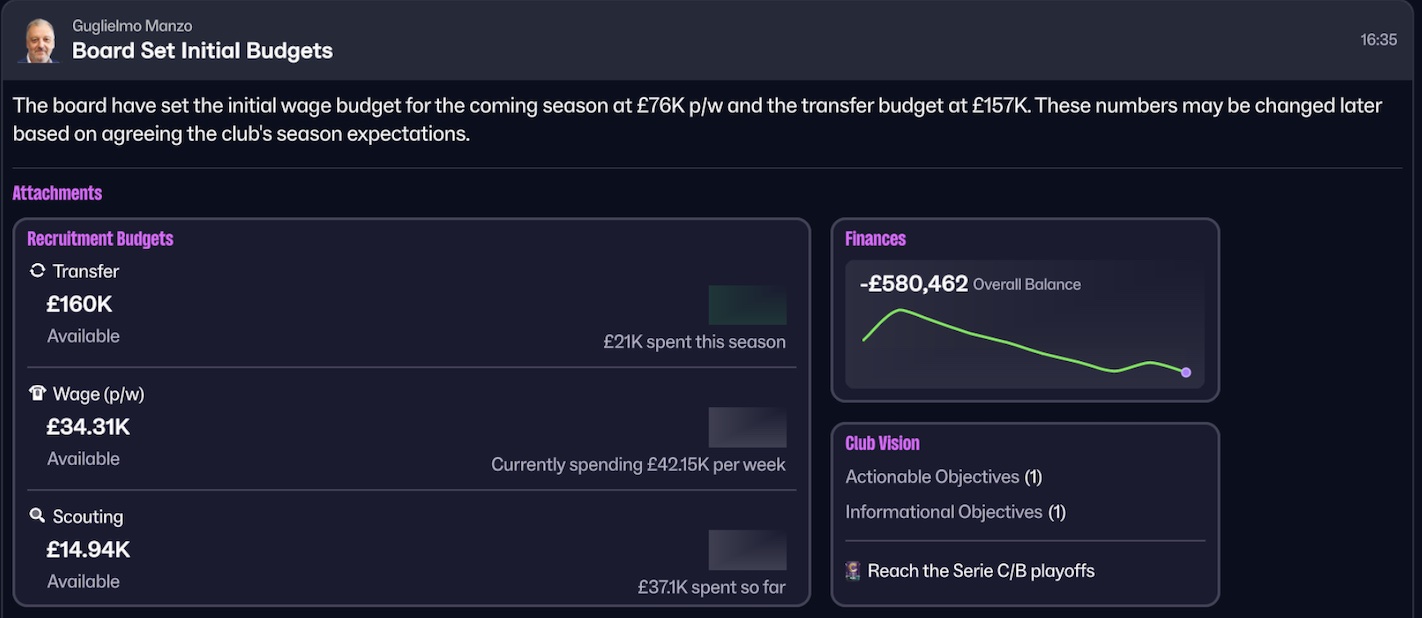
As you’d expect, budgets are tight, so I’ll need to recruit carefully. We’ve had around £30k added to the wage budget and have £157k to spend on new talent.
Luckily, I know exactly what I’m looking for from each player so as long as my Recruitment team have been doing their jobs, it could be a fun process.
I’m also being forced into overhauling the entire backroom staff, with lots of contracts expiring it gives me an excellent opportunity to clean house and start afresh. Sadly, my Assistant Manager Flavio Giampieretti will be one of those leaving.
As was said at the end of the update, progress is a cruel mistress… and not everyone can come along for the journey.



 The Gaffers Lounge
Leave a comment