

The tactical revolution of the last few decades—marked by the successes of coaches like José Mourinho, Pep Guardiola, and André Villas-Boas—can be traced back to the rigorous academic work of Professor Vítor Frade at the University of Porto. Frade’s methodology, Tactical Periodisation (TP), is not just a training schedule; it is a profound philosophical statement about the very nature of football, rooted in the social sciences and the Theory of Complexity.
This blog will look to provide you with an overview of the professor’s work and more importantly a downloadable training schedule for a single game week.
*clicking on the below image will take you to a classic video by Tifo Football called: What is Tactical Periodisation?
Frade applied the concepts of Complexity Theory, championed by the French philosopher and sociologist Edgar Morin, to the pitch. Morin’s work focuses on the relationship between the parts and the whole in any complex system. For Frade, the “whole” is the collective tactical reality of the match. Because “the action of one player on the pitch will affect the actions of every other player,” training the parts (fitness, technique) in isolation is seen as fundamentally illogical and detrimental to performance.
TP is the operational system designed to condition players to thrive amid this competitive chaos.
Ⅰ. The Philosophical Bedrock: Complexity and Specificity
Frade’s methodology demands that the tactical goal, not the physical output, must be the single greatest driving force behind all preparation.
1. The Game Model as the Overarching “Whole”
- The Blueprint: The coach’s predetermined Game Model (e.g., Farioli’s high-press 4-3-3) is the cognitive map that provides order and predictability. The model, comprised of main principles and sub-principles, is the “whole” that must be expressed collectively.
- Specificity (The Meta-Principle): This supreme principle dictates that every single exercise must be organised around the Game Model. Physical, technical, and psychological elements are never separated; they are integrated into exercises that demand high-speed decision-making in a context specific to Farioli’s style.
2. Fractal Geometry (The Part Reflects the Whole)
This principle is the practical application of Complexity Theory. It insists that the characteristics of the collective game (the press structure, the build-up shape) must be present and replicated even in small-sided games. Whether the training is 11v11 or 4v4, the Farioli principle of the Counter-Press must be present, forcing players to find solutions under pressure that mirror the demands of Match Day.
Ⅱ. The Operational Framework: The Four Moments & The Morphocycle
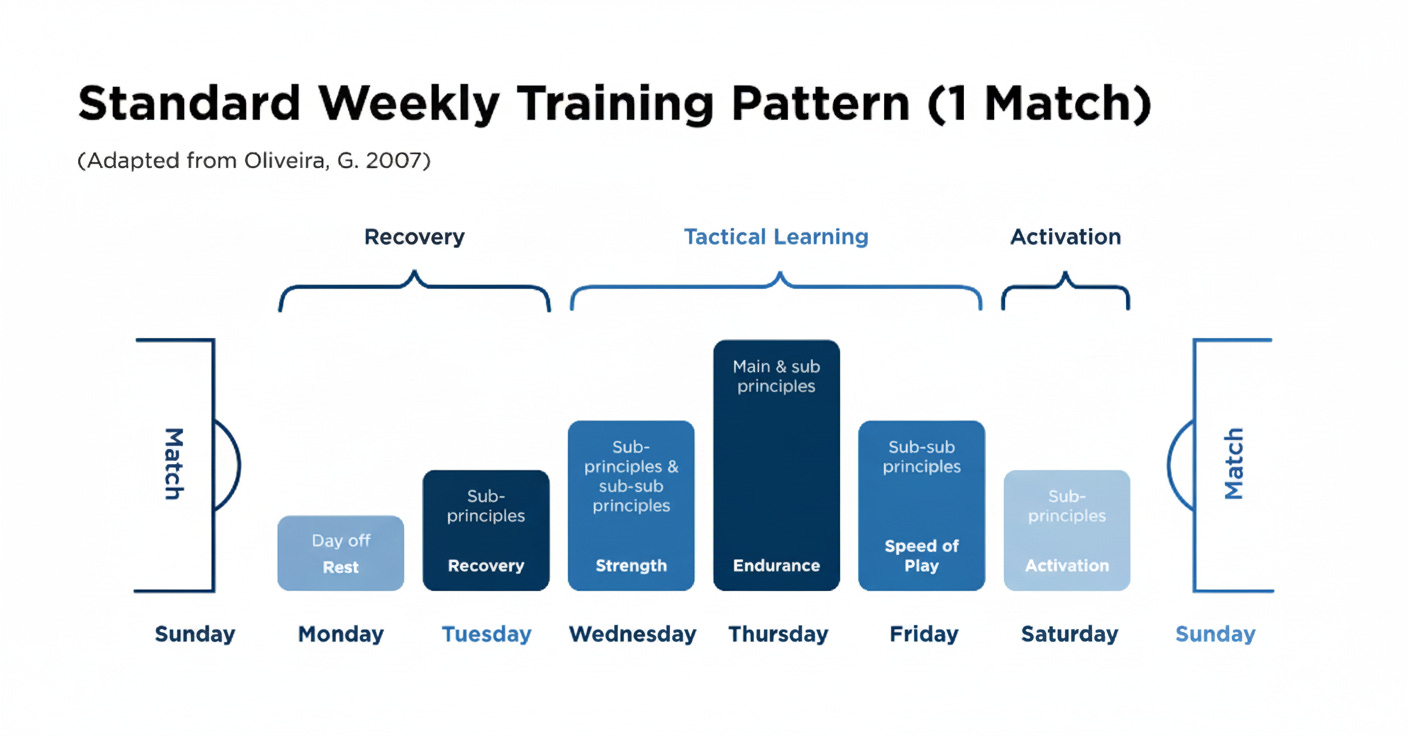
TP manages complexity by breaking the game down into four fundamental moments, which structure the daily training plan. The Morphocycle is the weekly pattern designed to manage the effort-recovery continuum.
The Four Moments of the Game (Farioli’s Focus)
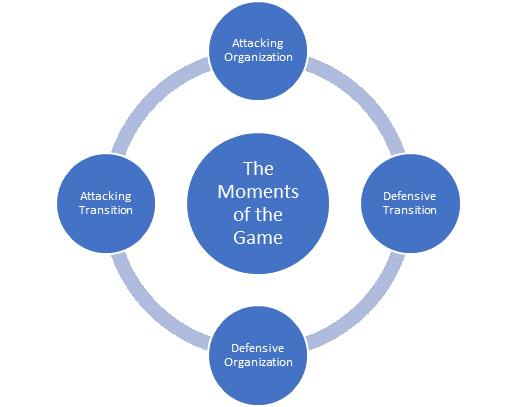
Frade simplified the complexity of football into four non-negotiable moments, which define the structure of the Game Model and the weekly training plan:
- Offensive Organisation: The team has possession and is in an organised attacking shape (Farioli’s Lure Build-Up).
- Defensive Transition: The critical moment when the ball is lost. The immediate action is the Counter-Press.
- Defensive Organisation: The team does not have the ball and is in a structured defensive shape (Farioli’s 5-4-1 Low Block).
- Attacking Transition: The moment the ball is won. The team must quickly decide whether to Counter-Attack or consolidate possession.
3. The Morphocycle (The Weekly Planning)
This is the operational unit of TP. It is a weekly cycle of stimuli and recovery, where the dominant type of muscular contraction (Velocity, Strength, Speed, Endurance) alternates to ensure peak performance on Match Day, with Wednesday often being the most intense day.
ⅡⅠ. FM26 Implementation: The Farioli TP Morphocycle
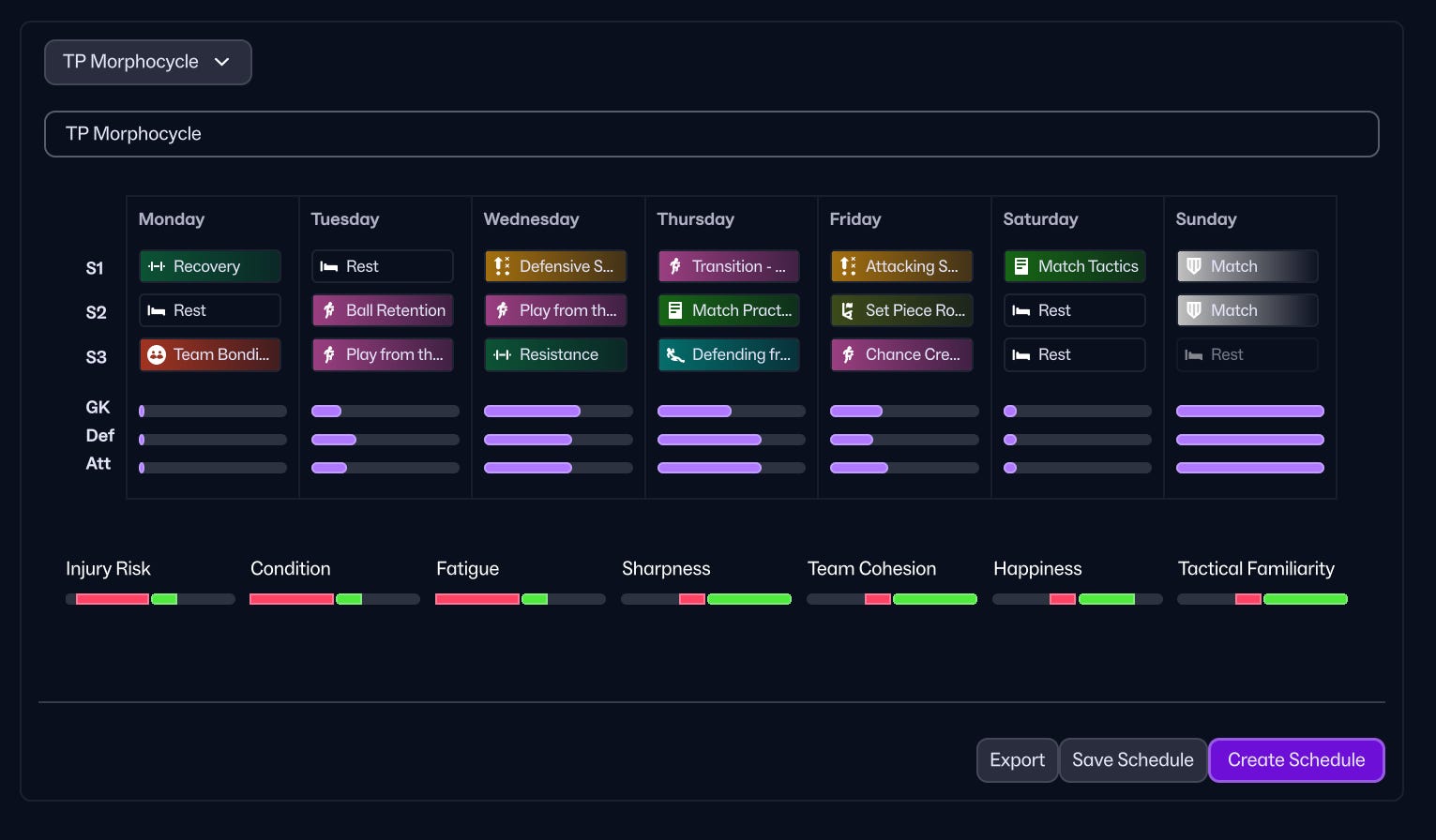
This seven-day schedule integrates Farioli’s tactical principles (Lure, Overload, Press) with Frade’s prescribed physical loads, preparing the players to “write the game in a collective basis.”
Why This Schedule Works (Frade’s Principles in FM26)
- Wednesday’s Double Tactical: The highest intensity day (Strength) is used to drill the most complex principles—the Defensive Organisation (Low Block) and the high-tension demands of the Lure Build-Up—ensuring players condition their muscles to perform these actions under maximum stress.
- Thursday’s Repetition: The Transition sessions focus on repetitive effort (Endurance), training the players’ ability to repeatedly apply the Counter-Press (Farioli’s primary defensive mechanism).
- FM Session Selection: By using Match Practice and specific Tactical sessions, we ensure players are constantly experiencing the relational dynamics of Farioli’s system: the Fullback tucking in, the Channel Midfielder running into the half-space, and the Centre Forward dropping to link play—all within the holistic context Frade pioneered.
TP Day-by-Day Rationale
Tuesday: Recovery (Technical & Tactical Acquisition)
- Load: Low Intensity / High Volume (Endurance in duration).
- Goal: Reconnect the team. The focus is on technical execution of simple actions (Ball Retention), ensuring players regain feeling for the ball under low physical stress. Tactical: Build-Up begins the conditioning of the backline’s passing.
Wednesday: Strength (Physical Peak & Foundational Principles)
- Load: High Intensity / Low Volume (Maximal Force/Tension).
- Goal: Condition muscles to apply maximum force (Strength) within the context of the game. Tactical: Defensive Shape is drilled intensely to establish the collective body positioning required to maintain the 5-4-1 Low Block under pressure (collision). Strength: General is the FM category used to achieve the physical peak.
Thursday: Endurance (Tactical Peak & Main Principles)
- Load: Medium-High Intensity / High Volume (Repetitive Efforts/Aerobic).
- Goal: This is the most complex learning day. Match Practice and Transition: Counter-Press force players to repeatedly execute Farioli’s key moments—losing the ball and immediately regaining it (Endurance), or launching the Central Overload (Offensive Organisation).
Friday: Speed of Play (Explosion & Finishing)
- Load: High Speed / Low Duration (Explosive Contractions).
- Goal: Convert the possession base into lethal goal scoring. Attacking: Final Third drills focus on the explosive movements of the Double 8’s to arrive in the box and the speed of the final pass required to utilise the Winger Isolation. Set pieces are also practiced, as they require precise timing and speed.
Saturday: Activation (Neural Priming)
- Load: Very Low Intensity (Speed of action, but not physical load).
- Goal: Maximise cognitive and neural alertness while minimising physical fatigue. Match Preview and Tactical: Teamwork sessions ensure players are mentally primed with final instructions and collective cues, ready for Match Day.




 The Gaffers Lounge
Leave a comment