
Hello there! It’s been a while since I’ve written about Football Manager. I know the game has taken a bit of a battering since release, but I have been having some fun over in Italy, and having shared some of the success I’ve been having on Twitter, I was asked to share my tactic. And I couldn’t do that with just an upload link, so here’s a little write-up to go with it.
You’re free to skip to the end and grab the download link, but if you want to read a little about how and why I created it, please do read on!
It’s good to be back.
The Core Philosophy
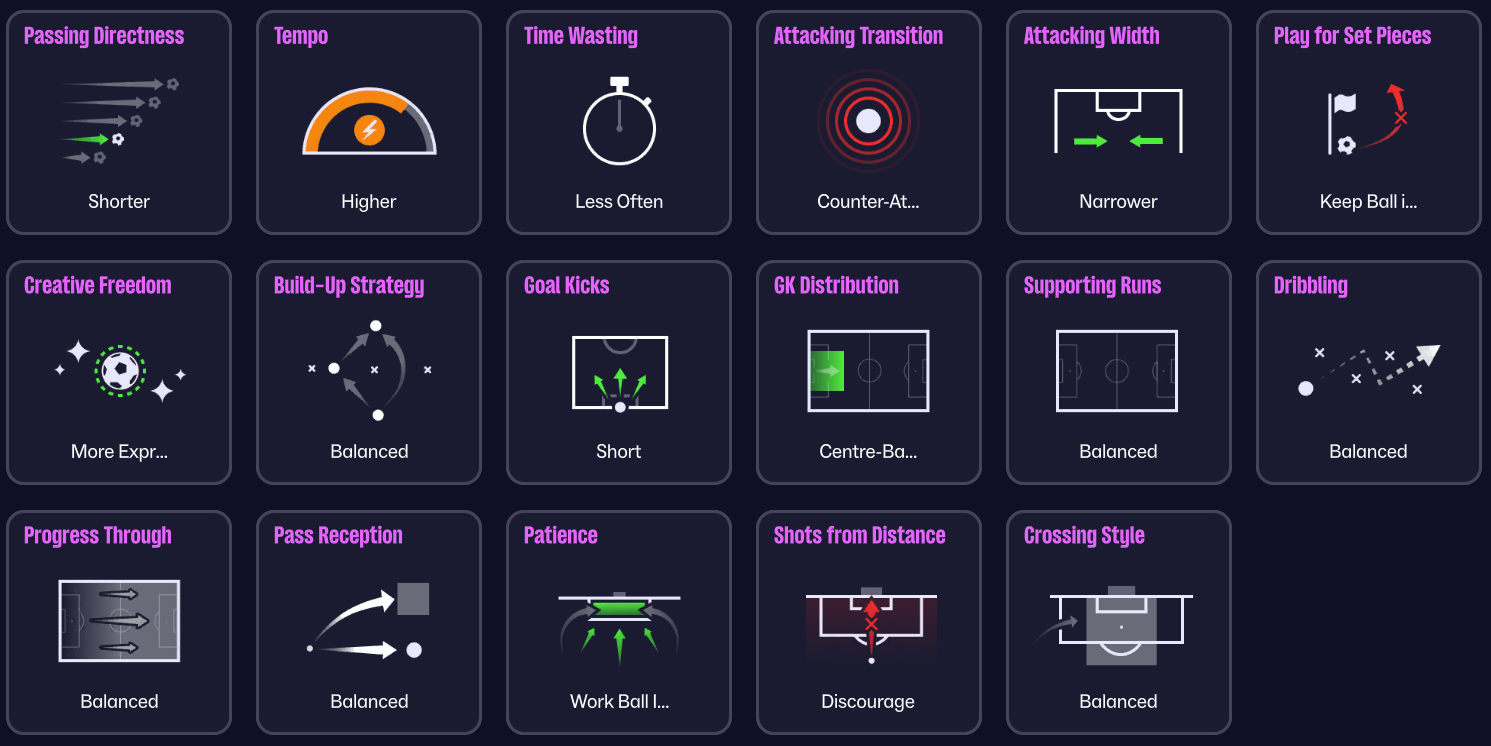
Control Through Tempo, Not Possession. This system rejects sterile dominance. It favours control through intensity. A higher tempo with shorter passes to keep the ball moving quickly and force opponents to constantly readjust. It’s about rhythm, not retention.
Vertical Precision, Not Endless Circulation. Passing is short, but always with purpose. We are calculated when it matters. We work the ball into the box and discourage long shots to maintain a commitment to quality over quantity. Patience until a high-value chance appears.
Compactness as a Weapon. A narrow attacking width ensures the side stays close and connected, with fluid support and overloads through the central zones. Out of possession, the lower defensive line and mid block reduce space behind, drawing opponents forward into traps where the press can bite.
Aggression on Transition. Counter-press and counter-attack define the identity. When the ball is lost, the immediate instinct is recovery; when it’s won, it’s acceleration. The team breathes in and out through these moments. Collective aggression that turns defence into attack within seconds.
Freedom Within Structure. We play more with more expression, which allows players to improvise once the collective framework delivers them into the final third. It’s not rigid automation, it’s guided chaos. The structure provides security; the freedom provides unpredictability.
The Modern Defensive Realism. A lower line and standard tackling show pragmatism. It accepts that not every match is to be dominated territorially. The team absorbs when needed, defends with compactness, and explodes forward with pace when the opportunity comes.
In short, the philosophy is controlled volatility: structured aggression, quick tempo, compact shape, and intelligent risk. Built to reflect Inter Milan’s tradition of tactical discipline fused with transitional power.
Tactical Overview
Base Formation and Shape
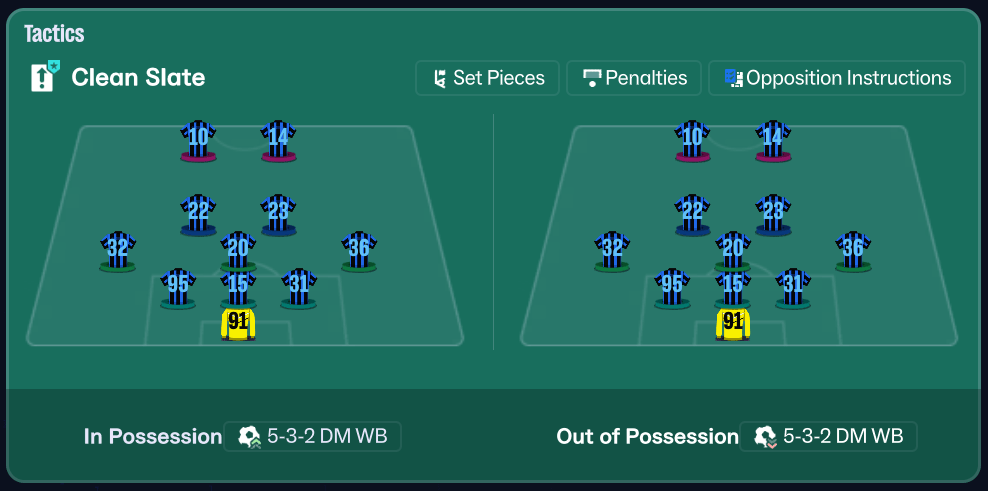
The base is a 3-5-2, built on control through structure. In possession, it becomes a 3-2-5, as both wing-backs advance and the two central midfielders push ahead of the deep-lying playmaker. Out of possession, it compresses into a disciplined 5-3-2, protecting the centre and forcing opponents wide. The three centre-backs stay compact, with the stopping wide centre-backs covering half-spaces while the central defender anchors.
Style of Play: Mentality, Tempo, and Pressing
The positive mentality keeps the side assertive but measured. Tempo is high, with short passing that promotes quick interplay between the midfield triangle and the front two. The team presses much more often from a mid-block, stepping forward collectively rather than pressing from the front line. It’s a blend of Italian compactness and modern intensity: containment first, then immediate progression.
Key Principles in Possession, Transition, and Out of Possession
- In Possession:
Build from the back through the deep lying playmakers’ distribution as the deep pivot. The wide central midfielders provide mobility and link play, while the attacking wing-backs push up to create width and overloads. Our strikers form a split-forward pairing, with one dropping to combine and one attacking from depth. The system thrives on tight triangles, vertical passing, and patience until a clear lane opens.
- In Transition:
Upon regaining possession, the team strikes quickly through central channels. Short, fast counter-attacks using the movement of the front two. When the ball is lost, the side immediately counter-presses, seeking to recover within seconds before the shape resets. - Out of Possession:
The line of engagement sits mid-block, with a lower defensive line designed to deny space behind it. Pressing traps are set outside, forcing opponents toward the flanks where wing-backs can engage. Tackling remains controlled, relying on structure rather than aggression.
In possession example: In most scenarios, our keeper will play into the central defender, who will distribute to one of the wider central defenders, offering an outlet. This typically creates a 3v1 or 3v2 against the opposition. From here, it is easy for us to work out from the back, as the wide central midfielders cover laterally to offer passing options, along with the defensive midfielder and wing-back.
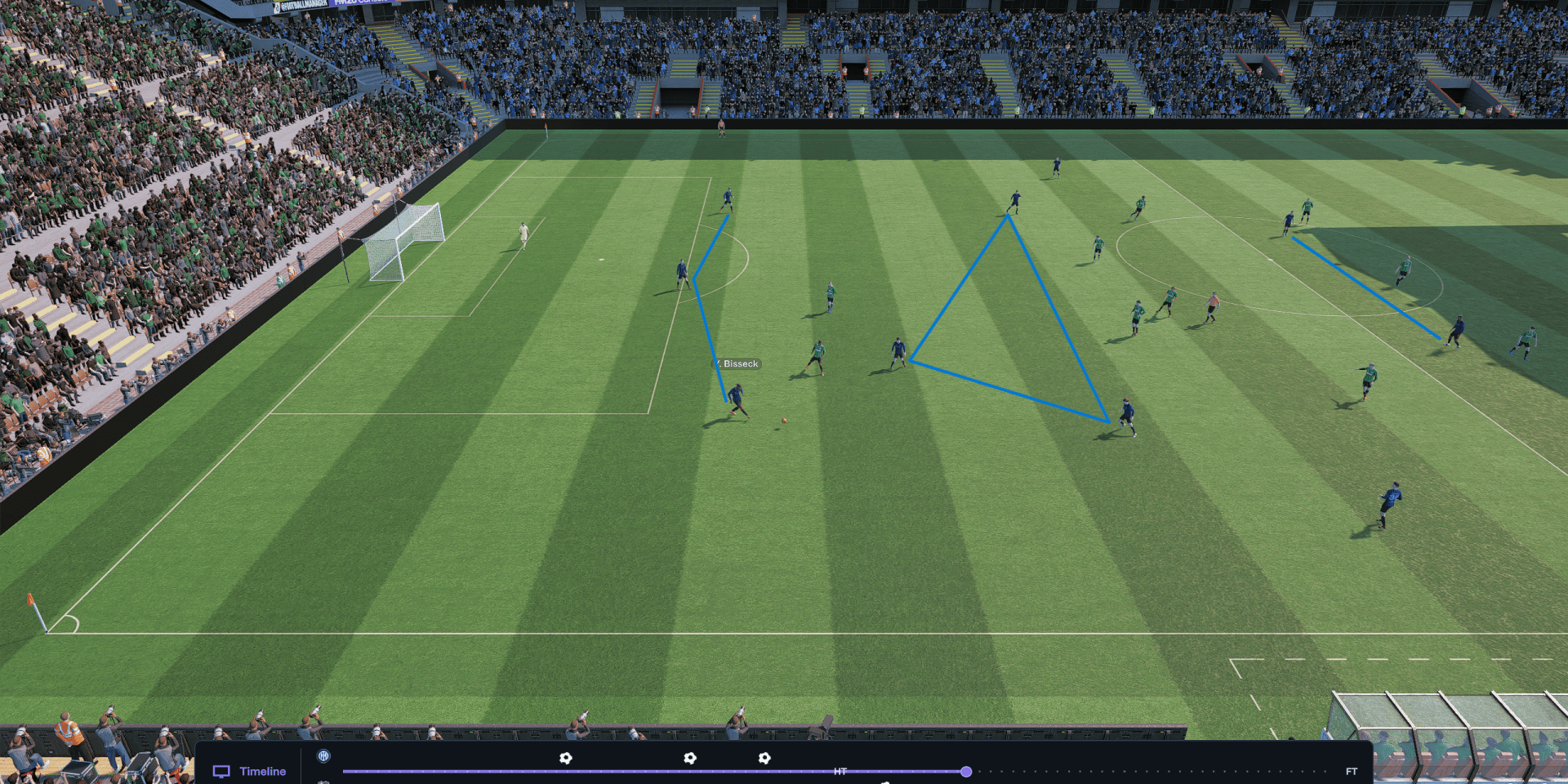
Out of possession example: I’ve always been a fan of forcing the opposition out wide as this limits the passing options for the player in possession, since they can only go forwards, backwards or come back inside. However, with this being Football Manager, it also forces the ball into wide, dangerous positions, since, at the time of writing, wingers are somewhat overpowered. But old habits die hard (feel free to remove this instruction if you’re uncomfortable with it). Doig is forced to the flanks, the defence compacts. We have five defenders in the box with the central midfielders shielding the perimeter.
The risk: Doig is 1v1 against my wing-back (although the Stopping Wide Centre Back will also engage).
The reward: They’re crossing into a box where they’re outnumbered three to five.
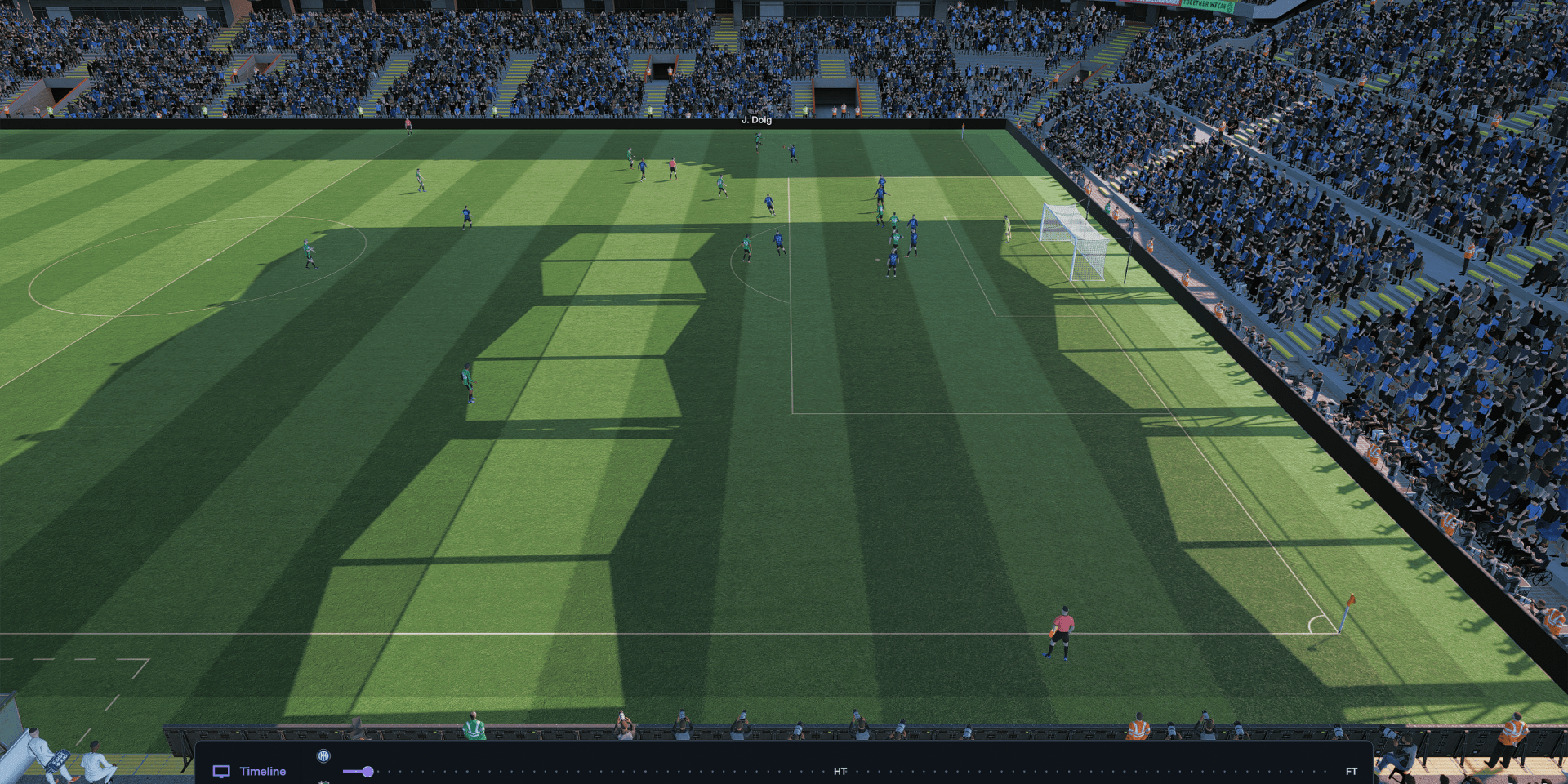
This 3-5-2 embodies balance. Compact off the ball, aggressive through transition, and fluid in build-up. A modern interpretation of Inter’s tactical DNA.

Player Roles and Instructions
The Goalkeeper and Defensive Line
At the base sits a Ball-Playing Goalkeeper for calm distribution, who operates as a Sweeper-Keeper out of possession to protect the space behind a lower line. The centre-backs define the build-up rhythm. The Overlapping Centre-Backs stay wider and shoot less often, providing width in the early phases and composure in recycling play. When defending, they become Stopping Wide Centre-Backs, easing off tackles to maintain shape and avoid rash challenges.
At the core, a Ball Playing Centre-Back in possession feeds progressive passes into midfield, but reverts to a conservative Centre-Back out of possession, pressing less and standing ground. This mix balances aggression with control, creating a back three that builds patiently but defends cautiously.
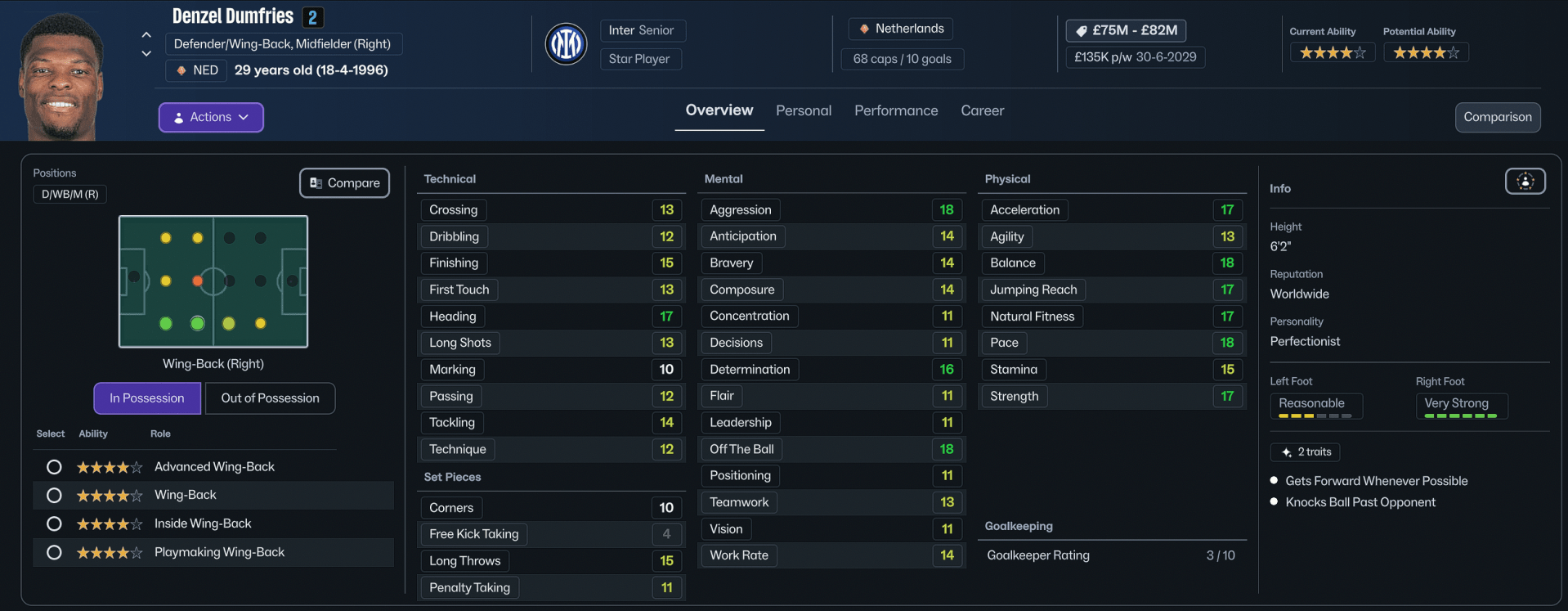
On the flanks, two modern wing-backs in the Advanced Wing-Back role with instructions to sit narrower, run wide with the ball, and cross from the byline, adding depth and precision from the flanks, maintaining vertical balance and recycling play early when needed. Both become Pressing Wing-Backs defensively, helping lock opponents in wide areas.
I cannot stress enough how important it is to have two very agile attacking wing-backs. You’re going to want them to have pace and acceleration in abundance, along with a healthy dose of stamina to keep them running up and down the wings. This system relies on them, so make sure you recruit well if you do not already have anyone to fill these positions.
Midfield Trio: Control and Balance
The defensive midfielder anchors as the tactical pivot. In possession, his Deep-Lying Playmaker role is instructed to play more direct passes, exploiting the full range of his vision to link defence and attack. Out of possession, he transforms into a Defensive Midfielder tasked to tackle harder, disrupting transitions and shielding the back line.
Ahead of him, operate mirrored Wide Central Midfielders. Both are instructed to run wide with the ball and shoot less often, helping stretch play horizontally while maintaining central dominance. One of the pair, generally whoever has the greater stamina, makes more forward runs to stagger the line, creating a subtle asymmetry that improves passing angles and penetration. When defending, both drop into compact Pressing Central Midfielders. A disciplined unit that compresses space and screens passing lanes rather than diving into tackles.
Front Two: Movement, Creativity, and Finishing
The strike pair combines structure and chaos. A Channel Forward thrives on diagonal runs into half-spaces, offering vertical outlets and movement that stretches back lines. This, coupled with a Deep-Lying Forward role, complements with intelligence. Moving into channels, roaming from position, taking more passing risks, and using shorter passing to link midfield and attack. This contrast, one runner, one connector, creates constant unpredictability.
Out of possession, both transform into Centre Forwards tasked with pressing more often and tackling harder, setting the tone for coordinated frontline pressure.
This player framework fuses tactical discipline with intelligent freedom. Each role serves a dual identity, a positional structure balanced by transitional ferocity. The essence of a modern, balanced side.
The download
The link to download and try this tactic is below, but it comes with some caveats:
1⃣ It needs fast wing-backs with lots of stamina!
2⃣ The mentality should be adjusted based on the game state. If winning, you can drop to balanced to see the game out and preserve energy. Losing, pump it up to attacking.
3⃣ Set pieces are a great way to get back into the game, don’t be afraid to play for set pieces to give yourself a chance to lump it up to the big man (I’ve a lot of them)! I’m using Knap’s MC40 set pieces because I’ve been too lazy to make my own this year.
4⃣ The tempo is adjustable; the tactic doesn’t rely on a higher tempo. It works with a lower and normal tempo, too. Adjust it based on your players’ skill level. Higher tempo with shorter passing requires technically gifted players.
5⃣ Same with crossing style, if you don’t have a big target man, play low crosses. The key is to play to your players’ strengths.
6⃣ If you’re going to adjust the line of engagement to press higher, I’d advise bumping up the defensive line a bit; otherwise, you’ll be too easy to pass around. Again, this should work with differing lines of engagement and defensive lines.
Thanks for reading. OJ.






 The Gaffers Lounge
Leave a comment