Long ago, before the trains came to the mountains, before even the roads wound through the passes, there was a valley cradled by peaks so high their crowns touched the stars. In this valley stood a settlement called Chur, though the Romans named it Curia, and the people before them called it by names now lost to time. It was said that Chur was older than any other town in all of Switzerland, as old as the stones themselves. The Rhine flowed past its feet, whispering tales from the glaciers, and the ibex climbed its cliffs, guardians of the Graubünden peaks.

The city was blessed but also tested. For every blessing of fertile land and Alpine beauty, there came the trials of war, fire, and invasion. Kings and emperors passed through, each laying claim, but Chur endured, as if protected by unseen Alpine spirits.
In one tale, the Ibex of Calanda stood watch over the town. Hunters tried to bring it down, but it vanished into mist, returning each time Chur was threatened – a symbol of resilience, reminding the people that as long as they stood together, their home would never fall. In another, the three voices of Chur – Romansh, German, and Italian -sang in harmony at the city gates. Outsiders said no three tongues could live as one, but the people of Chur proved them wrong, weaving a melody as rich as the valleys and as strong as the mountain stone. The people learned to climb, to carve tunnels, to tame rivers, to send iron rails over ice and stone. They built bridges that seemed to defy gravity, carrying red trains across white mountains. The world called them dreamers, but they only smiled: for in Chur, the mountains teach patience, and patience moves mountains.

And so, Chur, the oldest town, remained ever young – reborn in every century, carrying its people forward like the Rhine carries snowmelt to the sea. Its towers and churches rose against the sky, its markets filled with the chatter of many tongues, and its people carried both tradition and ambition in equal measure.
One day, not somany winters ago, a new tale was born. The youth of Chur, restless beneath the shadow of the peaks, gathered in the fields. They had no swords or crowns, but a ball of leather, patched and worn. And from their laughter, from their contests of strength and speed, came a new story: the tale of Chur’s football club. The club was said to be blessed by the same ibex that watched over the town. Its horns gleamed gold in the morning light, and from that day forward, the players wore red, colours of endurance and pride. Their boots struck the ground like cowbells ringing in the valleys, their voices carried like alphorns, and their unity echoed the three languages of the city.

Football became a mirror of Chur itself: resilient, daring, unafraid to climb. The team fought in the lower valleys of Swiss football, but always with the spirit of mountaineers – each step higher, each battle fiercer, each victory another stone on the path toward greatness. And so, from ancient myths to modern fields, Chur’s story continues. The Rhine still flows, the peaks still watch, and in the chants of the fans, the city finds its newest chapter:
“We are Chur, eternal as the Alps.”
The Alpine Rebirth: Chur’s golden dawn
July 2026. Via Chur 97’s official website:
– –
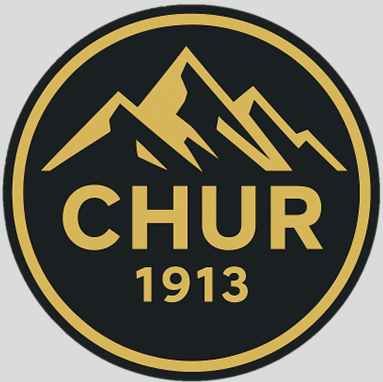
The board of FC Chur are proud to announce a historic new chapter in the life of our football club. With immediate effect, the club will move forward under a renewed identity: Chur, Switzerland’s oldest Alpine football club, reborn with a clear vision and rooted in the pride of our people and our land.
Formerly known as Chur 97, the club will now be known simply as Chur. This decision reconnects us with over a century of heritage, dating back to our founding in 1913, while ensuring that the name of the city – the heart of Graubünden and the oldest town in Switzerland – is once again at the forefront of our story.
Our colours will now be black and gold. Black represents the rugged Alpine rock, timeless and immovable, while gold reflects the sun rising over the peaks, symbolising resilience, unity, and ambition. These colours will feature across our home kit, produced by Jako, with our main shirt sponsor confirmed as Graubündner Kantonalbank (GKB) – a partner rooted in the region and trusted by its people.
Chur will henceforth be known as Les Alpinistes (The Mountaineers), a name chosen to represent both our geographic reality and our footballing ambition. Isolated by the Alps, our history has often been one of the underdog, battling against the odds and the weight of larger cities and clubs. This nickname is a badge of honour, reflecting the grit and endurance needed to carve out victories in the valleys and on the slopes.
At the heart of this transformation lies a new ideology: Alpine Football. More than just a style of play, Alpine Football is a way of life. It is about:
- Ambition: Scaling heights thought unreachable, climbing steadily but relentlessly.
- Resilience: Withstanding pressure, just as mountains weather storms.
- Unity: Standing together like peaks in a range, connected and unbreakable.
- Identity: Representing the culture, languages, and traditions of the Grisons – Romansh, German, and Italian alike.
Every match we play will embody these values. We will embrace attacking intent, collective strength, and the pride of carrying our Alpine heritage onto the field.
In announcing this rebrand, the board released the following statement:
“Switzerland’s oldest Alpine club, reborn. Playing with ambition, resilience, and unity, we carry the strength of the mountains into every match.”
This is not simply a change of name, colours, or kits. It is a declaration of purpose. Chur is not only a football team – it is the voice of the Alps, the pride of Graubünden, and aguardian of our culture and traditions.
The Voices of the Valley
As Chur begins a new era on the pitch, so too does the conversation around the club. To capture this rebirth, we are proud to announce the launch of Calanda – a dedicated football magazine covering Chur and its place within the wider sporting, cultural, and historical landscape of Graubünden. The slogan is simple and evocative:
“The Voice of Alpine Football.”
The five key writers for the club are:
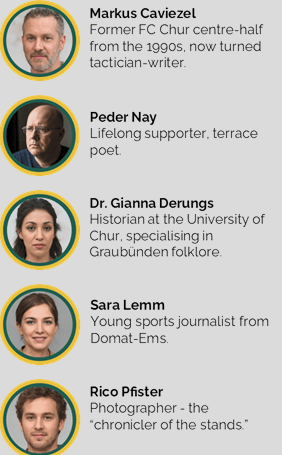
Markus Caviezel – Tactical Analyst. A former centre-back for Chur during the 1990s, Markus has transitioned from the pitch to the page. Known for his uncompromising defending and sharp footballing brain, he now dissects matches with the same discipline he once brought to the back line. His writing blends local loyalty with tactical sophistication, offering readers an insider’s view of how Chur is shaping its Alpine style.
Peder Nay – The Voice of the Supporters. Peder has stood on the terraces of Chur for over forty years, and his column is the heartbeat of the fans. Unpolished, emotional, and unafraid of criticism, Peder writes with the raw honesty of someone who has lived every triumph and heartbreak. He gives voice to the passion of the people, a reminder that football belongs to those who fill the stands.
Dr. Gianna Derungs – Folklore and History. A respected historian at the University of Zurich specialising in Graubünden folklore, Gianna’s contributions place Chur’s story within the wider tapestry of Alpine myth and identity. From Romansh tales of mountain spirits to medieval legends of Chur, her writing adds depth and timeless resonance, tying the club to the land’s ancient narrative.
Sara Lemm – Sports Journalist. A rising voice in Swiss sports journalism, Sara brings professionalism and polish to Calanda. Her matchday reports, interviews, and features connect the local with the national, ensuring Chur’s story resonates beyond the valleys. Her work captures the immediacy of football: the goals, the saves, and the turning points that define each season.
Rico Pfister – Photographer. A Chur native and award-winning photographer, Rico provides the visual soul of Calanda. His lens captures not only the action on the pitch but also the landscapes, supporters, and cultural moments that surround the club. Each image is a reminder that football here is inseparable from the Alps themselves.
– – –

The name of the magazine is taken from the Calanda massif, the mountain range that looms over Chur and defines the city’s horizon. For generations, it has stood as a symbol of endurance and belonging, a reminder that life in the Alps is lived against a backdrop of permanence. Naming the magazine after this mountain is no coincidence; it is a declaration of intent. Calanda exists to be as enduring as the rock that overlooks the city, to give Chur’s footballing story a voice as immovable as the peaks themselves.
At its heart, Calanda is built on the values of pride, identity, and resilience. It is a publication that seeks to champion Graubünden, not as an outpost in Switzerland’s footballing landscape, but as a cultural force in its own right. This is more than a magazine of scores and tactics; it is a journal of Alpine life, a celebration of the languages, traditions, and landscapes that shape football in Chur. Just as the region has been overlooked by many, Calanda embraces the role of the underdog, proud of being different, remote, and stubbornly independent. Its writers are committed to weaving football into the larger story of Alpine identity, where every matchday reflects not only ninety minutes on the pitch, but centuries of endurance in the mountains.
The design and feel of the magazine reinforce these ideals. It is modern yet rooted, balancing sleek lines with textures that echo stone and snow. Black and gold dominate its pages, symbols of resilience and ambition, accented with the whites and greys of the Alpine world. Photography is central to the storytelling, with Rico Pfister capturing fog over the Rhine, floodlights piercing the winter dark, or fans wrapped in scarves against the cold. Each issue is intended not merely as something to read and discard, but as a keepsake – an artefact of the season, something to hold onto as one holds onto memory.
Inside its pages, the magazine flows like the valleys that lead to Chur. Matchdays are covered in The Ibex Report – Markus’ opportunity to break things down, and, in Peaks and Valleys, Sara Lemm’s digs deeper and wider into sporting culture of the area. Fan culture is captured in the voice of Peder Nay, whose column is raw, heartfelt, and unfiltered, ensuring that supporters remain at the centre of the club’s narrative in his Voices from the Peaks. History and folklore are entrusted to Dr. Gianna Derungs, who writes Legend of Graubünden, linking football to myths, its Romansh traditions, and the struggles of its people through time and Kurve, by Rico Pfister, is an opportunity to see the action from a different perspective.
The editorial voice of Calanda is literary, rooted in place, and deeply evocative. It avoids sterile reporting in favour of storytelling that blends memory, myth, and tactical insight. Every article is written with the conviction that football is more than a game – it is a cultural mirror, an expression of community. In Graubünden, where valleys isolate and mountains demand resilience, football carries a unique symbolism, and Calanda seeks to capture that truth. It is not only a football magazine, but a chronicle of Alpine life and a reminder that Chur is not a forgotten outpost, but the beating heart of a different kind of footballing story.
We are Chur, not Wimbledon

When the board’s statement landed in my inbox – slick, polished, the sort they’ll hand to TV cameras and put in Sunday papers – I sat by the window and read it three times while the Alps kept their slow, indifferent watch outside. The words are proud words. They are dangerous words. They are, in places, exactly what we needed to hear.
“Switzerland’s oldest Alpine club, reborn. Playing with ambition, resilience, and unity, we carry the strength of the mountains into every match.” That sentence – short, sharp, golden – sits at the heart of the new identity. And for an old man who has sung in the rain for Chur since before your grandchildren were born, it is impossible not to feel a sudden, fierce lift in the chest. Finally: someone outside the terraces is saying what we have always known in our bones. Chur matters. Graubünden matters. Romansh voices, mountain valleys, the ibex on the ridge – they matter.
Let me be blunt. The name change – stripping the unnecessary suffix and standing simply as Chur – was the right move. Clean, honest, unshowy. The board kept 1913 visible; they’ve given us continuity, not erasure. That single choice avoids the slings and arrows we have seen elsewhere when clubs tried to paper over memory. Fans do not forget their stones. Look at Austria Salzburg after the Red Bull takeover: discard the violet, slap on corporate red, and half your city walks out to form a new club because you stole their colours along with their stories. No. Not here. Not us.
Black and gold – I’ll admit the first thing that struck me was how it looks when the sun hits the peaks at dawn. It is classy. It is grave. It is a colourway that does not shout “sponsor first.” It suggests a club that knows its place in the landscape. The circular crest with the peaks and “Chur 1913” is modern and yet quiet in its reverence. You could put that badge on a scarf and not be ashamed at a funeral or a festival. Good taste matters. Keep it.
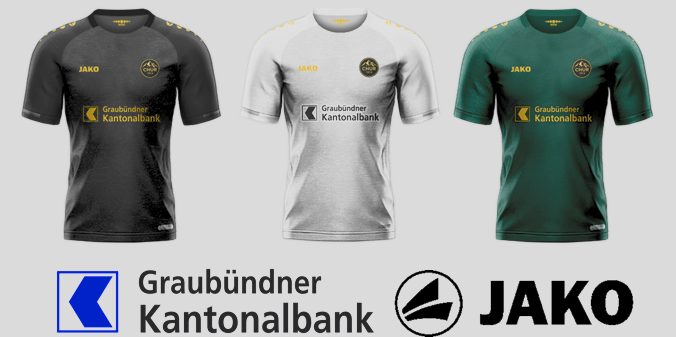
And here’s where I have to take off the poetry hat and put on the old man’s practical cap: the kit deal with Jako and the shirt sponsor Graubündner Kantonalbank (GKB) – that feels right. Jako is sensible: not a flashy global logo pretending to be part of our story; a brand that outfits real clubs and understands what a lower-league community side needs. GKB is our bank. It has branches in the valleys where my mates live. Sponsors can define a rebrand more than the press release can. Pick a multinational and you have a Red Bull or RB Leipzig narrative in a heartbeat. Pick a partner embedded here, and you keep the story local. That gives me hope.
But hope without vigilance is a naïve thing. I have been around long enough to remember the splendid promises that arrived in glossy suits and boarded trains. We have seen clubs “modernise” their crests into corporate icons until the terraces didn’t recognise themselves in the shape of their own flag. We have watched phoenix clubs born from outrage – AFC Wimbledon is the textbook: when a club becomes a corporate property rather than a town’s heartbeat, the people will build anew. We do not want to hand ourselves over and then stand on the pavement as others sell our name. If the board truly means the rhetoric about culture and identity, then they must lock those ideals into governance, not just marketing copy.
That is why Calanda – the magazine – matters so much. If the board is sincere – and the first issue’s masthead of Markus Caviezel, Dr. Gianna Derungs, Sara Lemm, Rico Pfister, and myself (well, they asked; I’m flattered) is any sign – then this rebrand isn’t just a logo swap. It is a public conversation. It is the difference between a slogan and a civil contract with the supporters. Let the fans read, question, and critique. Let the historians remind us of our mistakes. If rebrand is a story told only by directors, it becomes a script we did not write. Calanda offers the chance to write together. Use it. Don’t hide behind it.
Now, about Alpine Football. The board’s definition in the press release – ambition, resilience, unity – is a lovely framework, but it needs teeth. “Alpine Football” cannot be a catchphrase on a scarf. It must be operational: a commitment to youth from Graubünden, to Romansh outreach in the academy, to scouting that looks to Vals and Disentis as readily as it looks to Bern or Zürich. If Alpine Football is real, our starting XI next season should have names local kids grew up with, not a dozen boys with no connection to our valleys. Give us the academy plan, the scholarship program, the staff who will teach Romansh to foreign recruits. If the ibex is our symbol, then the mountains must feed our squad.
And yes – let us be honest about the board’s past. There have been failures. Promises about stadium upgrades and youth projects have been delayed and forgotten. There have been managers parachuted in as quick fixes while the academy rotted quietly; there have been marketing ploys that felt like fast food: tasty in the moment, empty in the morning. So I ask: where is the money set aside for the academy? What legal protections prevent a future buyer re-colouring our badge and selling our name? The board can give grand speeches, but real loyalty is built through audited budgets, community seats on the board, and transparent planning. I want to sing in the terraces, not to attend an emergency meeting every season because the club’s heart is being auctioned.
We should also talk about tone. The press release is high on elevation and poetry. Good. But watches must be wound. The fans don’t need empty verse; we need detail. A sponsorship by GKB is excellent, but who signs that check? How long is the deal? Are there community clauses? Did the club consult the ultras on the badge before it went public? These are not petty questions. They are the mortar between stone and roof. Ignoring them is how well-meaning rebrands dissolve into branded emptiness.
The nickname choice – The Mountaineers, Les Alpinistes – is not bad. It is strong, sturdy, unpretentious. But let us own it properly. Give us chants that fit the name, a template for tifos that references ibex horns and the Calanda silhouette, a community day where the first scarves roll off the presses and proceeds help kit local youth teams. Branding without ritual is just decoration. Ritual is what turns logos into anthems.
So here is my verdict, loud and biased and full of cowbell noise: this rebrand could be the beginning of something precious. It could instead be another chapter in the book of good intentions if we let it rest on hype alone. The board has done the right things on paper: kept 1913, picked black and gold that actually feel like Chur, chosen local partners rather than corporate giants, launched Calanda to foster a real conversation. That is the scaffolding of trust.
But scaffolding is only useful if we build. I want a fan representative with a vote. I want a legally binding community clause on any future sale – a right for supporters to buy a controlling stake before a stranger does. I want a five-year youth plan, publicly published. I want the badge to remain ours, not a commodity to be repainted with quarterly profits in mind. In short: talk to us, not at us.
If the board believes in “Alpine Football” – real football built from valley to peak – then let them prove it with deeds. Let them show the academy kits, not just the glossy home strip. Let them announce the first Romansh-language community workshops. Let them, for once, surprise us by keeping a promise.
Until then I will sing. I will wave my scarf. I will read and contribute to Calanda and shout back my questions. I will stand at the front of the Kurve and remind anyone who will listen that the club was never made by logos alone. It was made by people who hauled stones for the terraces, who once played in the meadows with patched boots, who kept the flames of this old city alive beneath the snow. If the board is serious – truly serious – then this rebrand will become our legacy, not their headline.
We are Chur. We are the ibex on the cliff. We are stubborn, we are patient, and we are ready to climb. If you want to put your name to our flag, you will need to climb with us, not just fly over us in private jets.
Clemente on the brink
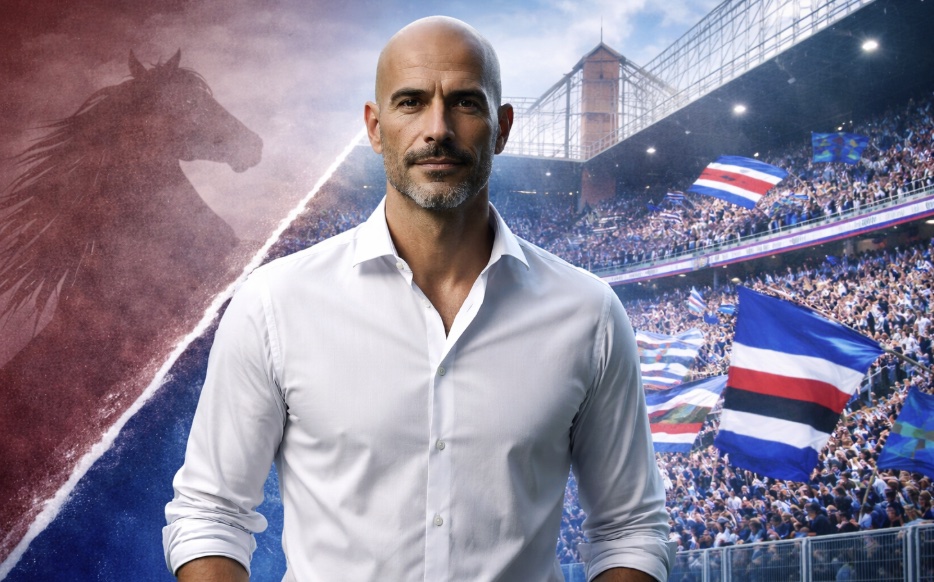
As a lifelong Chur supporter, this one hurts to share. I’ve followed this club through every rise and fall, and while last season gave us hope, things just haven’t clicked this time around. The local paper has picked up on what most of us have been whispering – questions about Francesco Clemente’s future. Whatever happens, I just hope the board remember how far we’ve come these past two years, and what this club means to our town. Here’s the full article from Churer Tagblatt:
CHUR BOARD CONSIDERING MANAGERIAL CHANGE AFTER SLOW START TO THE SEASON
By Lukas Bernet | Churer Tagblatt Sport | 5thSeptember 2026
There are growing questions over the future of Francesco Clemente, the head coach of Chur, as the club’s board, led by president Marc Jaggi, is understood to be reviewing his position following a difficult start to the new season.
Clemente, who has been in charge for 14 months, guided the newly rebranded club to a second-place finish in the 2. Liga Interregional Gruppe 5 last term – an impressive first campaign that raised hopes of a promotion push. However, those ambitions have faltered in recent weeks. Now competing in Gruppe 4 after the summer’s regional reshuffle, Chur have struggled to find consistency. The side has recorded no wins in their first five, sitting deep in relegation trouble.
Sources close to the club suggest that the board has begun “internal discussions” about the direction of the team, with some members expressing concern about the lack of progress since August.
Recruitment over the summer was described by one supporter as “disappointing,” with Chur failing to secure the experienced reinforcements many felt were needed to build on last season’s success. Instead, Clemente has relied on a mix of aging professionals and promising local youngsters, a balance that has yet to produce results on the pitch. President Marc Jaggi declined to comment on Clemente’s future directly but confirmed that “all aspects of the club’s sporting performance are being evaluated.”
Clemente’s record stands at 15 wins from 35 matches in charge – a 42% win rate – and his emphasis on local development has earned him respect among parts of the Chur faithful. However, with the club eager to establish itself as a stable force in Switzerland’s fifth tier, patience may be running thin.
The coming weeks could prove decisive for Clemente and for a club still searching for its footing after an ambitious rebranding and a promising, yet fragile, start to a new era.
 The Gaffers Lounge
Leave a comment