
The appointment of Francesco Farioli at FC Porto has placed one of Europe’s most intriguing tactical minds under the spotlight. At just 36, Farioli is often tagged as “Football’s Philosopher,” a moniker earned not just by his age, but by a coaching methodology uniquely driven by an academic background in philosophy.
This is not a coach who simply follows trends. This is a coach who sees football as an “expression of the self,” rejecting external statistical dogma in favor of an authentic, yet meticulously structured, possession-based system.
This detailed analysis breaks down Farioli’s principles, from the philosophical roots of his “romantic” style to the precise tactical roles that define his teams, whether at Nice, Ajax, or now, Porto.
Ⅰ. The Philosophical Foundation: Coaching From the Interior
Farioli’s vision stems directly from his university studies at the University of Florence. He authored a thesis titled ‘Football as rebirth: the aesthetics of the game and the role of the goalkeeper,’ which defines his unique lens on the game.
The Aesthetics of Control
- The Rejection of Modernism: Farioli critiques the purely data-driven, “scientific” approach to football. He argues that coaching decisions must come from “what I like, the football that I love,” viewing style as an aesthetic choice akin to art or music, rather than a mathematical equation.
- The De Zerbi Influence: While his mentor, Roberto De Zerbi, is his clearest tactical predecessor, Farioli is seen as building upon the high-risk build-up principles by adding his own layer of defensive solidity and control.
The Defensive Pillar
Despite the attacking fluency often associated with his teams, Farioli emphatically states that a strong defense is the pillar of his philosophy. This is evidenced by his time at OGC Nice (2023/2024), where the team achieved:
- Best Defensive Record: Conceding the fewest goals (29) in Ligue 1.
- Clean Sheets: Securing a league-leading 17 shutouts.
This mean defense provides the crucial security required to execute his high-risk passing schemes.
Ⅱ. Tactical Identity: The Lure of Possession
Farioli’s system is not merely a high-press, possession side; it is a meticulously calculated strategy to manage risk and exploit specific areas of the pitch.
The most unique aspect of Farioli’s 4-3-3 is the creation of a 5-man central unit when attacking, which ensures control and effective defensive stability (Rest-Defence).
The “Lure” and Third-Man Principle The low tempo and short passing in the defensive third serve a single, daring purpose: to lure the opposition’s press.
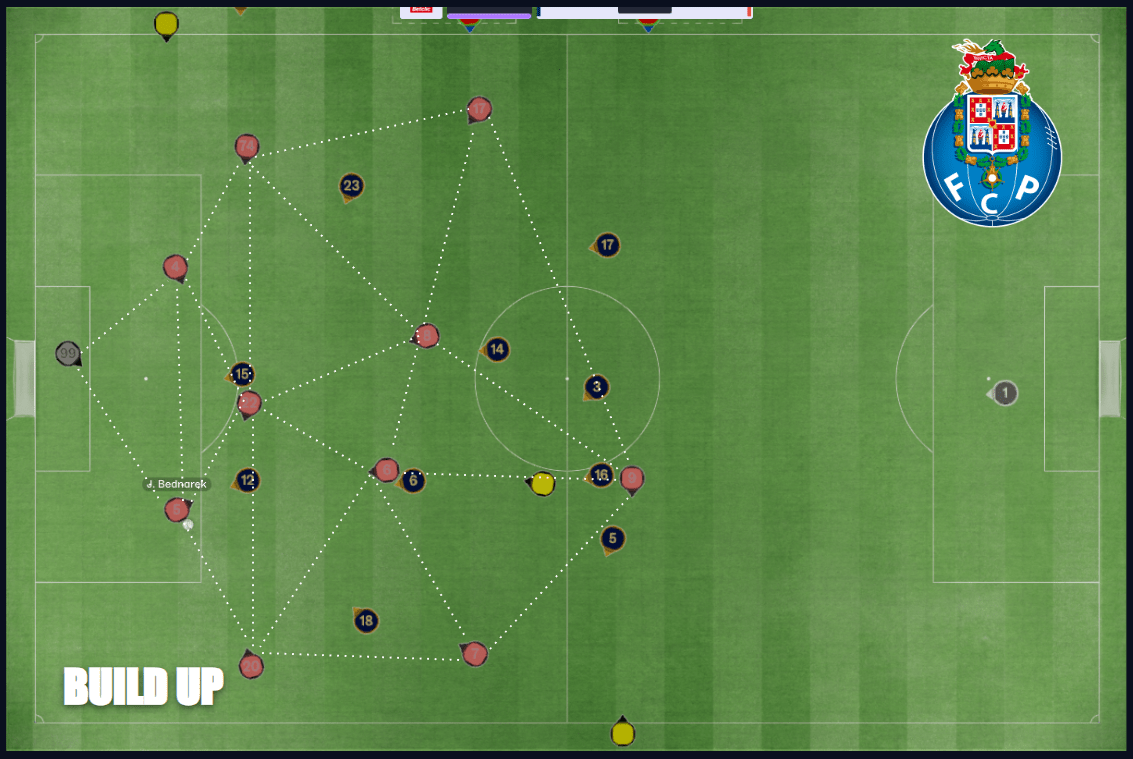
- Delay and Bait: Farioli instructs the Ball Playing Defenders to pause on the ball, inviting the opponent’s forwards to commit to a press. This is a moment of extreme risk, but it’s essential for creating the subsequent advantage.
- The Third-Man Principle: Once an opponent commits (e.g., a forward presses a CB), a passing lane opens to a third player (e.g., a Mezzala) who is not marked by the pressing player.This sequence—A → B → C, where C is the free player—is the primary mechanism for bypassing the entire first line of pressure.
- The Goal: The aim is to convert a slow, meticulous build-up into a sudden, effective near-counter-attack against a stretched midfield.
The Central Overload and Wide Isolation
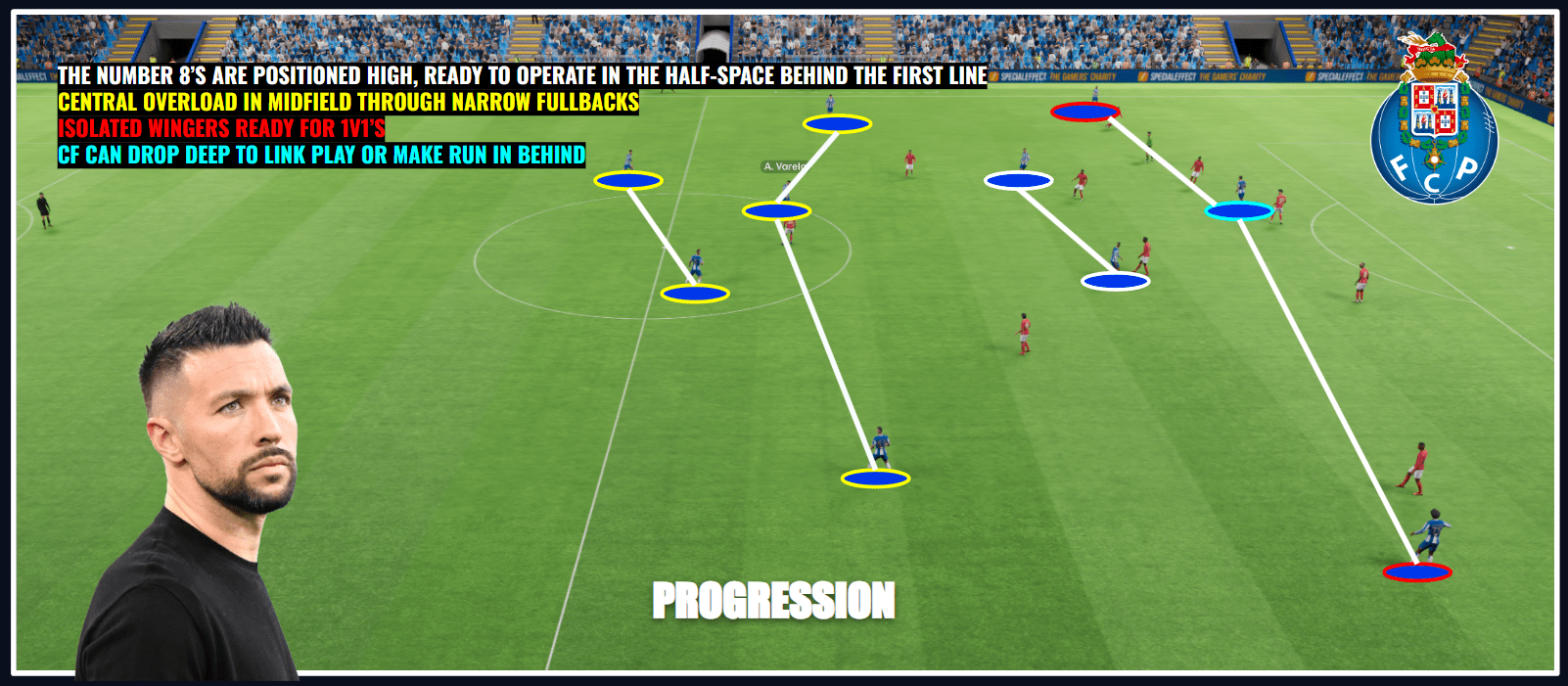
Once the ball is past the first press, the team’s shape is designed to maximize creative output in the half-spaces.
- Inverted Fullbacks: The Fullbacks (DR/DL) tuck inside to create a central overload in midfield, rather than providing traditional wing width. This helps to secure the defensive transition (rest-defence) and positions more players centrally to dictate tempo.
- The Number Eights: The two Central Midfielders (MCs) are positioned high, ready to operate in the half-spaces behind the opposition’s first line. One often plays as a creator (like Gabri Veiga), making fluid runs and linking play, while the other functions as a goal-threat (like Froholdt), focused on late runs into the box.
- Winger’s 1v1: By centralising the Fullbacks, the Wingers are isolated high and wide, giving them the space to directly attack their opposite Fullback in favourable 1v1 duels.
Ⅲ. Tactical Identity: Out of Possession and Transition
Farioli demands aggression and exceptional organisation when the ball is lost. The press is immediate, and the deeper defence is highly compact.
The Immediate Counter-Press

- Aggression: When the ball is lost, the command is always Counter-Press. The concentration of players in central areas due to the Inverted Fullbacks ensures the team can quickly surround the ball-winner.
- Pressing Forward: The Pressing Forward (S) (like Samu Aghehowa) leads the high press and serves as the immediate passing option for a quick transition.
Defensive Organisation (Man-Oriented)
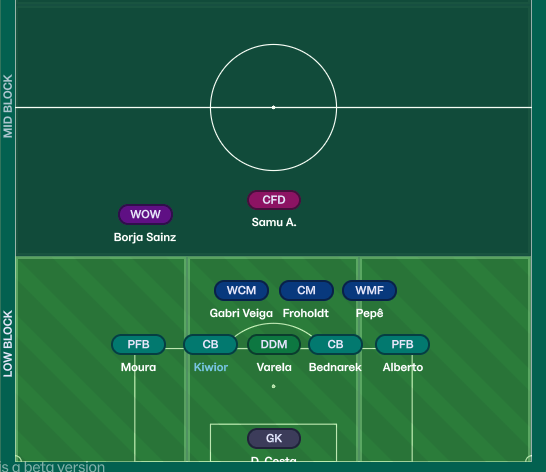
- High Press: Farioli favors a man-oriented, intense high press, with the attacking players assigned individual marking responsibilities to eliminate easy short options.
- Low Block: If the press is successfully broken, the team quickly drops into a compact low block (A hybrid 5-3-2 which could be flexed to a 5-4-1 by changing Sainz to a wide outlet wide midfielder). This structure, with five defenders and a tight line of midfielders, closes central spaces and forces the opponent into predictable wide or square passes, demonstrating tactical flexibility.
IV. FC Porto Player Analysis & Role Suitability
To successfully replicate Farioli’s system, players must possess high Composure, Passing, Off The Ball movement, and Work Rate. Here is a detailed look at the best candidates for the most specialised roles at FC Porto.
Defensive Core (The Lure)
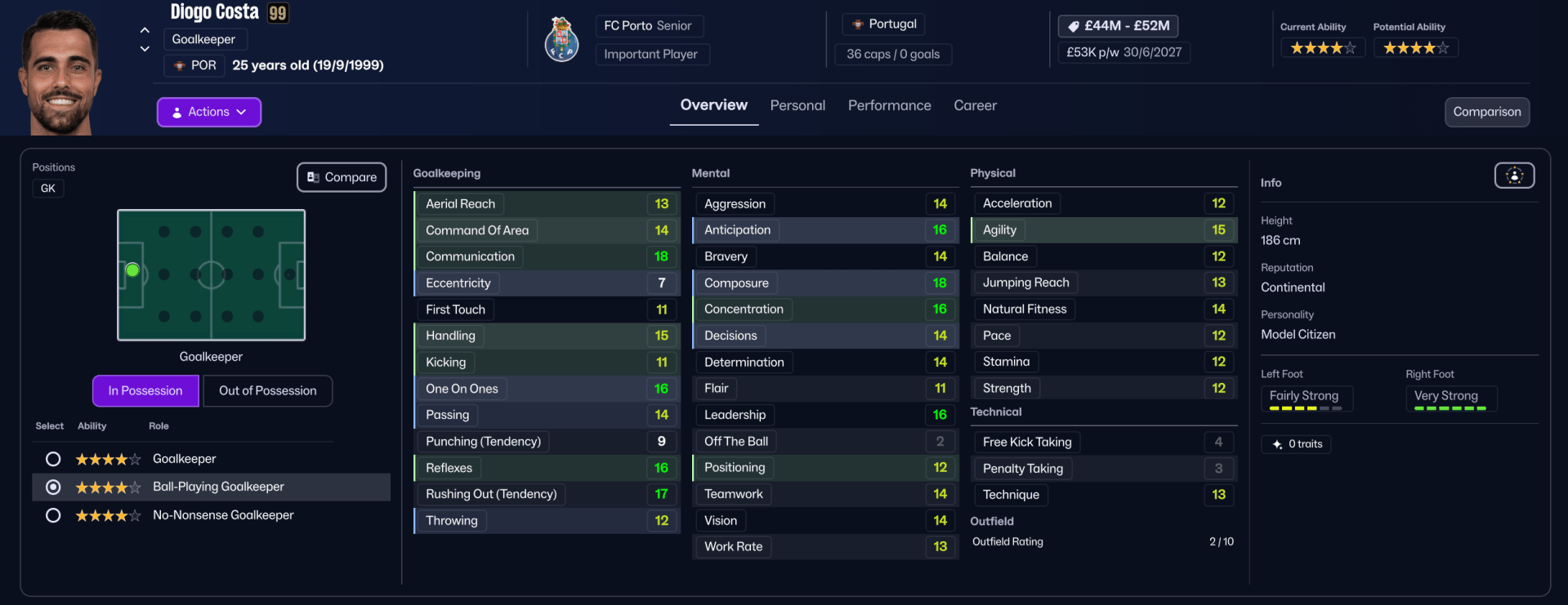
Diogo Costa is the perfect fit as the system’s primary playmaker, possessing solid passing (14), vision (14), and composure (18) to confidently participate in the initial Lure Mechanism, turning the opposition’s press into a tactical advantage.
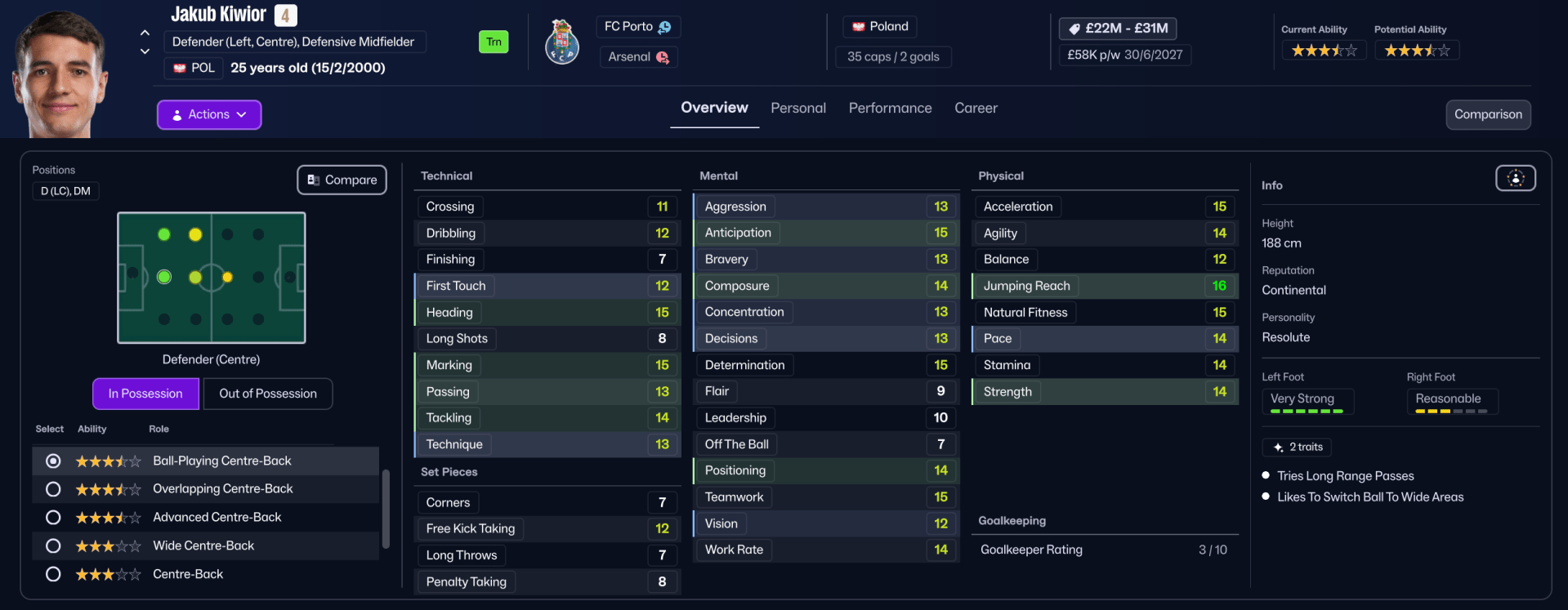
Jakub Kiwior’s passing range (tries long range passes, and likes to switch ball to wide areas) and high defensive positioning (14) are essential for the backline’s functionality, enabling him to receive the ball from the goalkeeper and reliably execute the short-to-medium passes that bait the press while maintaining defensive structure.
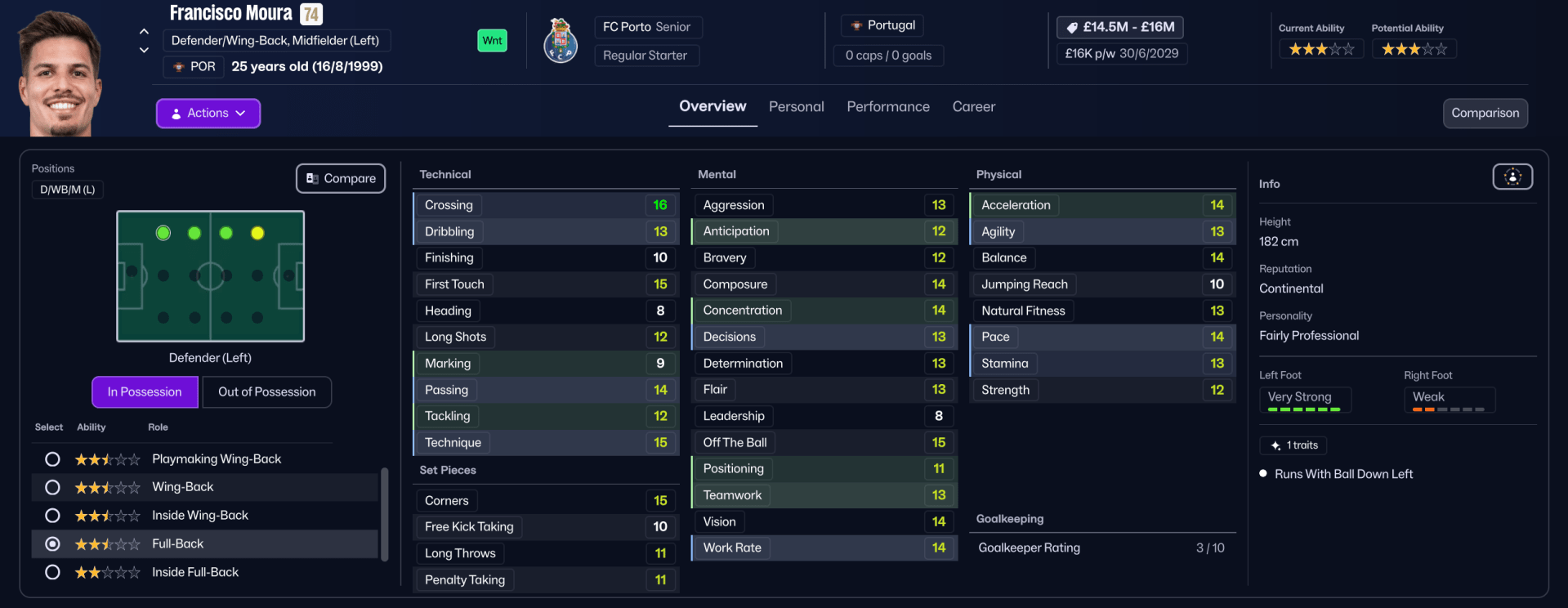
Francisco Moura is critical to the central overload, as his technical quality (Passing 14, Technique 15, and Vision 14) and off the ball movement (15) allow him to consistently tuck inside, forming the midfield base and linking play quickly to create superior numbers centrally.
The Dynamic Midfield (The Creators & Runners)
For those who have followed my work over the years, they will know just how much I love a three-man midfield. A love which stemmed from writing about Massimiliano Allegri’s UEFA Pro thesis, which he completed in Coverciano.
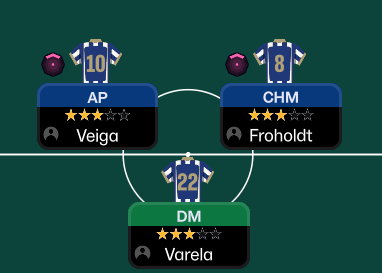
The holder (often a Defensive Midfielder or ‘Number 6’) provides essential defensive stability, screening the back four and dictating the tempo with short, safe passes. The passer is the creative hub, responsible for distributing the ball, unlocking defenses with intricate through balls, and controlling the direction of the team’s attacks. Finally, the runner (a ‘Box-to-Box’ or ‘Attacking Midfielder’) links defense to attack, providing crucial dynamic movement, arriving late in the box to score, and pressing opponents high up the pitch. This combination ensures the midfield can effectively manage all phases of play: defense, transition, and attack.
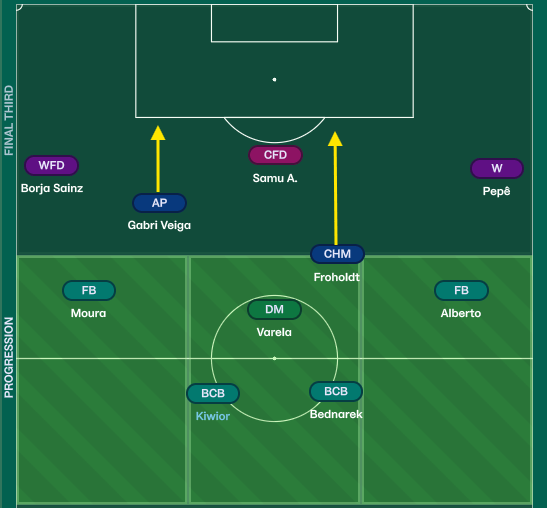
Porto’s midfield foundations adhere to all of the above. However, it is in the final third where Farioli’s attack is flexible and unpredictable through fluid forward movements and vertical threats.
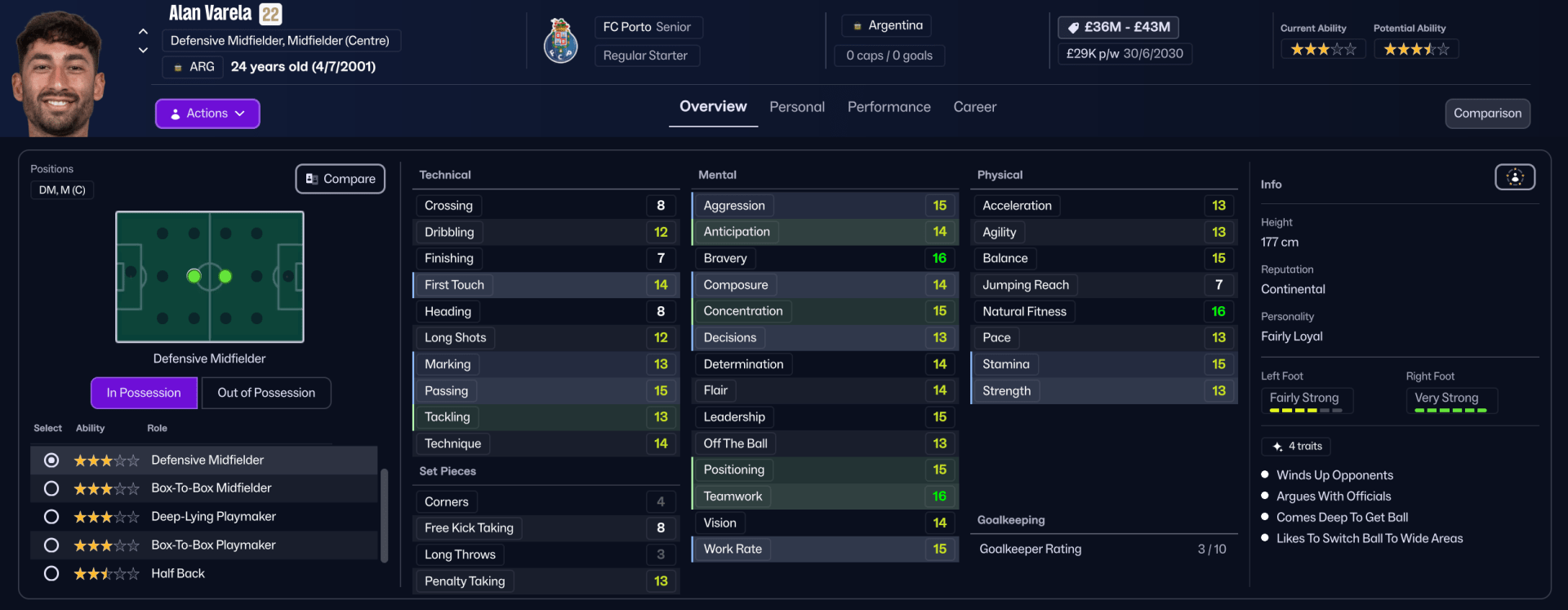
Alan ‘The Holder’ Varela has the perfect blend of technical, mental, and physical attributes for this role. Whilst his traits such as ‘Comes Deep To Get The Ball’ and ‘Likes To Switch Ball to Wide Areas’ are also appealing.
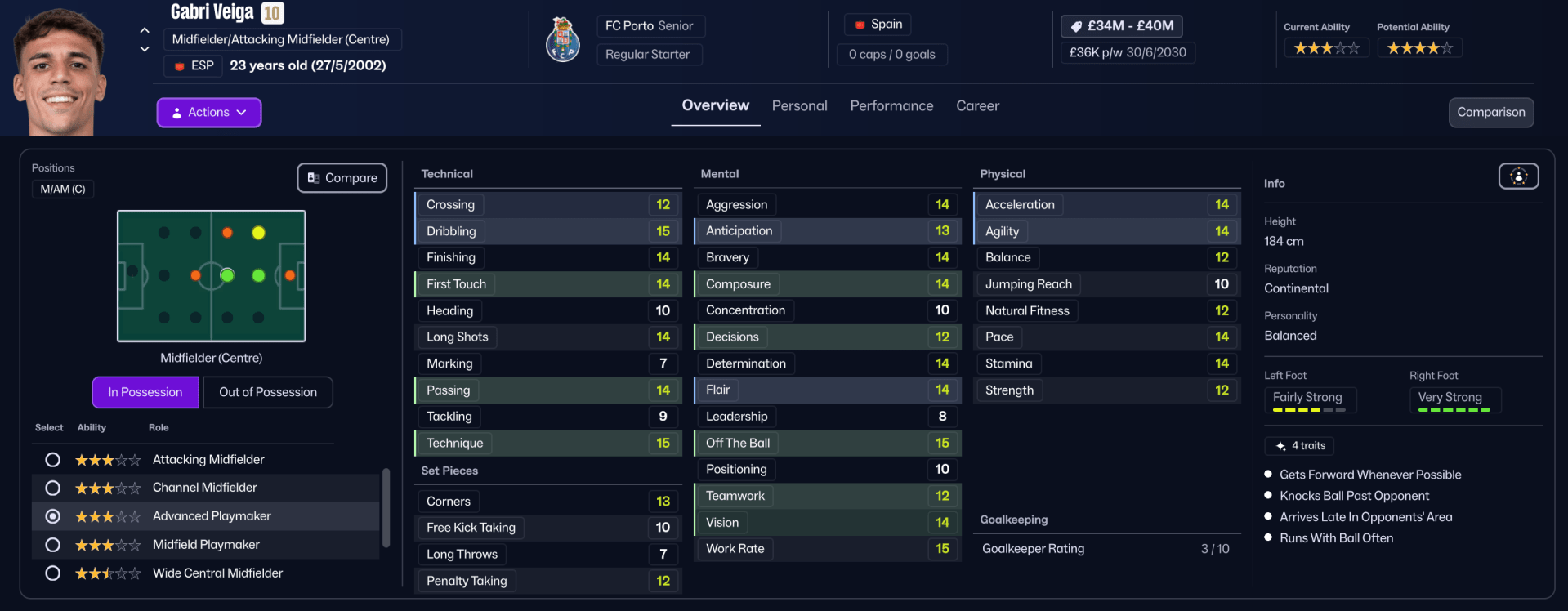
Gabri ‘The Creator’ Veiga – The 23 year-old is arguably better positioned as an attacking midfielder. Especially when you consider his long list of traits. However, I feel that he would be successful playing in the ‘Advanced Playmaker’ role which looks to operate in the space between the oppositions defence and midfield. He has the right profile to enable him to operate in tight spaces and should still make some of those runs in the channel due to his player traits.
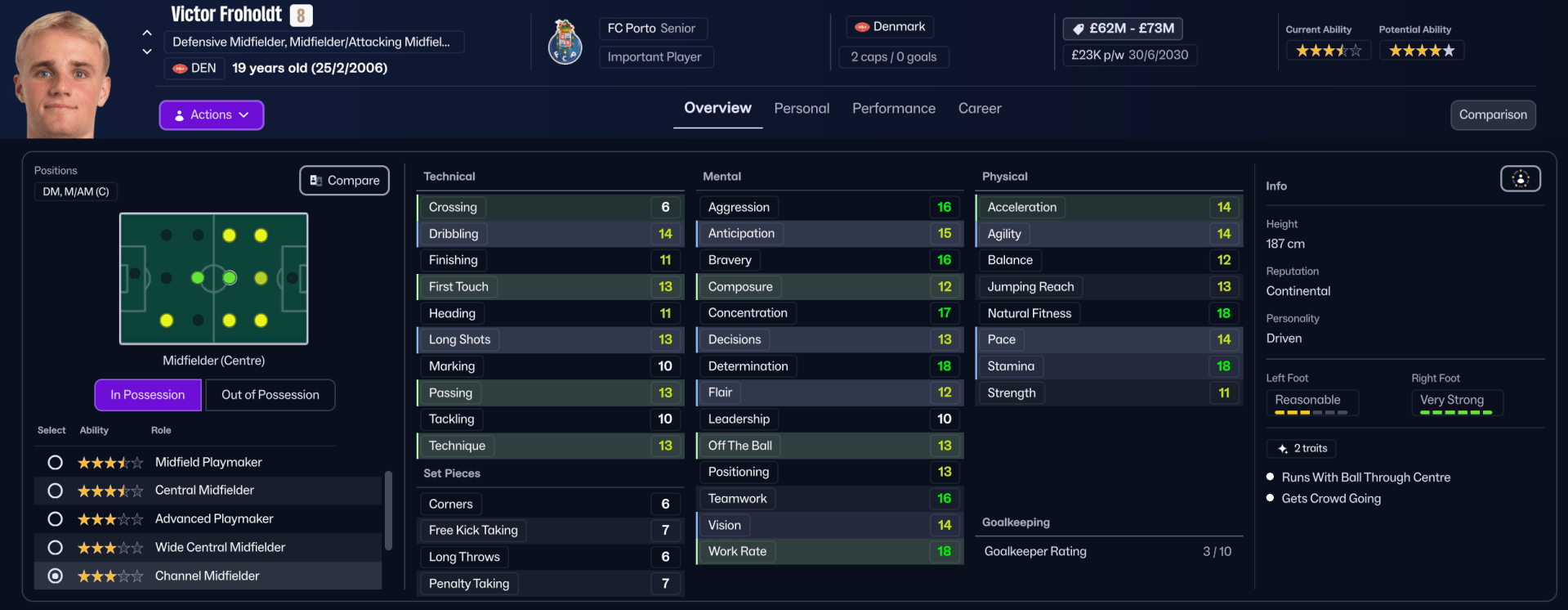
Victor ‘Five Lungs’ Froholdt – Do not let this young man’s age deceive you, at just 19 years old Victor is an absolute machine! Teamwork, Work Rate, Stamina, and Natural Fitness all at an elite level, and I won’t even bother listing off some of those mentals – PI’s added are ‘Move into channels’, ‘Make more forward runs’, and ‘Roam from position’.
The Flanks and Attack (The Isolation)
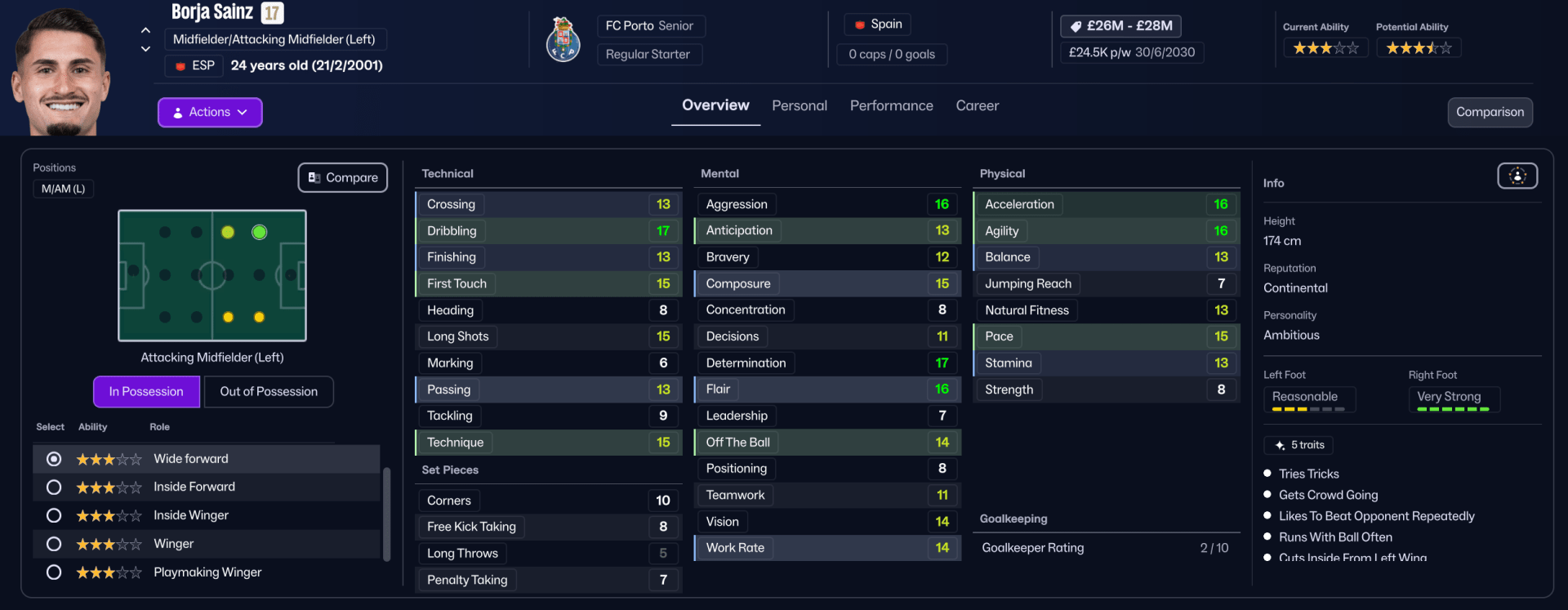
Borja Sainz – 19 goals in the Championship across 2024/25 was enough for Porto to pay £13 million for the Spaniard’ signing. Borja has taken ownership of the left flank, breaking into the TOP 5 dribblers in the Primeira Liga. I though long and hard about his designated role – flipping between the Inside Forward and Wide forward. I opted for the latter as the positioning will help to provide more width throughout the attack. This should help to stretch the opposition defence and still be one of the main attacking threats.
The wide forward is still an offensive role that looks to attack the box and make dangerous runs behind the oppositions defence in the final third. It appeals to me as from time to time I still would like to play direct long balls into space for winger runs, which will make the team less predictable, mixing short combinations with sudden depth – At the time of writing this post Borja is one of the leading shooters for FC Porto.

Pepê takes up ownership of the opposite flank – this time in the role of an old school winger. However, due to his traits he should also be able to offer variation – just like Borja – which will keep the opponents on their toes. (Quite literally when looking at his traits).

Samu Aghehowa – At 6’4’‘ Samu is a penalty area dominant striker that can provide an outlet to receive long balls for hold up, or to run the channels in behind. He arguably could be the next £80m striker as his conversion profile over his career would see him dining at the top table if he continues his tradjectory.
V. The Tactic – Francisco Farioli – The Philosopher
Creating this detailed tactical replication of Francesco Farioli’s game model has been an absolute blast, and I sincerely hope that this analysis does justice to his philosophy and makes all the passionate FC Porto supporters proud!
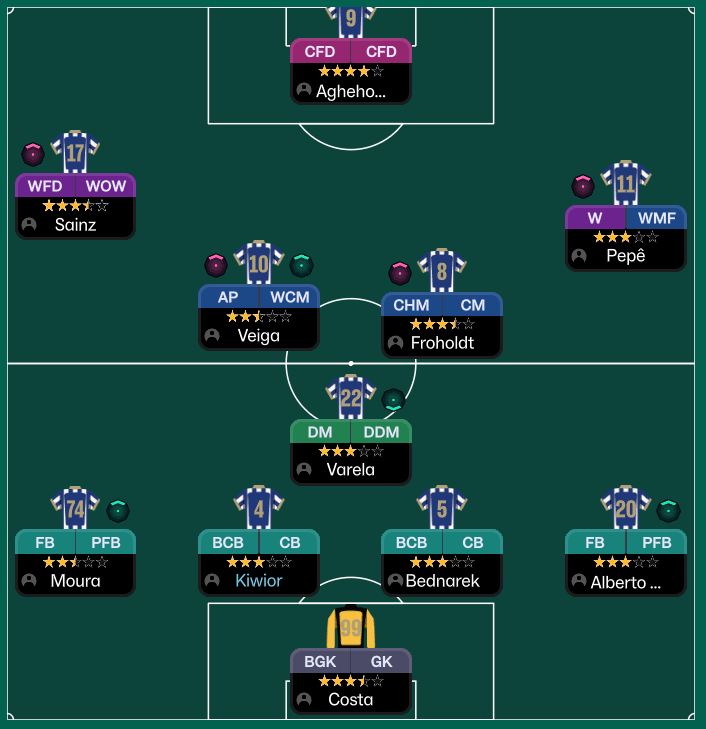
Downloadable link > Francisco Farioli – The Philosopher *note the tactic doesn’t include Froholdt as a ‘pressing cenral midfielder’ – which is currently under testing.
The below captures the most frequent plays and connections between the wide players—that means the fullbacks and wingers. Why them? Because their link-up is absolutely crucial for a solid build-up and, most importantly, for creating chances in the final third.
We’re deliberately running two distinct tactical setups on the flanks, and the differences are fascinating.

The Left Flank: Precision and Playmaking: On the left, we’ve built a triangle designed for elite connection. It features Moura, who is an elite passer, paired with Sainz, a classic direct runner. The system is anchored by Veiga, a top-tier ball receiver and playmaker operating in the half-space. The key here is the direct passes from Moura into Veiga—these vertical deliveries into the half-space are absolutely vital for our build-up and penetration.
The Right Flank: Carrying and Versatility: The right side offers a different profile. Costa is a less expressive passer than Moura, but he’s a significantly more effective ball carrier. This is paired with Pepê, a true hybrid who can switch between creation and running. Up front, Froholdt will likely play higher, constantly making movements in behind the defense. This advanced role by Froholdt is the catalyst: it creates the necessary space for Costa to invert and generate crucial overloads in the right channel. This flexibility means Gomes can fluidly shift between being ball-dominant and being primarily movement-focused.
If this post has been of interest – I have a thread over on the SI Forum called Francisco Farioli – The Philosopher which explores Farioli’s game model in much more detail. If you’d like to show your appreciation towards this post – please head on over to my Substack and hit the subscribe button.




 The Gaffers Lounge
Leave a comment