

Inside the Machine: Ten Games That Explain Arezzo’s Rise
The whistle blows at the Stadio Città di Arezzo and the home crowd exhales. Another narrow victory secured.
Ten games into the Serie C season and Throwing Copper’s side remain unbeaten.
Yet beneath the impressive numbers (18 scored, 7 conceded) lie the beginnings of an experiment: can tactical precision outlast chaos in Italy’s most unpredictable division?

The Shape of Control — S.S. Arezzo’s 4-3-3 Framework
It’s not the kind of football often seen in Serie C.
There are no frantic diagonals, no panicked clearances, no midfielders sprinting to chase shadows. Instead, there’s shape, discipline, calm and resilience..
This system is a 4-3-3 built on balance. Every movement is designed to protect space before it attacks it.
When Arezzo build from the back, the two centre-backs split while the inverted full-backs tuck into midfield, forming a narrow base beside the single pivot. That pivot — usually midfield enforcer Shaka Mawuli Eklu — acts as the hinge between defence and midfield, his positioning dictating when the rest can advance.
Short passing lanes, tight distances, minimal chaos.
It’s not possession for possession’s sake, but possession as protection. The objective is to draw opponents forward, then punch vertically through the lines, often through veteran playmaker Filippo Guccione, whose vision from the left-sided eight slot has become the side’s creative axis.
The wingers hold the width, cutting inside to combine with the lone striker. Their presence pins opposition wingbacks, forcing opponents to defend wider than they’d like and keeping the wingbacks honest in their positioning.
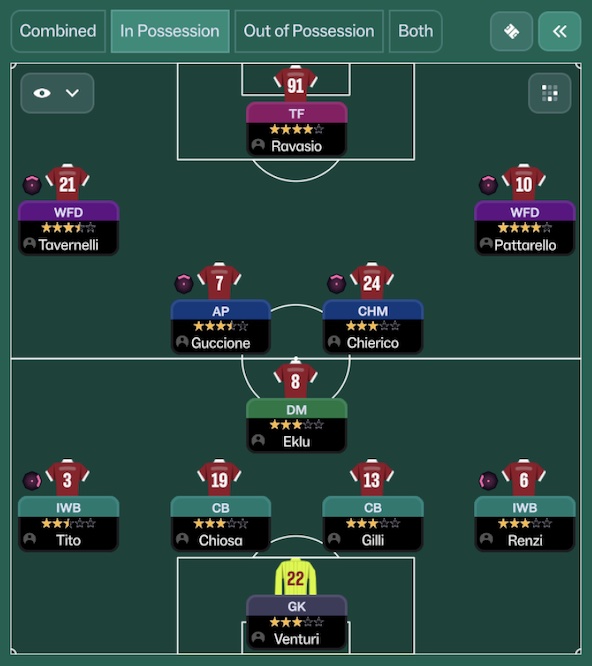
It’s a structure that values discipline over flair — but within that discipline lies the freedom to express.
Players are encouraged to make brave passes once the pattern is set; they just have to be made from the right zones.
The simplicity of the framework is part of its strength.
We’re not overloaded with instructions,” says captain Marco Chiosa. “Everyone knows their job. The system’s clear — if one moves, the next fills in. It means we play fast without overthinking.”
That quote encapsulates the philosophy. Arezzo’s 4-3-3 isn’t complicated, But it’s also not rigid — it flexes subtly depending on the match state. When facing different opponents, small tweaks will be made but the system remains the same.
There have been two recent examples of these changes paying off.
Firstly, during the Etruria Derby against Perugia, Arezzo were struggling, amassing just 0.04 xG from 3 shots at half time. In the second half the team played as narrow as possible, trying to draw Perguia into the middle, before spraying long balls out to the wings. They scored and ended up with a 1-0 win in a hard-fought game.
The following week, against a narrow Pontedera’s 4-4-2 Diamond , the players were encouraged to use the full width of the pitch and build more in wide areas. Two goals followed and the Amaranto flipped the game to win 2-1.
When defending a lead, the midfield triangle sometimes collapses into a 5-4-1 and the wide forwards retreat just enough to seal the half-spaces.
Through ten games, the results speak for themselves: unbeaten, 18 goals scored, seven conceded. The shape has given them stability, and stability has given them confidence.
Still, despite the need for dramatic comebacks and last-gasp winners, the system holds — a quiet assertion that even in Italy’s third tier, there’s room for order among the noise.
Building from the Back — Calm Amid the Chaos
If the 4-3-3 is the shape of control, its heartbeat starts deep.
Arezzo’s build-up phase is a deliberate act of patience — a small rebellion in a league where most defenders still prefer to clear their lines first and think later.
When Shaka Mawuli Eklu drops between the centre-backs, the structure briefly becomes a 3-2 platform, with the inverted full-backs pushing just ahead of him when possession is established. It’s here that Throwing Copper’s Arezzo begin to dictate tempo.
Short, deliberate passes invite pressure; once it arrives, a single vertical ball can split the first line.
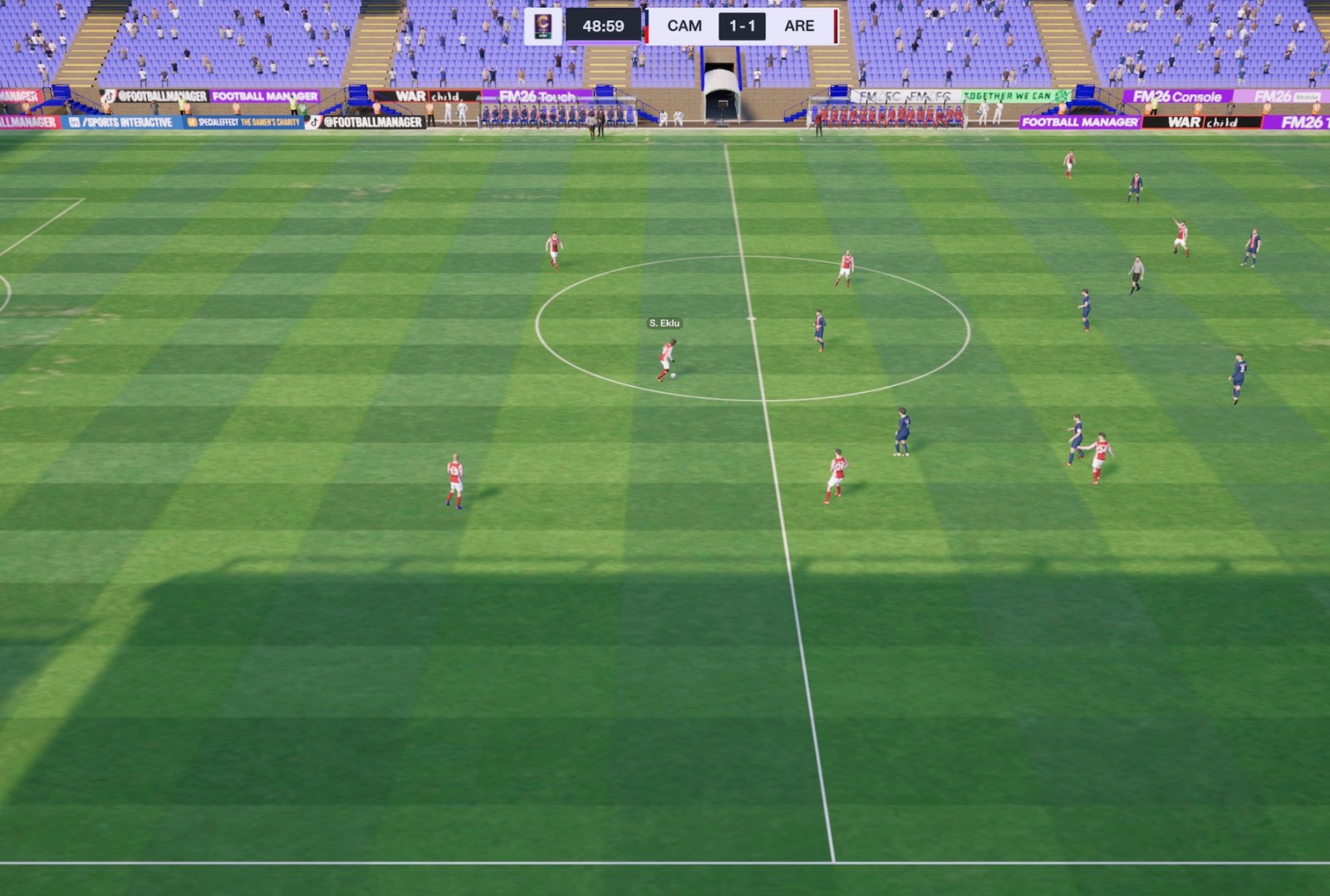
Wingbacks tuck inside to support Shaka Eklu Mawuli
It’s a pattern rehearsed endlessly at the Stadio Città di Arezzo — calm in possession, courage in progression. From there, Guccione or Chierico – the central midfielders – or the nearest full-back takes responsibility for the next phase, feeding the wingers or releasing a forward run from midfield.
“We try to look composed, even when it’s tight,” says central defender Matteo Gilli, who has been asked to play shorter and with greater precision this season. “The manager wants us to build with intelligence, not fear. The first pass matters — it sets the rhythm for everything that follows.”
That rhythm, however, can sometimes stutter. The single pivot system relies heavily on Eklu’s anticipation and positioning — and when transitions break against him, the consequences are clear and he can have oceans of space either side of him to defend whilst the wingbacks recover.
Copper has acknowledged the problem privately, describing it as “the tax you pay for bravery.” For all its control, his 4-3-3 invites risk the moment a pass is misplaced.
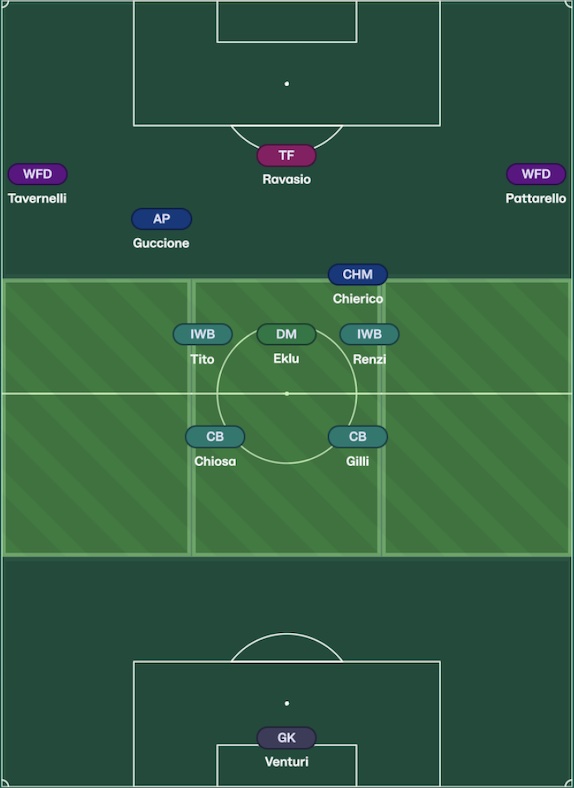
The coaching staff have trialled small adjustments — but the philosophy remains intact. The idea isn’t to eliminate risk entirely, but to make it predictable, to ensure that when Arezzo lose the ball, they’re well set to recover it.
Despite the occasional gaps, the approach has largely worked. Arezzo’s defensive metrics tell a quiet story of improvement: few shots conceded per game, more recoveries in the middle third, and one of the lowest xGA in the division after ten matches.
Out of possession, Arezzo defend in a hybrid 4-4-2, with Left Winger Tavernelli staying high and wide as an outlet whilst the striker will track back and try to cut off passing lanes.
When closing out a game, the Defensive Midfielder (usually Eklu) will drop in to the back line to create a five at the back.
As with every formation, it’s not flawless, but it’s methodical — a team learning to stay calm amid the chaos, even when the game threatens to spin away.
Key Stats:
- 48 shots on target against (4th best in division)
- 81 final third passes allowed (2nd best in division)
- 0.96 xGA per game (5th best in division)
The Wings of Tuscany — Pattarello and Tavernelli
If Arezzo’s defensive discipline provides the foundation, the wingers supply the chaos that makes it work.
Between them, Emiliano Pattarello and Camillo Tavernelli have contributed six goals and four assists in the opening ten league matches — the twin outlets of a system designed to stretch defences without losing structure.
On paper they play the same role; on grass, they couldn’t be more different.

Pattarello and team mates rush to celebrate with goalscorer, Tavernelli
Pattarello, stationed on the right but armed with a left foot made for cutting inside, represents the side’s unpredictability.
He averages over four dribbles per 90 and completes 93% of his passes, evidence of a player who combines flair with efficiency. His expected goal total sits at 2.68 — near-perfect alignment with his three actual strikes — suggesting a wide forward performing right on the curve of his finishing ability.
When Arezzo attack, he’s often the one to break the pattern: drifting into the half-space to exchange short passes with Chierico or taking on his man one-v-one.
“He gives us something different,” says assistant coach Flavio Giampieretti. “You can’t script what Emiliano does — but he always starts from the right place. That’s the key.”
On the opposite flank, Tavernelli’s contribution is quieter but no less vital. A natural right-footer, he operates closer to the touchline, completing 92% of his passes and generating six key chances already this season. His balance allows Arezzo to sustain pressure without losing their compactness. Tavernelli steadies the rhythm.
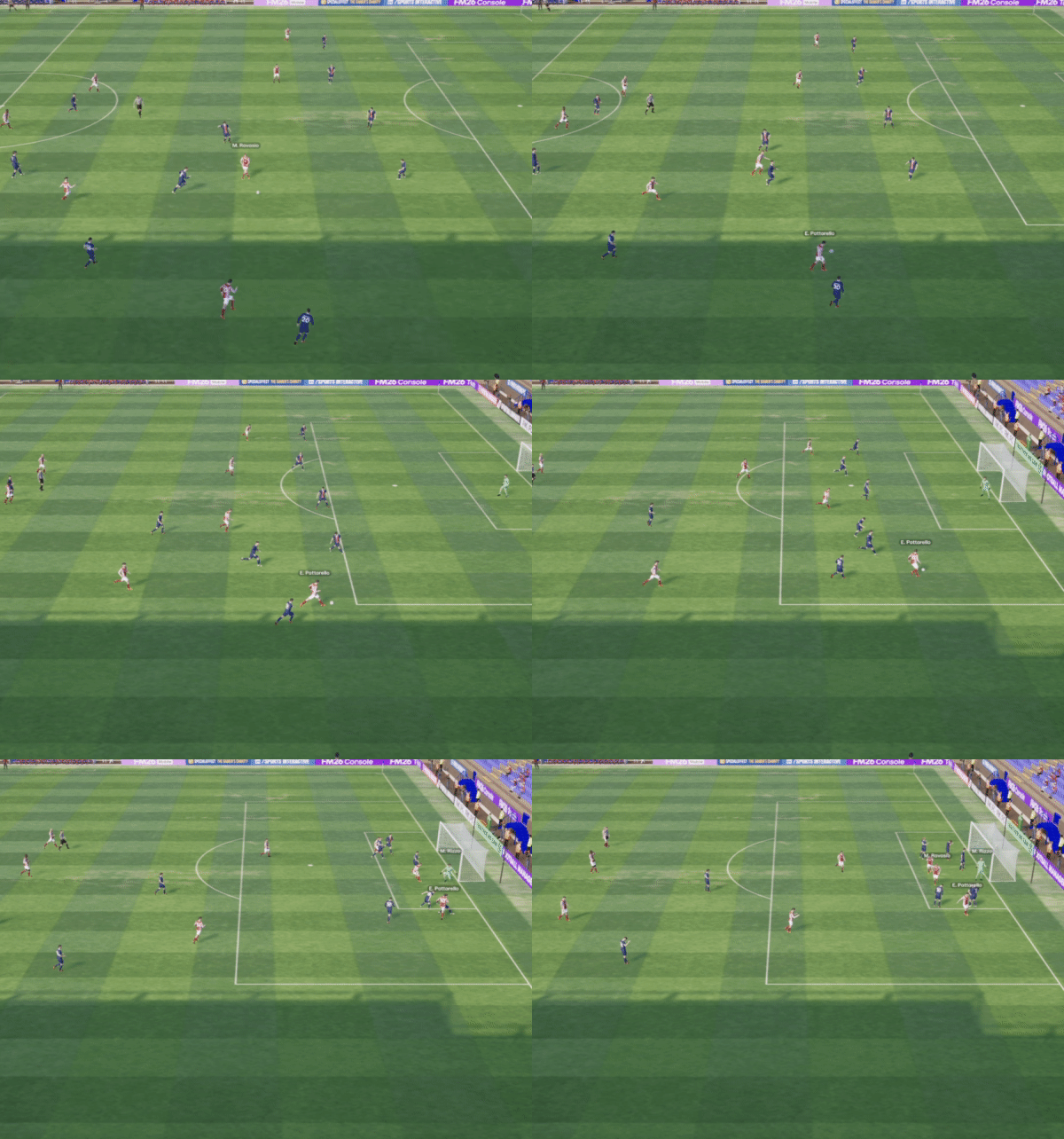
Pattarello shows his goalscoring prowess
The contrast between them almost seems deliberate. Pattarello provokes uncertainty; Tavernelli restores order. Together, they form the potency and unpredictability of Arezzo’s attack.
Even their defensive contribution tells a story — each winger averages close to five possession recoveries per 90, essential in the compact pressing structure.
For all the focus on shape and control, it’s often these two who give the football its pulse.
The Strikers Shaping Arezzo’s Promotion Push
At the tip of Arezzo’s structure sits a role that defines everything around it.
The lone striker is more than a finisher in Arezzo’s 4-3-3 — he’s the outlet, the attacking pivot. And through the first ten games, that responsibility has been shared between Pietro Cianci and Mario Ravasio — two forwards who mirror each other more than they differ.
Both are classic Italian number nines in the modern sense: powerful, disciplined, technically clean.
Cianci, standing at 6’5”, provides the archetype. He plays with his back to goal, linking with the midfield, drawing centre-backs into areas they’d rather avoid. His blend of heading, finishing, and passing makes him a reliable target in possession-heavy phases.
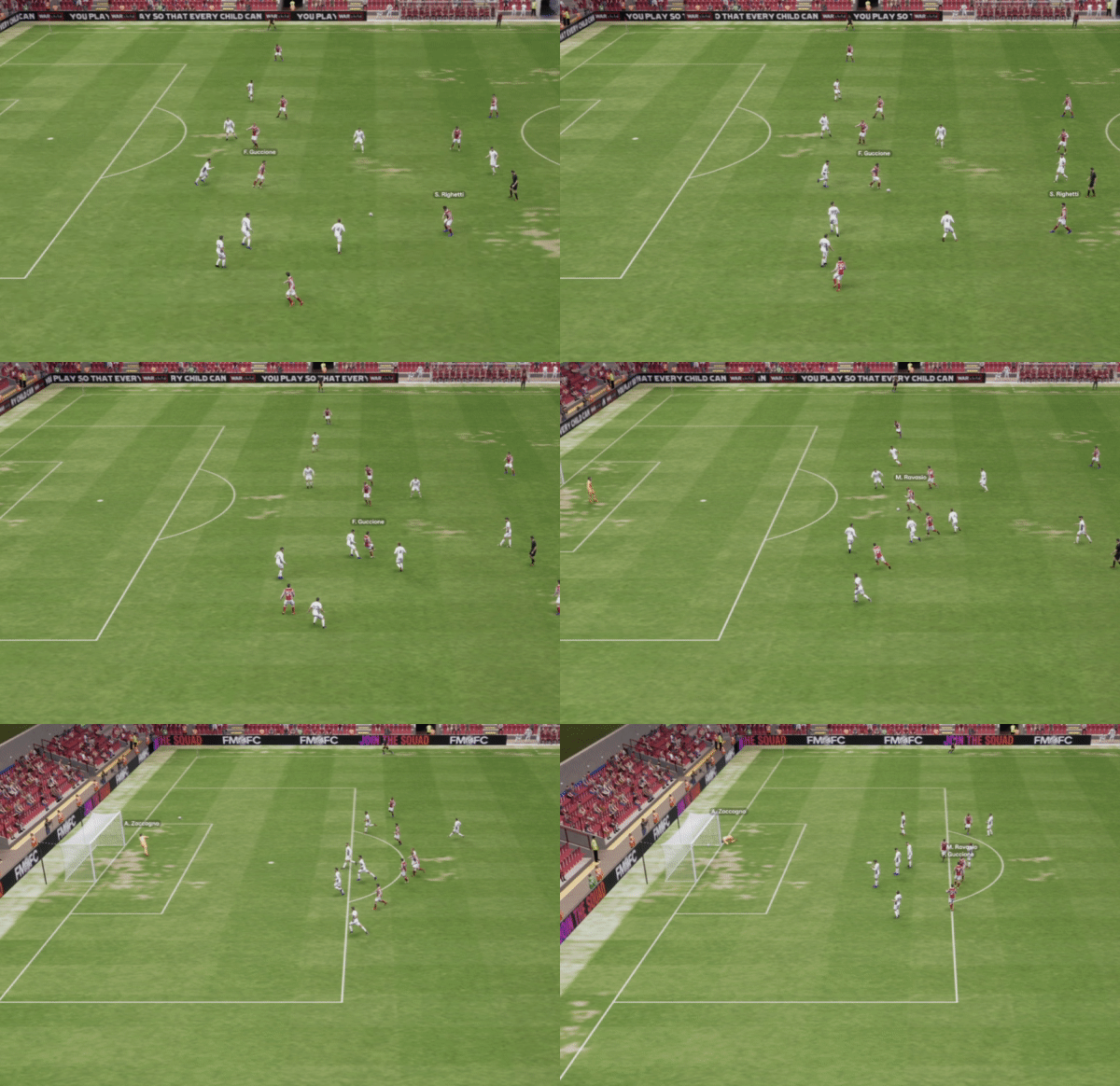
Ravasio comes off the bench to rescue a point against Torres
Ravasio, only a few inches shorter, offers the same framework at a slightly higher tempo. His profile is strikingly similar but his movement carries more aggression. Where Cianci holds and waits, Ravasio spins and attacks. He plays the same notes, just at double speed.
That subtle difference is why Copper is delighted to have both men in the squad.
“They both understand the system,” Copper says. “The runs, the triggers — everything’s the same. The difference is in what they see first: space or contact.”
The data backs it up. Cianci sits mid-table on Serie C/B’s goals-per-90 chart, consistent and steady. Ravasio, meanwhile, has emerged as one of the division’s most clinical finishers, occupying the top-right corner of the scoring graph — high scoring and high conversion. Both deliver what the system demands: presence in the box, simplicity in transition, and calmness when the move finally unfolds.
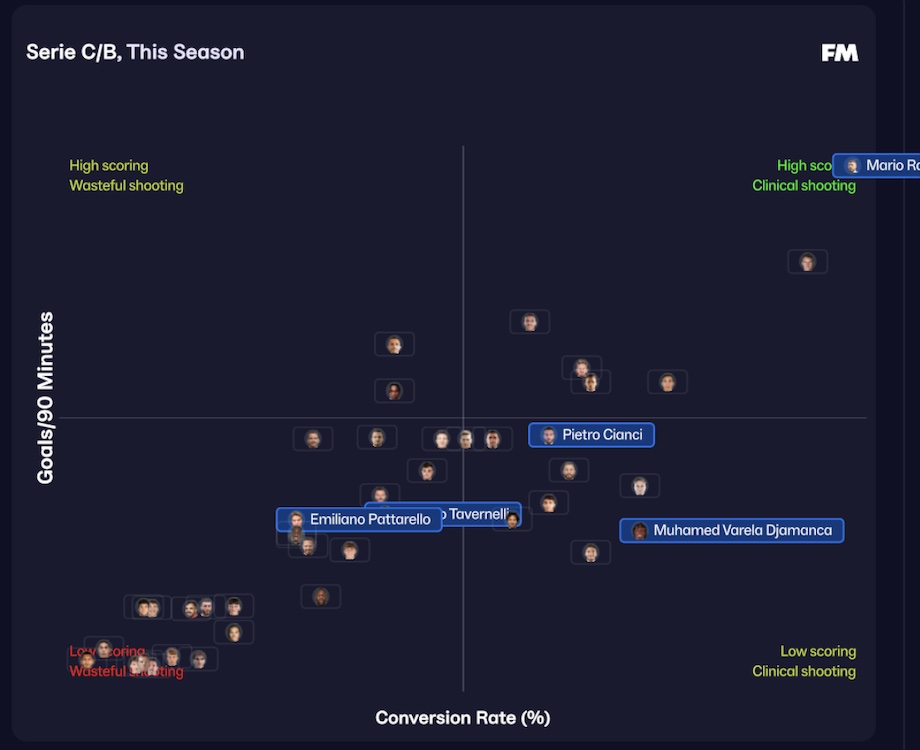
For a team defined by control, it’s no coincidence that their forwards embody the same principle. Whether it’s Cianci posting up or Ravasio darting across the near post, the effect is the same — a single point of focus at the end of a carefully drawn structure.
Ten games in, that clarity is what separates Arezzo from the pack. They don’t rely on luck or chaos to score; they rely on execution. And in Cianci and Ravasio, Copper has two strikers who understand that sometimes, the hardest thing to do in Serie C is the simplest: stand still, stay patient, and finish the move.
The Fragility of Control: Learnings from the 5-3-2
For all the structure, precision and discipline of Throwing Copper’s Arezzo, there’s a quiet truth running beneath their unbeaten start: they’ve been walking a fine line.
The data doesn’t lie. In ten matches, Arezzo have faced a 5-3-2 shape nearly half the time — 47 percent of all fixtures— and those games have yielded an uncomfortable pattern. Against that formation, the team have created just three clear-cut chances while conceding five, a ratio that hints at how thin the margins really are.
It’s a tactical mirror that exposes the system’s limits. The 5-3-2 more than matches Arezzo’s desire to command the middle of the park. With Copper pulling wingbacks inside, this often leaves room for the marauding fullbacks of the opposition. Facing a 5-3-2 also see’s both Central Defenders matched man for man with two strikers, which limits the ability to build up from the back .
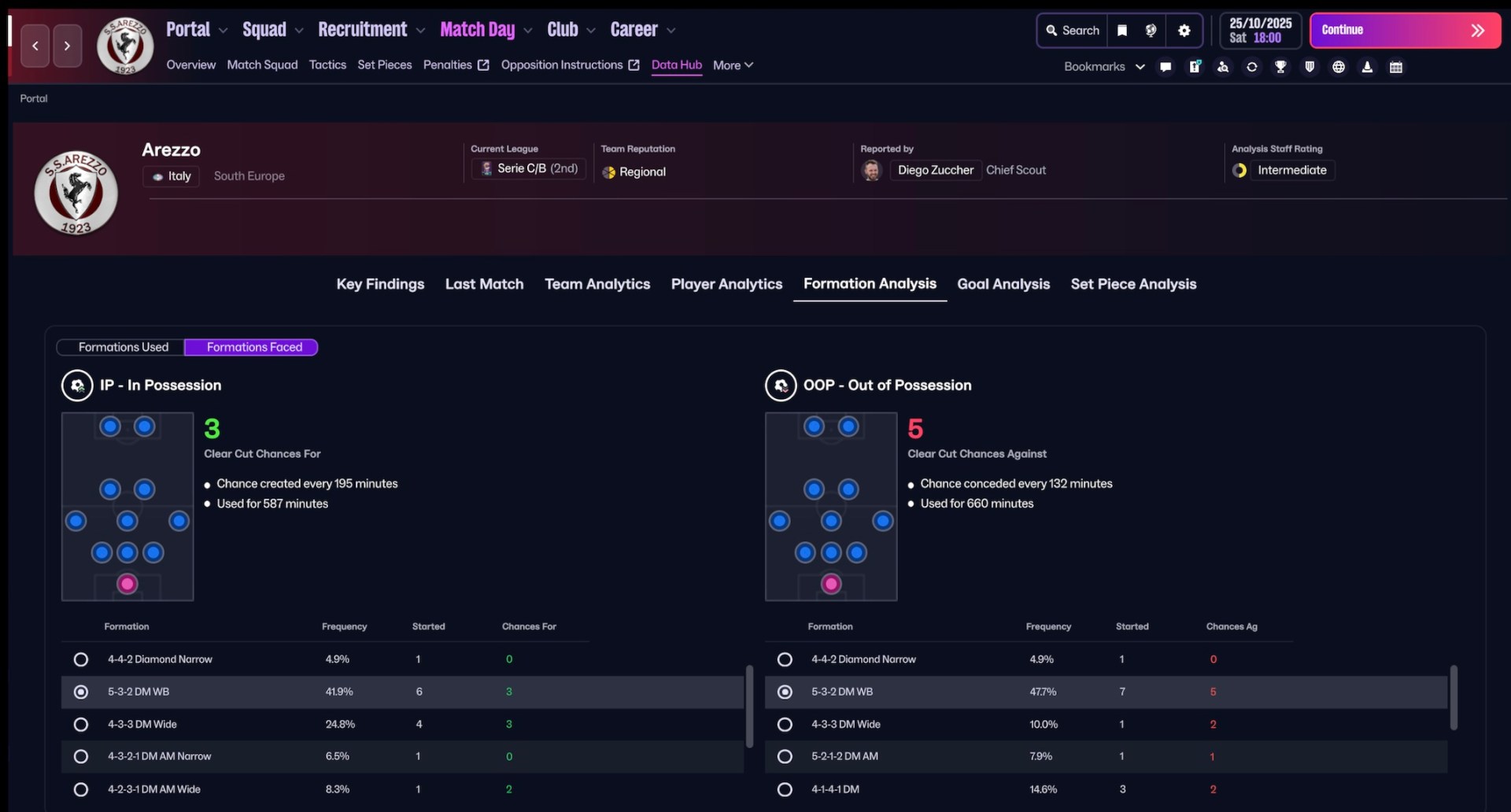
Analysts inside the club’s data hub have already flagged it. Their internal report shows that Arezzo concede a clear-cut chance every 132 minutes against 5-3-2s, compared to once every 195 minutes versus any other shape. It’s not disaster — it’s drift, the kind that slowly erodes a team built on margins.
There’s recognition, too, that luck has played its part. Several late recoveries, a post struck instead of being punished, and a handful of last-ditch blocks have preserved the unbeaten run. Copper, ever the realist, sees that as a warning rather than reassurance.
“You can’t build promotion on good fortune,” he said after the most recent win. “We’ve earned our points, but we’ve also been reminded how fragile shape can be sometimes”
Ten games in, Arezzo’s story remains one of balance — a team learning not just how to control matches, but how to survive when control slips away.





 The Gaffers Lounge
Leave a comment